One wall, two doors
The house stood at 1714½ Tamaroa Street in Muskogee, Oklahoma. It was what people called a shotgun house: three rooms in a line, one behind the other, with no hallway.
Nathaniel Pannell lived in the front room. It had one door, and that door opened onto the yard. Augustus Shoals and his wife Mabel lived in the two rooms behind it, with their own door onto the same yard. Between the two households was a single partition. A police officer later described it for the court: one by twelve inch boards, covered with paper.
There was no way through from one side to the other, but anything said on one side could be heard on the other.
The two men were second cousins, and the court record calls them longtime friends. Both were in their late fifties. Both, it would turn out, had served in the First World War.
A carpenter
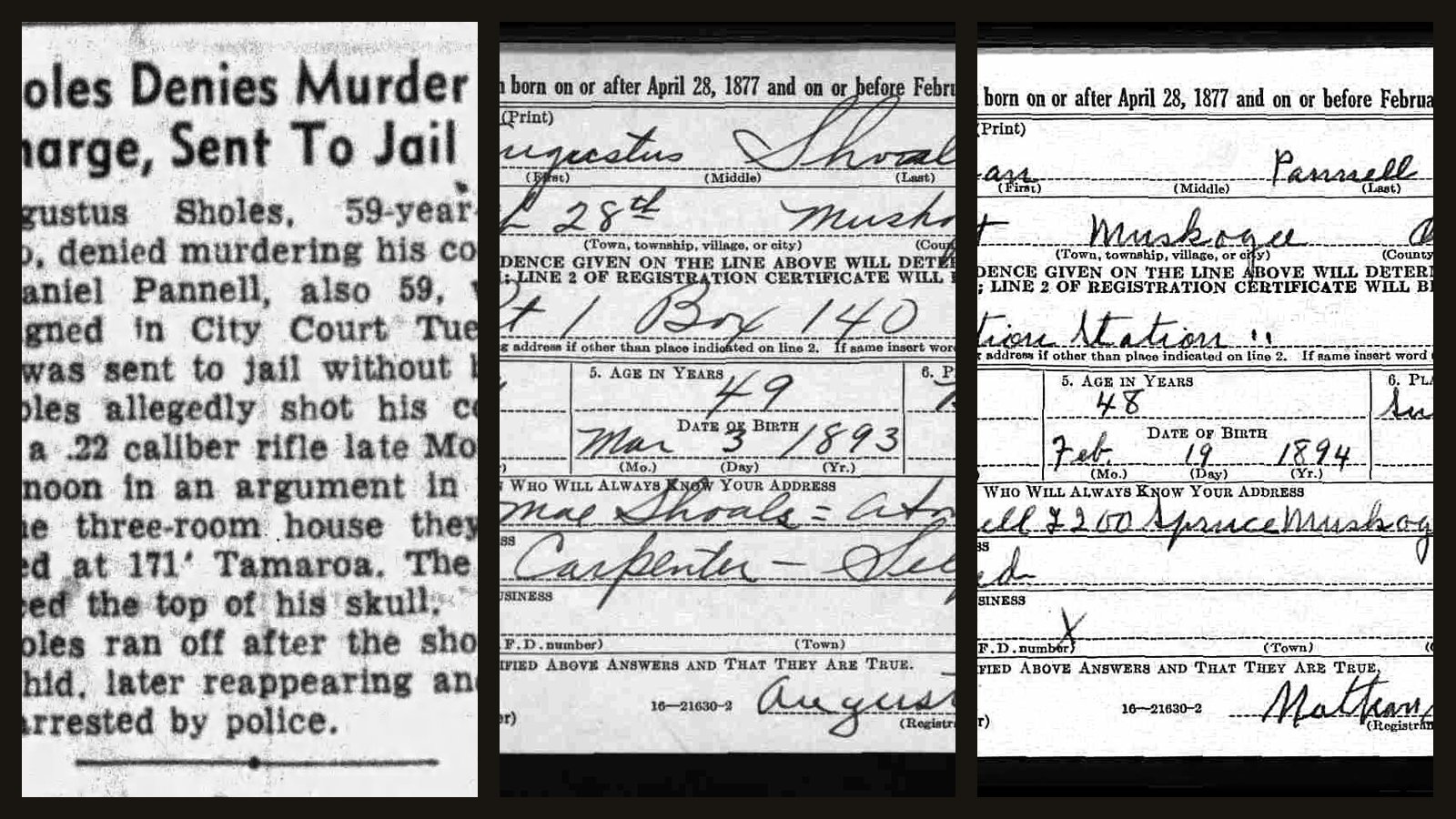
Ten years earlier, in April 1942, Augustus filled out a draft registration card at the Muskogee board. Under occupation he wrote "Carpenter," and under employer, "Self." He had a telephone. He signed the card Augustus Shoals, and that spelling matters, because the court that tried him and most of the papers that covered him spelled it Sholes.
In 1947 arthritis set in. By 1952 the government rated him totally disabled and paid him sixty dollars a month for his service in the war, and that was all the money he had. He weighed about 120 pounds. Pannell was over six feet tall.
Mabel was forty-two. Almost nothing about her survives except what she said in court. The only description of her in the record is three words in a newspaper: "a crippled woman."
The beans
On Sunday, March 2, Augustus was not home. That night, by his later account, Pannell "had been bothering" Mabel, and two women, Bessie Prince and the landlady, Daisy Wofford, put him out of the house.
On Monday morning, March 3, a neighbour named Sarah Muldrow came over at about a quarter to ten to borrow some soda. While the two women talked, Pannell called through the wall to ask what Mabel had to eat. Mabel told the story later, under oath:
Sarah Muldrow got up and went home. "She could not stay," Mabel said, "and left me there alone." Mabel told Pannell to go home, and when he would not, she went to the door and called her landlady. Daisy Wofford came over, told Pannell to come to her house and she would give him something to eat, and shoved him out the door. It was around noon.
Through the wall
Mabel said her husband came home at about half past two. Augustus himself gave two other times: about four o'clock in his signed statement, and about five at his trial. The record never settles it.
He found her, he said, "sitting on the bed, kind of with her head down." She told him what had happened that morning, and Pannell heard every word through the boards. In Mabel's account, Pannell answered through the wall:
And her husband answered him: "No, don't do that, Pannell, meet me out doors."
Then she heard the door open in Pannell's room. "When the door opened Augustus got up, took his gun and walked outside of his door, and Pannell was meeting him around the corner of the house." She did not go out. She heard the shot. Her husband came back in, laid his gun on the dresser, and left.
The yard
At about 5.15 that afternoon, Officer Charles Hefner was sent to Tamaroa Street. He found a man lying in the yard near the front of the house, "with blood oozing out of his head under the edge of the hair line." There were no weapons anywhere near him. About eight feet from the corner of the house, Officer L. L. Parks picked up an old black hat with a hole in the front, where the brim met the crown, big enough to push a pencil through.
In the corner of the back room the officers found a .22 Winchester pump-action rifle, with an empty shell in the chamber and a loaded one in the magazine. Mabel was sitting on the side of the bed. Augustus was gone.
The early newspaper stories called the weapon a pistol. The trial record and the later papers say rifle. The sources also disagree about the wound: the doctor who examined Pannell at Provident Hospital described it as in the forehead, while the papers said the bullet went through the top of his head. The doctor put the death at about 5.45 p.m.; the papers said 6.20. The skull was never probed, and no bullet was recovered.
The morning paper told what Augustus did next:
Officers Parks and Ross Clayton found him in hiding at about a quarter to seven in a house just north of his own. In the police car, without being asked anything, he said: "Well I guess I am gone for a long time."
March 3, 1952, was Augustus Shoals's fifty-ninth birthday.
The captain's room
At about seven that evening, in the captain's room at the Muskogee police department, Assistant County Attorney John D. Luton questioned him with the sheriff, R. T. Sypert, Officer Parks and a number of uniformed officers in the room. He was told he did not have to make a statement, and that he could consult a lawyer. Luton wrote down the answers. A deputy sheriff read them back, and Augustus signed. The statement says, in part:
It ends: "Nathaniel didn't make any move to hit me and didn't have his shotgun or any other gun that I saw."
Mabel spent that night in the City-Federal Jail. The Phoenix described her as "obviously very drunk" when she spoke to Luton. At the trial she admitted she had been drinking some that day, but said she was not drunk.
Upstairs to County Court
He was charged with murder in City Court, pleaded not guilty and was sent to jail without bond. On March 11 his preliminary hearing was put off for two weeks, and that same day, the Times-Democrat reported, he "went upstairs to County Court, where he was adjudged an incompetent person and put under care of a guardian." The petition said his sole income was the sixty dollars a month for his war service and that he needed a guardian to manage his affairs.
At the hearing on March 25 he pleaded self-defence. City Judge J. F. Beavers ordered him held for trial anyway, and said why from the bench:
And then: "He stepped out of his own house and you killed a man before he gets away from his own doorway."
Because he admittedly could not make bond, he chose to be tried in the term already running rather than wait in jail for the fall. The paper added a careful sentence: "Earl Boyd Pierce, Shoals' attorney, took every precaution to make certain that Shoals was making the decision for an early trial all by himself."
One day in May
The trial took one day, Monday, May 26, before District Judge Francis Stewart. Assistant County Attorneys John Luton and Joe Cannon told the jury Shoals had shot an unarmed man "down in cold blood." Pierce and Cecil Robertson argued self-defence: that Pannell had threatened to kill both him and his wife with a shotgun.
Augustus took the stand. He said Pannell had called him out: "Come on out doors, I will show you something." He said that when Pannell came round the corner he "ran his hand in his pocket when he saw me and put his head down and kept coming." He was asked why he fired.
On cross-examination he said Pannell's overcoat was over his hand, that he fired from twenty to twenty-five feet, and that he did not see a shotgun or any other weapon in Pannell's hand.
Then Mabel testified. In the words of the Phoenix: "Mrs. Sholes, a crippled woman, declared that Sholes did the inviting." It matched her own account of the afternoon, in which her husband said "meet me out doors."
The jury was out thirty-five minutes. It found him not guilty of murder and guilty of manslaughter in the first degree, and it could not agree on the punishment.
Something in between
The range was four years to life. At the sentencing on June 9, Judge Stewart explained his choice. The jury, he said, "did not agree that he should receive life imprisonment and I am not going to give him life imprisonment."
When the defence said Shoals was "afflicted," the judge answered: "So was the white man that I sentenced last week, more so than this man." He meant Charles Pitts, sixty-six, who had come into court on a stretcher, pleaded guilty to manslaughter for the pistol-killing of Allie Blair, and received fifteen years. According to the Phoenix of May 22, Pitts was a former Muskogee carpenter and Blair his former carpentry partner. Augustus Shoals had been a carpenter too, a fact that appears in no newspaper or court record of the case.
Stewart gave him twelve years and set an appeal bond of $5,000. His lawyers said they would ask the Court of Criminal Appeals "to tell Sholes what he should have done under the circumstances — whether he should have tried to crawl out through a window and escape, or whether he should have gone outside to meet Pannell."
The same ground
The bond was never made. The Oklahoma State Penitentiary at McAlester received him on July 7, 1952. On July 29, 1953, after he had been inside for more than a year, the Court of Criminal Appeals affirmed. It held the statement voluntary, though it noted that the officer "failed to warn the defendant that the statement, if he should make one, might be used against him," and that "it is not too clear when the defendant was advised that he could see an attorney, whether before the statement was made or after." It declined to cut the sentence. "Whiskey appears to have been the basic fact bringing about the conduct of all the parties concerned," it wrote. It did not answer the question about the window.
On June 6, 1956, Augustus Shoals was paroled, at sixty-three, after three years and eleven months. The prison card spells his name correctly.
He went back to Muskogee. On September 24, 1964, he married a woman named Emma Greer. The county marriage index shows he had married her once before, on July 5, 1949. No record of Mabel has been found outside the 1952 trial. Everyone in 1952 called her his wife, and he never said otherwise. The gap is a hole in the record, not an accusation.
He died on November 14, 1966, at seventy-three, and on November 21 he was buried at Fort Gibson National Cemetery, under a government stone for a World War I private. He had been drafted in the last summer of that war and was out by Christmas. Nathan Pannell, as his own stone names him, had been buried in the same cemetery since March 10, 1952.
From the stand, Augustus had said one more thing about that afternoon:
Eight days after the shooting a county court found him unable to manage his own affairs. Who filed that petition, who was appointed guardian, and whether it ever came up at the trial is not in anything found so far. The appellate opinion, which turned on whether his statement was voluntary, never mentions it.
The three homecoming times (half past two, four, and five) leave a gap of up to three hours between the morning's trouble and the shot. What happened in that time was never described by anyone.
Who Mabel was on paper is unknown. He married Emma Greer in 1949 and again in 1964, and no marriage, death or census record for a Mabel has turned up.
Pannell's age is uncertain too: his headstone gives February 19, 1893, and his own 1942 draft card gives the same day in 1894.