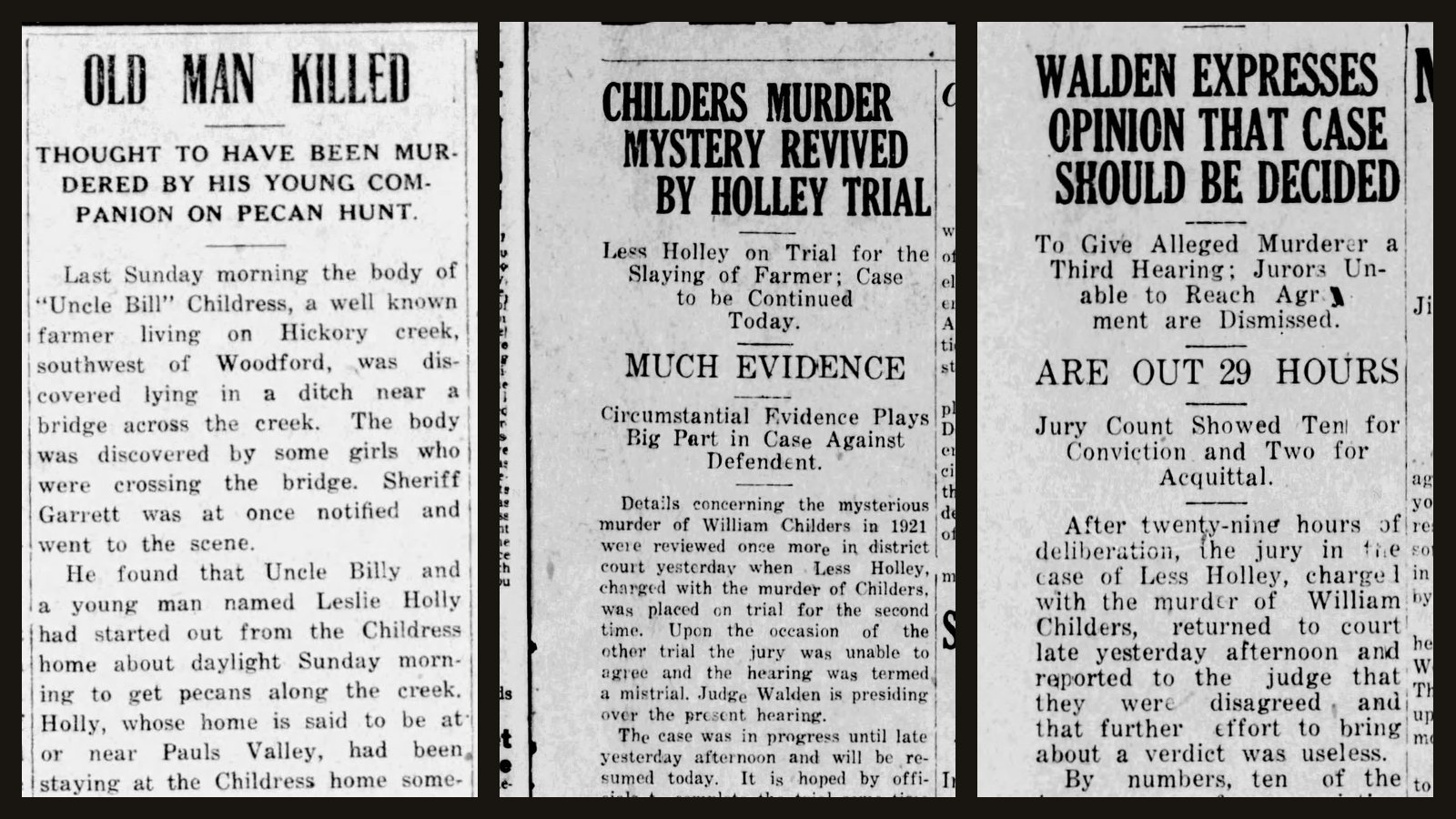
Hickory Creek
William Childress had lived around Berwyn, in Carter County, Oklahoma, for a good many years. In about 1919 he moved a few miles over to the Woodford community and took up a farm on Hickory Creek. People called him Uncle Bill. He was about sixty.
The papers didn't have much to say about his life, but what they said was consistent. The Ardmore Statesman called him "well known over the county and well thought of," and added:
He lived there with his wife and an adopted daughter. The papers never printed either woman's first name.
A note on names before going on. The 1921 papers spell him Childress, and that is the spelling the case file treats as correct. By 1924 the Ardmore papers were printing Childers, and so does the title of the episode. The young man in this story had it worse: Leslie Holley, Leslie Holly, Les, Lee, Less, and finally Jess. This page calls them Childress and Less Holley, and quotes the papers as they were printed.
The pecan money
In the fall of 1921 Uncle Bill had a boarder. Less Holley was a young man, about twenty-eight by the first report, who lived at Provence and worked on farms around the county. One paper said his home was "at or near Pauls Valley." He had relatives in Ardmore and a brother living near Berwyn. For a week or two, the papers disagree on how long, he had been staying at the Childress house, and the two of them had been gathering pecans along the creek to sell.
On Thursday, November 10, Holley took what they had gathered into Ardmore and sold it. He came back and they split the money. The Statesman put the next part plainly: "Uncle Billy giving his part to his wife to keep."
Then they went back to the creek.
Sunday morning
On Sunday, November 13, the two men left the house together at about seven o'clock. Some young women were supposed to join them on the hunt later in the day.
He was lying in a ditch near the bridge over Hickory Creek. The Daily Ardmoreite called it the McCann bridge. Doctors said every wound had gone in from the back, and they thought the gun was a .32 calibre revolver. Death was "almost instantaneous."
Less Holley was gone.
Sheriff Buck Garrett came out from Ardmore and talked to the family. Mrs. Childress and her daughter told him they knew of no quarrel between the two men, "nor could they conceive of any reason why Holly or any one else should have shot the old man." Holley's relatives said the same. Nobody offered a motive then, and nothing in the record offers one now.
Uncle Bill was buried at Berwyn, his old home, on Monday afternoon. The Statesman summed up what the county had to go on: he and Holley had left the house shortly before the shots, "and the fact that Holly has disappeared."
Nine o'clock at night
For five weeks nobody in authority knew where Less Holley was. Then on Tuesday night, December 20, 1921, at about nine o'clock, he walked into the sheriff's office in Ardmore and gave himself up.
It was not a quiet week at that jail. The front page of the next day's Daily Ardmoreite was full of the county's other troubles: the state attorney general had come to town himself over a string of killings, and the sheriff was keeping a close guard on a jail full of other defendants.
The Ardmoreite gave Holley's surrender a headline that read "HOLLEY CONFESSES TO THE MURDER OF WILLIAM CHILDRESS." The story under it said nothing of the kind.
There is no confession anywhere in the record. The other Ardmore paper, the Daily Press, got one sentence out of him that same day: "He says that he has been in Arkansas for the past three weeks."
That morning County Attorney Mathers filed a charge of murder against him in Justice Butcher's court. On Friday, December 30, Holley had his preliminary hearing and was bound over for the district court. His lawyers, Tom Champion and S. A. George, filed a petition for habeas corpus the same week. What came of it isn't in anything found so far.
The first jury
The first trial is the thinnest part of the record. A January 1922 docket set the case for February 3 of that year, but nothing on file confirms that it ran then. All we know for certain comes from the 1924 papers, looking back: it came after his surrender, "the jury was unable to agree and the hearing was termed a mistrial."
The second trial
On Monday, February 11, 1924, more than two years after the shooting, Less Holley went on trial for the second time, before Judge Asa Walden. County Attorney John L. Hodge and his assistant, E. W. Schenk, prosecuted. Champion and George were still with him. The Daily Press said the courtroom "was packed with interested spectators all day."
The state's case was all circumstance. Holley had left the house with the old man that morning. Then he had disappeared. Tracks around the body showed two men had stood together there for several minutes, and one of them wore hobnailed shoes. Uncle Bill wore "a common, light shoe and could not have made the tracks." Holley was wearing hobnails that day. And when he walked into the jail he had handed the jailer a pistol:
Similar, the paper said. In court the state went further and argued it was the same gun.
Holley took the stand as the first witness for his own defense. Yes, he wore hobnailed shoes. He and Uncle Bill had gone that morning to a new spot, and the pecans there were poor. He decided it wasn't worth it, left the old man a short way from where the body was found, and caught a ride into Berwyn with a stranger in a passing car. The state answered that cars seldom passed in that neighborhood.
From Berwyn, he said, he went to an uncle's farm and worked there for five weeks. He didn't know Childress was dead, or that he was wanted, until the day before he surrendered. Then he borrowed the revolver from his uncle, put it in his pocket and came to Ardmore. He said he had never carried a gun before that day.
That was not the Arkansas story he had given in 1921. And there was one more thing he told the jury:
Ten to two
The jury went out and stayed out for twenty-nine hours. On the afternoon of Wednesday, February 13, it came back and told the judge it could not agree.
Judge Walden dismissed them and said what he thought. Two trials had cost the taxpayers thousands of dollars, and the case was no further along than the day the charge was filed.
He set a third trial for early the next week, and said that if that jury failed too, a fourth would follow at once. It was the court's purpose, he said, "to proceed with the trial of Holley until some decision is reached in the case without further delay."
The Saturday that didn't come
The third trial did not start that Monday. On Saturday, February 16, Walden closed his criminal setting, and the Daily Press called the term "highly successful": a robbery conviction with twenty-five years, a string of guilty pleas. Then: "One murder case was tried, the result being a hung jury."
In April the case came around again. On Sunday, April 6, the Daily Press ran down the cases for the new setting:
That Saturday was April 12. The same week, in a different murder case, Judge Walden told a crowded courtroom that "the hardest part of the life of a judge is when the mob howls for a man's life."
But there is no record of a third trial. When the April docket was checked, the Holley case was no longer on it. No verdict, no appeal, no prison record has turned up under any version of his name.
A fence on the river
Two months later, on the afternoon of Tuesday, June 10, 1924, Less Holley and his brother Herman went hunting along the river near Mangum, in Greer County, about 150 miles from Hickory Creek. Herman was carrying a shotgun. Crawling through a fence, he caught the hammer on the wire.
It took Herman until three o'clock to get a doctor out to him. Holley died in the Mangum hospital at half past one the next morning. The Carnegie Herald's obituary ended this way:
The obituary spells him "Less Holly." The name, the date, the navy service and the burial back home at Provence all fit the man from the Ardmore trials. The court file that would settle it beyond question hasn't been pulled. His age doesn't settle anything either. The obituary says 38, his grave marker gives a birth year that would make him 35, and the 1921 papers said about 28. This page gives none of them.
What the obituary does make plain is that in June 1924 he was a free man, farming with his brothers. He was charged with the murder of William Childress and tried twice. Two juries could not agree. He was never convicted and never acquitted, and the case ended without a verdict.
Where Holley spent those five weeks. He told the Daily Press in December 1921 it was Arkansas, three weeks. He told a jury in 1924 it was an uncle's farm near Berwyn, five weeks. The 1921 papers mention a brother near Berwyn, not an uncle.
How the case left the docket. Nothing found so far shows a dismissal, a continuance, or an order closing the case after his death. The Carter County district court file, filed under "Jess Holley," may show it.
When the first trial was held, and whether the habeas petition of January 1922 got him out on bond. He was free by June 1924, but the record doesn't say since when.
Where Uncle Bill is buried. The papers say Berwyn, but no grave for him has been found in any cemetery index.