844-602-0660 — the family's tip line. Call or text. You do not have to give your name.
Buckeye Police Department: 623-349-6400, or submit online at buckeyeaz.gov/crimetip. The city's own page on Daniel gives no dedicated case or detective line, so the online form is the more reliable of the two.
pleasehelpfinddaniel.com · danielrobinsonfoundation.org
There is no current reward. No current figure appears anywhere, the family's own site lists none, and this page will not invent one. Anything you see quoted as a reward for this case is years out of date.
The morning
It was raining. That matters more than anything else in the first hour of this case, because the rain is the only reason anybody knows which way he went.
Daniel Robinson was twenty-four, a hydrogeologist about four years out of the College of Charleston, working well sites in the West Valley for Matrix New World Engineering. On the morning of Wednesday, June 23, 2021 he did not drive straight to work. Turn-by-turn navigation recovered from his phone puts him on a route that ran south, away from the site, and doubled back. He bought $10.55 of gasoline between 7:00 and 7:03. He arrived at a well pad near Sun Valley Parkway and Cactus Road late, in a storm cell, and told a coworker he had met for the first time that morning that he should go and rest.
At about 9:45 he got into his 2017 Jeep Renegade and drove off. The coworker watched him go, and told police he drove away south. The turn to the west is an inference from the tyre tracks in the wet ground — which is the whole reason the rain matters.
His phone put him at what would turn out to be the crash site by about 10:05 a.m. A mileage-tracking app running in the background, MileIQ, stopped recording at 10:32 a.m. at coordinates 33.584059, -112.729375 — the spot where the Jeep was found twenty-six days later.
David Robinson has said, consistently and on the record, that when he first called to report his son missing he was told to hang up, wait two hours and call back. No released dispatch record confirms or contradicts it.
What the file does show is that once the call was logged at 7:04 p.m. on June 23, the responding officer called Daniel repeatedly, called his employer, interviewed the coworker by phone, searched the desert with a second officer for hours, entered Daniel into NCIC that night, and tried the phone again at one in the morning.
Both of those can be true. This archive records both and resolves neither.
Twenty-six days
A missing man's car is normally the easiest object in a missing-person case to find. It weighs two thousand pounds, it is painted, it carries plates, and open desert is not a place where a vehicle hides well from an aircraft.
For twenty-six days nobody found the Jeep.
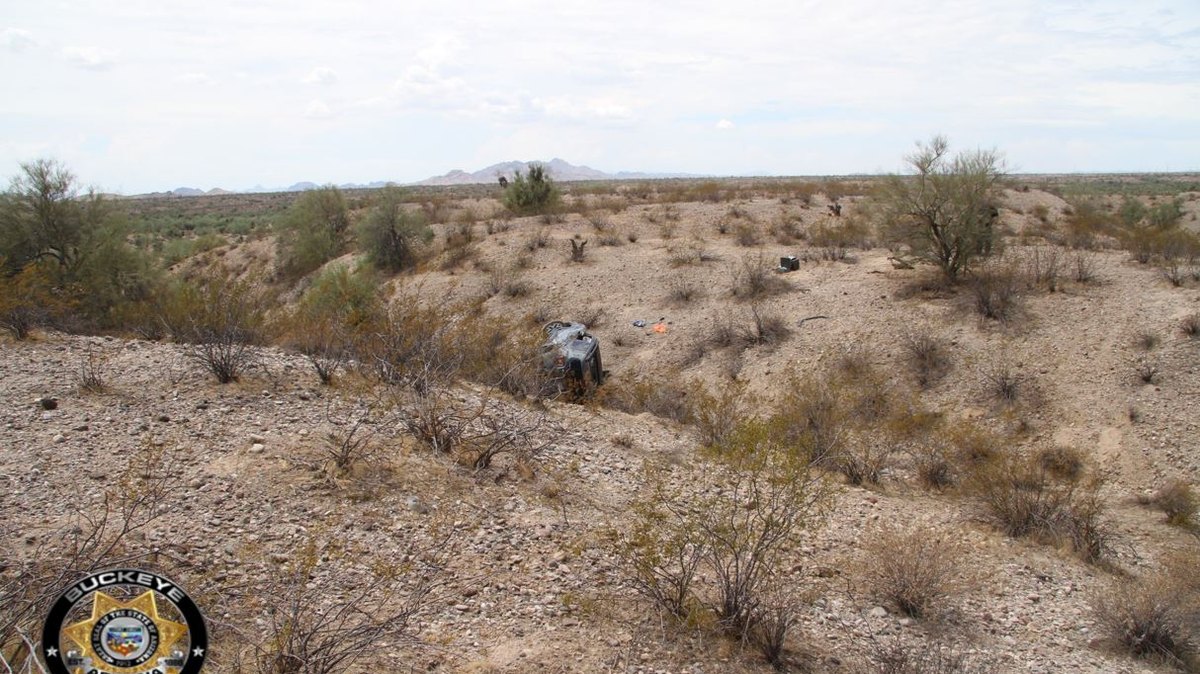
On July 19, 2021, on a rancher's property about three and a half miles from the well site — the department's own cold-case page says "approximately three miles" — the Renegade was found in a ravine, rolled onto its side.
What was in it is the whole case. Every argument of the last five years starts from this list.
His cell phone, dead. His keys. His backpack, with his work laptop inside. A hard hat, sitting upside down and full of rainwater. Every airbag in the vehicle had deployed — front and sides. The driver's seatbelt had been buckled when it rolled. There was no blood, in the vehicle or at the scene or anywhere anyone looked, despite what the detective described as substantial damage.
The Jeep was still in drive.
There was no Daniel.
The clothes on the hillside
For four years the published accounts of this case ran two ways. Some said the clothing was found inside the vehicle. The family said, consistently, that it was in a pile on the ground a few feet away.
Neither is what the file says.
Det. Biffin, writing at the scene, recorded a pair of jeans inside out, two brown work boots, a faded orange vest with the Matrix company logo, a tee shirt and two socks, also inside out — and noted that Daniel's clothing was collected from the ground. Catone, the reconstructionist, was more specific about where:
Not inside the car. Not folded. Scattered up a hillside above a wrecked Jeep, in open desert, with the wallet still in the jeans and no cash in it.
The episode says one thing about this that the record does not say, and flags it as an inference rather than a finding: clothing comes off inside out when it is pulled off in a hurry.
Two readings of the same Jeep
The family's case has rested on four things for four years, and every article written about Daniel Robinson has carried them. The 128-page file, released May 30, 2023, treats those four very differently from one another. One of them comes apart. One has never been tested by anybody. Two of them are still standing.
One — the eleven miles. It collapses, and it collapses in the family's own hands.
As it reached the press, the claim was that the Jeep was driven eleven miles after the crash. What happened is that when the family's investigator took possession of the vehicle and powered it up, the dash odometer read eleven miles higher than the figure stored in the crash module. That is a gap between two readings, not a record of driving.
On September 14, 2021, Det. Biffin put McGrath on the telephone and asked him two questions. If the Jeep came to rest on its side with the wheels off the ground and the engine still turning, could those wheels have run the odometer up? That was possible. If a tow truck dragged it out of the ravine with the wheels down, could that do it? Also possible.
That is the family's own expert, on the record, in 2021. Catone separately recorded that the discrepancy is a known one, reported by Jeep dealership service departments and among other reconstructionists. And the route itself is corroborated three ways to within half a mile — the Jeep's infotainment odometer, the MileIQ record carved out of Daniel's phone, and Det. Biffin driving the route himself on September 15, 2022, clocking 24.1 miles against a recorded 23.61.
Two — the red paint. Nobody has ever tested it.
There is red paint on a blue-grey Jeep, which would mean it touched something. The crash module logs an event whenever the vehicle's velocity changes by five miles an hour or more inside 150 milliseconds. It logged exactly one: the rollover. Catone's finding was that the Jeep shows no indication or evidence of having been involved in another collision.
But a scrape does not wake that module up, so the module does not answer the paint. And when Det. Biffin asked the investigator for more on it, the file records that he did not provide any.
Five years. It is the cheapest test in this entire case and neither side has run it.
Three — the passenger airbag. This one is stronger than it has been reported.
The family's position has always been that a deployed passenger-side airbag means somebody was in that seat. The standard answer is that modern systems fire a passenger bag in a rollover regardless of occupancy, which is true, and which on its own would end the argument.
Then there is what the officer who pulled the data actually wrote. The vehicle was not configured at the time of event to detect front passengers, though it did record that the front passenger seatbelt was not buckled.
The department's position is that there is no evidence anybody was in that seat. That is accurate. It is also, in part, a limitation of the instrument: an empty seat and an unbelted passenger look identical to a car that cannot tell them apart. This is not proof of a passenger. It is a question that vehicle was never built to answer, and no evidence of a passenger is doing quiet work in that sentence.
Four — the ignition cycles. Still unexplained, and the window is narrower than anyone has written.
The number is forty-four. Cycle count at the crash, 6,805; at the download, 6,850. Forty-four presses of the start button after the airbags fired.
The department's answers are fair and should be said: the count includes the officer's own download cycle — his report says he pressed it twice, once to bring the power up and once to shut it off — and it does not separate out a tow crew recovering a rolled vehicle from a ravine. That leaves roughly forty.
The figure of 64 that circulated for years was a typo, corrected by Catone in writing on November 1, 2021.
What matters more is when the count was taken. July 21, 2021 — two days after the Jeep came out of the desert, and two weeks before it was released to the family's private tow on August 4, 2021. Whatever ran that number up happened inside a window that begins at the bottom of a ravine and ends in a police impound lot. Catone's own phrase for it was an unanswered anomaly, and five years on that is still exactly what it is.
It is not "he drove off and got lost." The file carries a record of the days before, and it is not ambiguous.
On June 22 Daniel texted his sister Davisha three words — It's an emergency — and then answered nothing. Ten calls came in over the next two hours and he took none of them. His brother wrote that night asking him to call. That same afternoon he sent a last message to a young woman he had recently met, and moved the conversation to his phone's trash folder.
There is more in the file, including a list of his private internet searches in the week before. This archive does not reproduce that list, and neither does the episode — and neither pretends the list is not there, or that it reads like nothing.
Then the crash itself, from the module: the throttle moving the whole way, up to 78 percent, down to 22, and rising again at the end. Thirty miles an hour a tenth of a second before impact. The brakes were never applied.
Catone's conclusion: "The driver of the Jeep drove it into the ravine, and having rolled and unable to proceed further, abandoned the Jeep as it lay."
And the department's public position, on the City of Buckeye's own website, checked again on August 24, 2026:
What that reading explains is the driving, the crash, the phone and the timeline. It explains all of it.
It does not explain the hillside.
During a desert search the family's investigator recovered a sock — sun-faded, out there a long time, matching the socks lying by Daniel's car and the socks in his apartment, and nowhere near the Jeep.
McGrath has given the distance as three miles. The file does not support that figure, locating the recovery near the roadway that runs back to Sun Valley Parkway from the job site. The sock is real and is in the record; the mileage is his own and is not reproduced here.
His summary of it: "I can't rule out foul play, I don't know how Buckeye can."
A note on who is not named here
Buckeye PD flagged inconsistencies between the coworker's account and the data on Daniel's phone. He has never been named a person of interest, by the department or by anyone else. He is not named on this page and he is not named in the episode, and a second thread involving another named man was checked by detectives and came to nothing.
The month the country looked away
For about three months in the autumn of 2021 this case had national attention, and it had it for a reason that had almost nothing to do with Daniel — it arrived in the slipstream of the Gabby Petito coverage. Daniel's father said so plainly at the time:
The same season, Carmen Bolden Day was saying harder versions of the same thing about her son Jelani Day, missing out of Illinois: that a young white girl was getting the attention her young Black son was not, and that he is not a nobody.
The coverage that exists is real and is listed on the sources page — Phoenix television, NPR twice, Fox News, the BBC, CBS, People, Newsweek, Rolling Stone, an episode of ID's Disappeared, and the first-ever episode of Dateline: Missing in America.
What does not exist, across four separate research passes: anything from the New York Times, the Washington Post, the Guardian or CNN. That is a searched-for negative rather than a proven one, and if it is wrong this page will be corrected in public.
What a father built instead
He stayed. He rented an apartment and learned the desert the way you learn a job. By his own account he ran seven weeks of searches without assistance from the Buckeye Police Department — cadaver dogs, drones, fixed-wing aircraft flying grids over open ground — paying for it himself. Strangers kept coming out to walk a line abreast across scrub and rock for a young man they had never met. He calls them his extended family.
The searches got numbered. The fiftieth was on April 12, 2025, near Sun Valley Parkway and Rosewood Avenue, about a hundred volunteers, prompted by a witness report of a man walking out of a ravine. Joseph Petito — Gabby Petito's father — came in person.
He had been at a storage unit that morning before he came out, going through his son's things, deciding what to keep.
He also built two things that outlast the searching. The Daniel Robinson Foundation is a registered 501(c)(3) — EIN 88-2135623, motto Never Leave an American Behind — which publishes a guide for families of the newly missing and refers them to search-and-rescue groups and to specialists in ambiguous loss. And in January 2026 South Carolina Senate Bill S.745, the Help Find Missing Americans Act, was introduced by Sen. Ott; it would require wireless carriers to release a missing person's location data, call records and data usage to the account holder within thirty days.
Coverage close to the family often refers to S.745 by an informal name attaching Daniel's to it. The bill text does not mention Daniel Robinson by name — confirmed by reading it — so this archive and the episode use the real title. A Change.org petition of a similar name also exists; it is a different thing.
The workup, and sixteen months
On April 11–12, 2025, the physical evidence in this case changed hands. Everything the family had held and stored themselves for four years — the Jeep, the airbags out of it, the clothing recovered at that scene — went to the Buckeye Police Department for what David Robinson described as a full workup.
June 2025: testing still pending. July 2025: national coverage ran on the premise that new forensics might reveal the truth; nothing released. As of August 24, 2026 — sixteen months — no result from that workup has been made public, in any outlet. The family's own foundation keeps an active news page, and the most recent item on it specific to Daniel is from July 2025.
That is not the same as nothing having been done. Laboratories are backed up everywhere, and an open investigation owes no narration to anybody. But the questions those tests were meant to settle are not mysteries: whether there is anyone's DNA on that passenger airbag other than Daniel's; whether the recovered clothing carries anything at all; whether red paint on a blue-grey Jeep came off another vehicle or off a rock.
Meanwhile the City of Buckeye's investigation page carries a public timeline of what has been done on this case. Its most recent entry is dated November 23, 2021 — "FBI briefed on case" — while the narrative statement on the same page is kept current. Checked directly on August 24, 2026.
What nobody has
Recorded here so the next person does not have to look twice.
No litigation of any kind — no public-records suit, no notice of claim, no civil action against the department or the city. The family's records pressure went through Arizona public-records requests and a 2023 mail-in campaign, not through court. No outside agency ever took the case — the FBI was briefed twice and never opened its own investigation; the Maricopa County Sheriff's Office assisted with the February 2023 search only. No arrests, no named person of interest, no grand jury. No blood anywhere at the scene. No forensic results from the April 2025 workup. No confirmed ground search since April 2025. No written coverage of the five-year mark — June 23, 2026 appears to have been marked by a single Fox 10 Phoenix interview. No current reward figure.
And no Daniel.
Some of what is on this page corrects what was on it, or in the episode script, before it went up. Those changes are listed rather than quietly made, because a page that promises you every quote in context has no business editing itself in the dark.
The most important one is a quote. Daniel's mother's account of the last time she heard his voice was being cut a clause early — after "I'm just checking on you" — and then described as the last thing he said to her. It wasn't. The sentence continues, and the last thing Daniel said to his mother was that he loved her. The quote has been restored to its full length, and her account is set down in both of the shapes it has been printed in rather than one being chosen for her.
Two smaller ones: a word inside quotation marks in a David Robinson quote, and a transcription artifact in a Melissa Edmonds quote that had been silently tidied. Both are written out on the sources page, with the before and the after, alongside the corrections to the record itself.
If you find another one, say so. It will be fixed here, in public, and listed with the rest.
Why this one is here
Everything else in this archive is eighty or ninety years old and everyone in it is dead. This case is open right now. It got about ninety days of national attention in 2021 and then went quiet, which is exactly what happened to the 1930s cases on this site — it just usually takes fifty years.
Daniel Robinson is five foot eight, black hair, brown eyes, and he does not have his right hand, which means that if anything is ever found out there he is identifiable. That is more than can be said for most of the people covered here.
Somebody knows something. It may not be the somebody you are thinking of — it might be a person who saw a blue-grey Jeep somewhere it should not have been in June of 2021 and has spent five years assuming it did not matter.
844-602-0660. Call or text. You do not have to give your name.