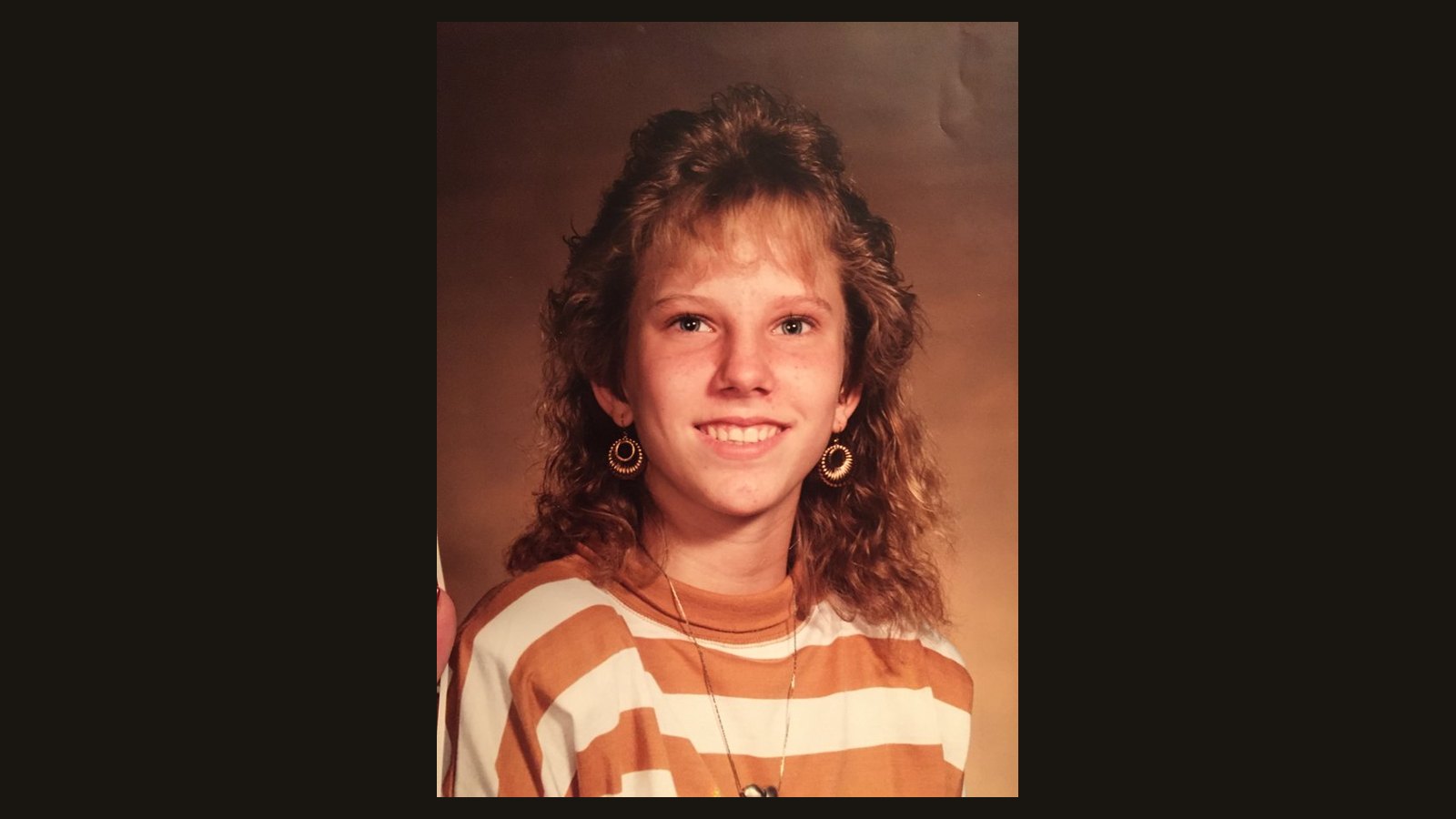
A bad connection
On a Thursday night in January 1995, May Martinez's phone rang in Orange Park, Florida. It was her daughter, Colleen, calling from Knoxville, Tennessee, about five hundred miles up the interstate. The call kept breaking up. May got a few words, then nothing. So she hung up and called her back.
Colleen had gone out.
That is the last ordinary thing in this story. Up in Knoxville, at about eight o'clock that night, Colleen and three other students signed out at the front desk of the building where they lived and walked off toward the university. A couple of hours later, three of those names were signed back in.
Colleen
Colleen Anne Slemmer was born in September 1975 in Bucks County, Pennsylvania, and grew up mostly in Orange Park, just outside Jacksonville. When reporters ask her mother about her, May doesn't start with that night. She starts with the Special Olympics. From the time Colleen was eight, she helped look after disabled children. Her mother called her an "awesome, giving person."
She loved roller skating. And she loved computers; she used to work on them with her stepfather. That became the plan, and the way to get there was the Job Corps, the federal program that gives young people with little money a place to live, meals and training in a trade. The Jacksonville center didn't teach computers. The one in Knoxville did.
So in the fall of 1994 Colleen moved north. By her mother's account the phone calls home were not happy ones. She was miserable and wanted to come back. Her family has always been certain of one more thing: she wasn't interested in anybody at that place. She was there to learn, and then she wanted to go home.
621 Dale Avenue
The Knoxville Job Corps center was a former Holiday Inn at 621 Dale Avenue, just north of the Fort Sanders neighbourhood and a few blocks from the university. The neighbours didn't trust it. In December 1993 two of its residents had attacked two University of Tennessee students, and both had been convicted.
Three of the students there that winter matter to this story. Christa Gail Pike was eighteen and had come from North Carolina at about the same time as Colleen. Her boyfriend, Tadaryl Shipp, was seventeen, from Memphis. Shadolla Peterson was eighteen, from Cleveland, Tennessee.
Something went wrong between Christa and Colleen in those three months. What it was depends on who you ask, and only one of them ever got to tell it. Pike later told a detective that Colleen had been trying to get her boyfriend, and that she had once woken to find Colleen standing over her with a box cutter. Nobody ever backed up the box cutter. Colleen's family says she wanted nothing to do with him. The State's theory at trial was jealousy.
On Wednesday, January 11, Pike told a friend at the center, Kim Iloilo, that she was going to kill Colleen. The reason she gave is in the court record:
Eight o'clock
The next night, at about eight, Pike asked Colleen to come out with her. The promise, as the reporter who covered the trial later described it, was a video and some pot; on the tape, Pike said she told Colleen she wanted her to come to Blockbuster. Shipp and Peterson came too. Iloilo watched the four of them walk away from the center toward 17th Street. Earlier, Pike had borrowed a small meat cleaver from someone at the center. She never said who.
They walked down to the Cumberland Avenue Strip, then to Tyson Park, along a busy greenway, and up a paved path to a dark corner of the university's agricultural campus, behind the steam plant and near the greenhouses.
The steam plant
The fullest account of what happened there comes from Pike herself, told to Iloilo that night and to a detective two days later. The Tennessee Supreme Court set it out from her statement. She attacked Colleen with her hands and feet, then with a box cutter, and Colleen repeatedly asked, "Why are you doing this to me?" Pike said a second person, whom she called only "he," helped hold Colleen down. The record never says who that was.
Colleen tried to bargain. The court's summary of the tape records her offer:
Pike did not let her go. By her own account the attack lasted "about thirty minutes to an hour." The medical examiner, Dr. Sandra Elkins, found many slash wounds, bruises on Colleen's knees consistent with crawling, and defensive wounds on her arm. She died of blunt force injuries to the head, from a chunk of asphalt. A pentagram had been carved into her chest. Pike denied doing the carving and blamed the other person; who did it has never been settled.
Four out, three in
At about 10:15, Iloilo saw Pike, Shipp and Peterson come back into the center. Colleen was not with them. They signed back in.
Later that night Pike went to Iloilo's room, told her she had killed Colleen, and showed her a piece of Colleen's skull. Iloilo testified that Pike danced in a circle as she told it, smiling and singing "la, la, la."
At breakfast the next morning Iloilo asked what she had done with the piece of skull. Pike said it was in her pocket: "And, yes, I'm eating breakfast with it." In class she showed it, folded in a napkin, to another student, Stephanie Wilson.
At about 8:05 that Friday morning, January 13, a man from the university's grounds department found Colleen near the greenhouses. He testified that at first he thought she was an animal. She was identified through dental records as "a nineteen-year-old Job Corps student." Nobody who had been told had called the police. Colleen was found because a man went to work.
That afternoon Pike went back to the taped-off scene with three to five other girls from the center and questioned the university police officer standing guard, Harold Underwood, about the victim and any suspects. She was wearing a pentagram necklace.
The statement and the jacket
The investigator who caught the case, Randy York of the Knoxville Police Department, has long said the pentagram was the key. But a more ordinary thing had already tied the four together. A 2001 feature on the case put it in one sentence: "The police also looked at the log book and saw the four of them signed out together, and only three returning."
On Saturday, January 14, York interviewed Pike and Shipp separately. Pike waived her rights and gave a tape-recorded statement that ran to about forty-six pages when it was typed up. She denied carving the pentagram and denied taking any piece of the skull. Photographs taken at the police department that day show both Pike and Shipp wearing pentagram necklaces. Pike was arrested and charged with murder the same day; Shipp and Peterson were charged too. Shipp later told police Colleen was a sacrifice to the devil, though a defence expert at trial described the crime as an adolescent "dabbling in Satanism," and the State's theory remained jealousy.
On Friday, Pike had sat in the office of Robert Pollock, an orientation specialist at the center, about a misplaced ID card, and left her black leather jacket on the chair. When Pollock heard over the long weekend that she was a suspect, he turned it over at once. Officer Arthur Bohanan of the KPD found a small piece of bone in the inside pocket. A UT forensic anthropologist, Dr. Murray Marks, showed that it fit perfectly into the reconstructed skull. The crime lab found Colleen's blood on Pike's clothes and on Shipp's.
The trial
Pike's trial opened on March 22, 1996. The jury heard the tape, and she cried as it played. On Friday, March 29, seven men and five women convicted her of premeditated first-degree murder and conspiracy.
At the penalty phase the defence called three relatives who were in the courtroom. Her parents testified that they had divorced each other twice and passed her back and forth. Her mother, Carissa Hansen, said under cross-examination, "I should be the one in her seat. I should be punished for her crime." The jury did not hear from the mitigation expert the defence had retained, who was dropped at the last minute; the lead lawyer later said one reason was that she had once been in a relationship with the lead prosecutor. Claims of abuse and mental illness raised in later appeals were rejected by the courts, which found they probably would not have changed the outcome.
On Saturday, March 30, after about an hour and fifteen minutes, the jury sentenced her to death by electrocution. Judge Mary Beth Leibowitz said, "May God have mercy upon you." Pike, who had turned twenty that month, began crying. "Can I please hug my mom before I go? Please let me just hug my mom."
What the jury never knew was that the State had offered her a guilty plea to life without parole. Her lawyer later testified that she turned it down because "she did not want to grow old in jail," and said he probably should have pushed her harder. Pike's own account is that he told her a jury would never sentence a pretty young girl to death. He denies it.
Three fates
Tadaryl Shipp was seventeen that night, too young under the law to face the death penalty. He was convicted of murder in January 1997. The jury could not agree on life without parole, so he received life with the possibility of parole plus twenty-five years. The parole board turned him down in October 2025. His next review is in 2031.
Shadolla Peterson pleaded guilty to being an accessory after the fact and testified for the State. Prosecutors said they lacked the evidence to prove she was a murderer. She received credit for about 460 days in jail and served the rest of a six-year sentence on probation.
In 2019, when the Sixth Circuit turned down Pike's federal appeal, Judge Jane Stranch wrote separately:
Her lawyers counted eight people sentenced to death in modern Tennessee for crimes committed at eighteen. The seven men all had their sentences vacated. The eighth was Pike.
Thirty years
For May Martinez the verdict was not an end. The State kept Colleen's skull as evidence through the appeals. May had her daughter cremated, kept the ashes at home in a pewter box, and refused to bury them until every part of Colleen was returned.
There is a monument to Colleen at Our Lady of Grace Cemetery in Langhorne, Pennsylvania. Whether her remains are there is not something the record says.
Pike's conviction and sentence were upheld by the Tennessee Supreme Court in October 1998. In 2001, on death row, she choked a fellow prisoner unconscious with a bootlace; the woman survived, and Pike was convicted of attempted first-degree murder in 2004. In 2012 the State broke up a plan to help her escape, and a visitor and a former correctional officer were charged. A 2024 settlement ended her long years in solitary confinement.
The Tennessee Supreme Court set her execution for September 30, 2026. At a hearing that August, the State's lawyers said on the record that "the State does not dispute the terrible things that Ms. Pike suffered." The courts refused to stop it, and on September 28 Governor Bill Lee denied clemency. May Martinez said she would be there. In 2020 she had told a reporter she feared that, with all the attention on Pike, everyone had forgotten about her daughter.
September 30, 2026
As the episode reported it on October 1, 2026: on Tuesday the U.S. Supreme Court denied Pike's application for a stay. On Wednesday morning, with the witnesses gathered at Riverbend Maximum Security Institution in Nashville, the Sixth Circuit paused the execution to consider whether her claims of childhood sexual abuse had been fully weighed at sentencing. Later that day the Supreme Court lifted the pause, with three justices dissenting.
That evening the State of Tennessee tried to execute Christa Pike. According to the reporters who were there, she was given the drug, and then a second dose, and she did not die. A little before nine, the witnesses were taken out of the room. She was taken to a hospital.
The Department of Correction said it followed its protocol. Governor Lee ordered an outside review and said there would be no more executions in Tennessee this year. Her lawyers went back to court. As of October 1, 2026, Christa Pike was alive, and what happens next had not been decided.
Before that week, May Martinez had told the Nashville Banner she hoped it would bring her peace, "and that Colleen can always be remembered as the sweet little girl that she was."
Colleen Anne Slemmer was nineteen. She looked after disabled kids from the time she was eight, loved roller skating, and moved five hundred miles to learn computers. Four names went out of that building on a Thursday night in January. Three came back. The fourth was hers, and she was trying to go home.
Who carved the pentagram. Pike denied it on the tape and blamed "the other person." Shipp's account changed: years later, in post-conviction testimony, he said he did it himself.
Who "he" was, the person Pike said helped hold Colleen down, and who lent her the meat cleaver and took it back afterward. She never named either.
Where Colleen's remains are now, and whether the skull fragment was ever returned to her mother. A 2015 report had both still held as evidence; nothing later has been found.
The Knoxville police file, the sign-out book itself and the full forty-six-page transcript of Pike's statement have not been obtained, nor has the name of the grounds worker who found Colleen.