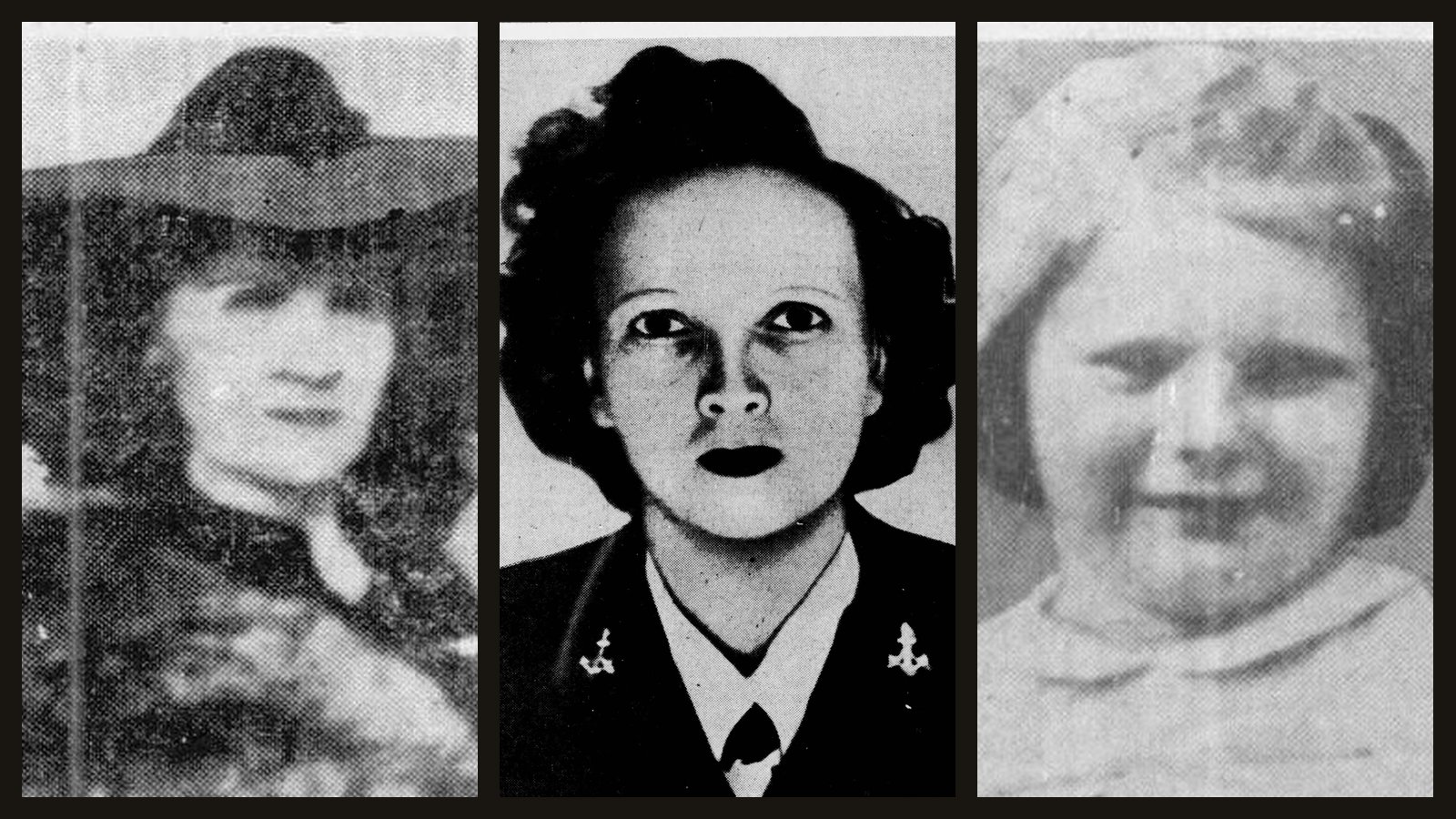
Three people
This case has a famous name, and the name belongs to the man who wrote on a wall. It does not belong to the people he wrote it over.
There were three of them, all on the North Side of Chicago, in a little over seven months: a widow named Josephine Ross in June 1945, a former Navy reservist named Frances Brown in December, and a six-year-old named Suzanne Degnan in January 1946. Each case was investigated on its own. Only later were they joined into one story, and by then the story had a confession in it.
4108 Kenmore
Josephine Alice Lunde was born on March 5, 1902, in Hayfield, Dodge County, Minnesota, the only girl among five children. By the 1910 census her mother, Anna, was divorced and taking in washing to keep the family. In 1920 Josie was eighteen and still a student.
She married three times. Her marriages to John Walsh and Herbert Miller ended in divorce, and each left her a daughter: Mary Jane, called Jane, and Jacqueline. In December 1931 she married Herbert P. Ross, who sold insurance and later gave his trade as portrait painter. In 1943 the family moved into a flat at 4108 North Kenmore Avenue. Herbert died in July 1944. By June 1945 Josephine was forty-three, a widow, living in the flat with Jacqueline, who was seventeen and worked in a food store at Wilson Avenue and Broadway.
On Tuesday, June 5, Jacqueline came home for lunch and found her mother dead on the bed. A red dress had been tied around her throat with a stocking. The bathtub was partly filled with her clothes and bloody water. The cuts in her neck had been drawn together with adhesive tape. Nothing had been taken.
The janitor, Elmer Nelson, told police he had seen a dark-haired, well-dressed man leave by the fire escape between noon and one o'clock, wearing a white sweater with what may have been blood on it. At the inquest the next day, police disclosed that she had been found with several short black hairs clutched in one hand, which the Tribune said "may aid in identifying the slayer."
Eight days
The investigation was run by Captain Frank Reynolds of the Town Hall station. His men brought in a suitor her daughters named, an ex-convict from Hammond, Indiana, and another man who had been seeing her; both were released. They looked hard at a neighbour already in federal custody on a California warrant. A woman named Eileen Huffman, five blocks away, told police a man answering the same description had held a gun on her in her basement that day, tied her hands with clothes line and tried to rape her, and fled when she screamed.
On June 11 they put Jacqueline on a lie detector, to find out whether she had put the tape on her mother's throat. She had not. The test settled what the tape meant:
The same paragraph reported that everyone taken in for questioning had been released. After that the papers went quiet. Her coroner's certificate gives the cause as stab wounds of the neck, "caused by sharp instrument held in hands of person unknown." No one was charged that year.
Apartment 611
Frances Brown was born on March 21, 1912, in Richmond, Indiana, the daughter of a railroad conductor. Her high-school yearbook listed the commercial course, the Girl Reserves and the orchestra, and added: "Frances can certainly play the 'Big Bass Fiddle.'" Her father was killed in a train accident in 1931. In 1934 she came to Chicago to work at the A. B. Dick Company, left to serve in the WAVES, the Navy's women's reserve, and was discharged in September 1945. She went back to her old job.
She shared apartment 611 of the Pine Crest, an apartment-hotel at 3941 Pine Grove Avenue, with a stenographer named Viola Butler. On Sunday, December 9, she had dinner with two friends and left at nine. Her roommate stayed the night elsewhere. Frances went home alone.
Exactly when she was attacked is not settled. The captain said a man he would not name had heard shots at about half past two. A tenant on the second floor put them at about four. At about four, the night clerk watched a stranger come down in the automatic elevator:
At a quarter past five, a newspaper carrier found her door shut. By six it was open and the radio inside was playing loudly. At about half past eight the maid went in.
Frances had been shot in the head and arm and stabbed with a bread knife from her own kitchen. Her body was in the bathtub. The coroner's physician found that the bullet killed her, and the autopsy showed she had not been raped. The apartment had been ransacked and her purse emptied. On the bedroom wall, in lipstick, someone had written four lines; the papers printed them as "For heaven's sake catch me before I kill more. I cannot control myself."
"Hunt Mad 'Lipstick Killer'"
By the next morning the Tribune had a name for him across the top of its front page. Captain Reynolds was on this case too. On December 12 the chief of detectives, Walter Storms, told the papers it resembled two earlier killings of women within half a mile, and one of them was Josephine Ross. It was the first time her name had been in the paper in six months.
There was a single smudged fingerprint on the bathroom door jamb. There were suspects arrested, questioned and cleared within days. On December 15 Frances Brown was buried at Earlham Cemetery in Richmond. A Tribune reporter, Gladys Priddy, counted fifty mourners, most of them friends of her widowed mother, and noticed one more thing:
The house on Kenmore and Thorndale
Suzanne Degnan was born in Boston on April 17, 1939. Her father, James E. Degnan, went to work for the Office of Price Administration in 1942, and the job moved the family to Washington, Baltimore and, in 1945, Chicago. Neighbours in Baltimore remembered her as "a chubby, honey-haired, friendly 'worry-wart.'" In Chicago the family could not find a home, so a lawyer named A. Louis Flynn offered them the first floor of his house at 5943 North Kenmore Avenue. Suzanne started first grade at Sacred Heart academy, and just before Christmas she played an angel in the school pageant.
On the night of January 6, 1946, her parents saw her get up at half past twelve and go back to bed. At about half past one the maid upstairs heard a commotion in the room below and the dogs began barking. At half past seven her father went to wake her for school. The bed was empty. On the floor was a note in pencil on oil-smeared paper: "Get $20,000 Reddy & waite for word do NOT NoTify FBI oR Police Bills in 5's & 10's." On the back: "Burn This For her SAfty."
James Degnan had already called the police. That day he went on the radio three times. He told the kidnapper he had burned the note, which he had not. And he spoke to her:
That afternoon, detectives on a house-to-house search lifted the cover of a catch basin half a block from the house. By midnight they had found her remains in four sewers within about a block. The coroner said she had been strangled. Her arms were not found until February 19.
The laundry room
The next day four detectives found the room where she had been taken apart, in the basement of 5901 Winthrop Avenue. A woman living above it had heard water running at a quarter to three that morning. They waited, and the janitor came in. Hector Verburgh was sixty-five and had spent the first day helping police find the manholes. He was held for two days. A sergeant announced similarities between his handwriting and the ransom note; the same story reported that he could not write. A judge, Harold G. Ward, gave police twenty-four hours to charge him or let him go, and on January 10 they let him go.
Suzanne was buried on January 11. In the weeks that followed, the clues came apart one by one. Handkerchiefs found near the basement led to a nationwide search for a former Marine named Sidney Sherman, who turned out to have left town to get married and passed two lie tests. A young man's story of a three-man kidnapping plot made the front page on January 29 and was called a hoax the next day. Then the papers went quiet for five months.
The twenty-sixth of June
On June 26, 1946, a young man was caught leaving an apartment on Wayne Avenue in Rogers Park. He pointed a revolver at a detective, Tiffin Constant, and it misfired twice. An off-duty patrolman coming home from the beach in his bathing suit, Abner Cunningham, ended the fight with three empty flowerpots. The young man was William Heirens, seventeen, a student at the University of Chicago. In his dormitory room police found guns, jewellery, war bonds in other people's names, and two surgical kits. Nothing in that room was ever shown to have touched Suzanne Degnan.
On June 29 the police announced that one of the prints on the ransom note matched his left little finger, and the FBI called it identical; a palm print followed. The same day, a sergeant said that at one in the morning, with Heirens strapped to a hospital cot after a head injury and no lawyer present, he had asked him about Suzanne. By the sergeant's own account, when Heirens named something he had cut off and was told he was wrong, he answered: "You tell me, and I'll tell you."
On June 30 the police said his prints did "not correspond" to the one on Frances Brown's door jamb. On July 12 a fingerprint sergeant said they matched on twenty-two points, and the chief of detectives said it put Heirens "right in there at the time of the crime." By then he had been given sodium pentothal, which the papers called truth serum. The state's attorney, William Tuohy, said at the time he did not know whether it had been used.
"How Heirens Slew 3"
On July 16 the Tribune printed, across its front page, a full account of all three murders "from unimpeachable sources." On the same front page it said "no legal confession exists."
On July 30 Heirens was arraigned for the murders of Suzanne Degnan and Frances Brown. On August 6, across a desk from Tuohy, he gave and signed a confession to all three. The Tribune reported that he said he picked Suzanne "solely by chance." The terms were printed the same morning: the state would not ask for death, and he would serve life terms one after another. Without a confession, the paper said, the state's case was "none too strong."
Twenty-four minutes
On September 4, 1946, before Chief Justice Ward, Heirens pleaded guilty to twenty-nine indictments, among them the murders of Josephine Ross, Frances Brown and Suzanne Degnan. It took twenty-four minutes. James Degnan testified "with his eyes straight ahead." Josephine Ross's daughter, Mary Jane Blanchard, told the court she had last seen her mother alive that June morning. In the hallway afterward, Heirens's mother walked over to her, and "they exchanged a few inaudible words and embraced lightly, both with tears in their eyes."
The next evening Tuohy asked the court for life terms rather than death, and explained why:
He added: "Without the aid of the defense, to this day we would have no answers for the death of Josephine Ross." The defence lawyer, John Coghlan, told the court there still existed in his mind "many doubts as to Heirens' mental condition." Judge Ward imposed three consecutive life terms. That day, the paper reported, Heirens had tried to hang himself. The Tribune called it "a case of the defendant convicting himself."
Sixty-five years
Heirens soon said the confession was false: that he had been mistreated and drugged, and had confessed to avoid the electric chair. In 1954 the Illinois Supreme Court found that the state's attorney had directed the truth serum without his or his parents' consent, called the handling of him "flagrant violations of his rights," and let the guilty pleas stand. A federal magistrate ordered him paroled in 1983; an appeals court reversed that in 1984. In 1996 a handwriting examiner, David Grimes, said on television that Heirens had written neither the ransom note nor the words on the wall. In 2002 Northwestern University's Center on Wrongful Convictions petitioned for clemency, arguing the confession was coerced and the evidence flawed. It was denied. Suzanne's sister and her brother, born after she died, went to his parole hearings for some thirty years and asked the board to keep him in.
William Heirens died in custody on March 5, 2012, aged eighty-three, having never stood trial. Josephine Ross is buried beside her husband at Irving Park Cemetery. Frances Brown's flat stone at Earlham gives only her name and years. Suzanne Degnan lies with her parents at All Saints, in a lot that, as far as the record shows, has no marker at all.
Whether the short black hairs in Josephine Ross's hand were ever kept or compared with anyone. Her coroner's inquest file has not been found.
Why the police said on June 30, 1946, that Heirens's prints did not match the one on Frances Brown's door jamb, and on July 12 that they matched on twenty-two points. No one was ever cross-examined about it.
Who telephoned the Degnans' unlisted line at ten o'clock on the morning of January 7 and repeated the ransom demand. The call was traced to Rogers Park, and nothing in the record explains it.
How much of the August 1946 confession had not already been printed in the newspapers. The full text, as the Tribune printed it on August 7, 1946, has not yet been laid line by line beside the stories that came before it.