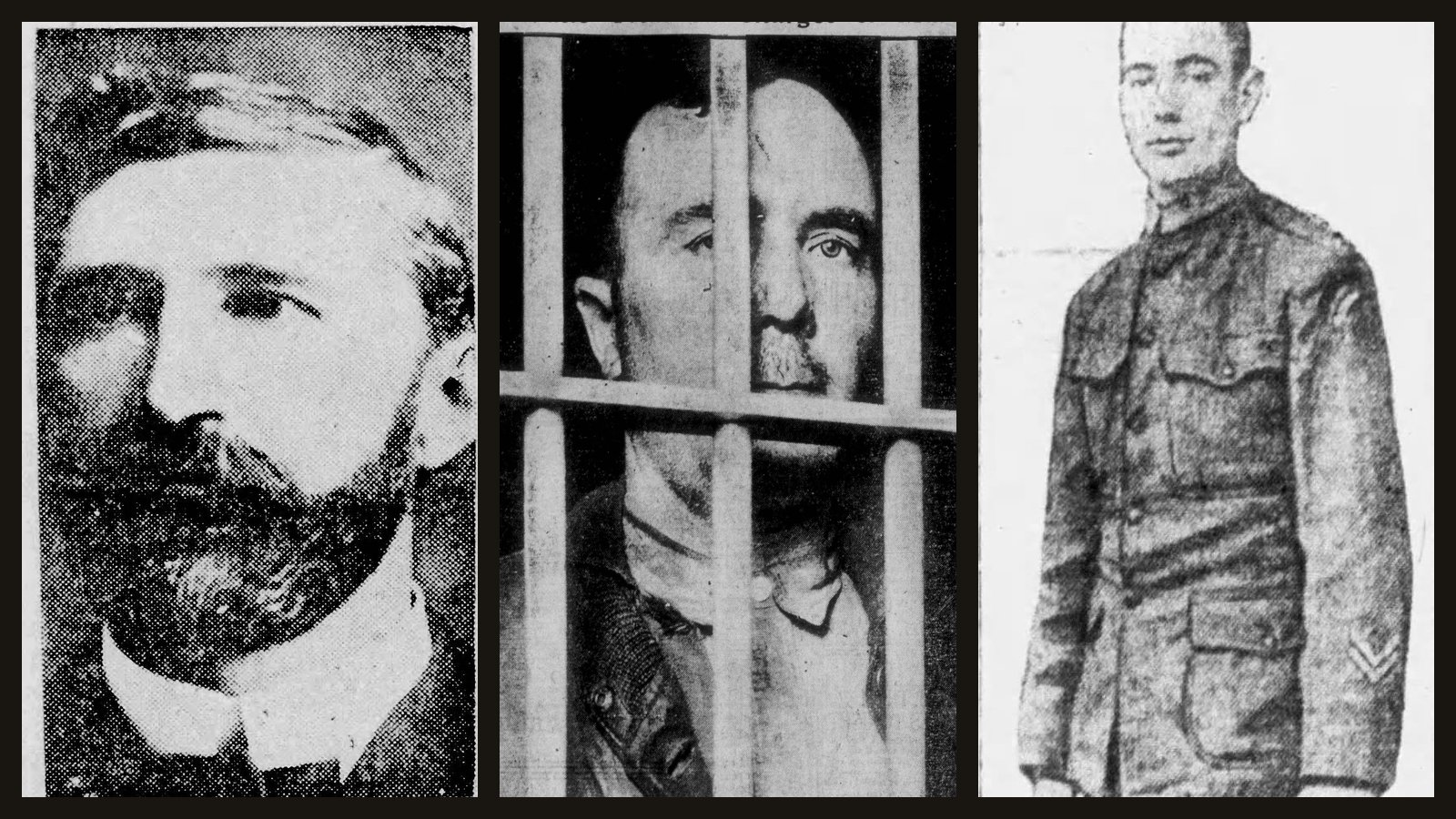
Davenport Street
On Sunday night, February 14, 1926, there was snow on the ground in Omaha. At about ten minutes past seven, a man named A. M. McCarthy was walking to Mercy Home, at Nineteenth and Davenport, when he came on a man lying face down on the sidewalk in front of the Albert Nixon house, 1922 Davenport street. The First Methodist church stood right beside it.
Billy Brooks had been standing in an ante-chamber of the church. He heard the shot and stepped outside. By then McCarthy was at the body and Albert Nixon was coming out of his own front door. Nobody saw who had fired.
A bullet had gone in behind the man's left ear. An empty shell lay ten feet away, so whoever fired it had been close. The Bee's first story called it a .25-caliber pistol. Every later report said .22.
The only thing on him that gave a name was two receipts from the Roberts Sanitary dairy. He was W. L. McDevitt, a milkman who lived around the corner on Chicago street with his brother Robert. Robert had not yet seen the body when the police told him.
And then: "He didn't have an enemy in the world."
A shot through the drug store window
Two nights later, a little before nine on Tuesday, a bullet came through the plate glass of Thompson's drug store at Twentieth and Cass. It missed a customer, Esther Mauthe, by very little. A splinter of glass hit the pharmacist, T. C. Berney. Nobody outside heard a report.
The police worked out the angle of the hole. The shooter had stood across the street near the alley between Cass and Chicago, and from there the only person he could see in the store was Miss Mauthe. All that was left of the bullet was a shaving of lead on the floor, but it was the same caliber as the one that killed McDevitt. The next morning an empty cartridge turned up in an alley half a block away, "identical to those found near McDevitt's body."
Inspector Ben Danbaum took six detectives through the neighborhood that night. He was sure of one thing:
The papers soon worked out that the shooting hadn't started that week. For about three weeks, people near Twentieth and Chicago and Twenty-second and Cass had reported small bullets coming from nowhere. One went through a dining room window and into the wall. A shot cracked Garrett Taylor's windshield. A window at Mercy Home was shot out. The Daily News later reported that a bullet had clipped Walter Peterson's lip near Seventeenth and Capitol avenue.
Behind the bolted door
Wednesday night a storm came through. Dr. Austin D. Searles, 62, had gone home to Vinton street for lunch at noon and gone back to his office at 1302 Douglas. When he didn't come home that night, his wife assumed the snow had kept him.
On Thursday morning she went to find him. The office door was locked. She looked through the letter slot.
"I called Dr. Kenner. Then called a policeman. The police broke the door. I found my husband dead." The lights were still on.
He had been shot once from behind. The bullet went in behind the left ear, and after the autopsy the World-Herald called it "the same kind of wound that killed McDevitt." He lay in front of his instrument cabinet. An empty .22 cartridge lay nearby. His keys, his purse and his watch were gone, and the door from the consulting room to the hall had been locked from outside.
The door that mattered was the other one. Dr. C. W. Edmonds, a close friend, told the police that Searles always bolted the door between his consulting room and the reception room when he was with a patient. It had two fasteners, and both were shut. The World-Herald put it plainly: that fact "convinces detectives the slayer was ushered into the consulting room as a patient and the doctor had locked the door."
A tenant, Mrs. Ed Deeds, had passed a man at the head of the stairs at about 8.30 Wednesday night. Searles had advertised for decades as a specialist in the diseases of men, and Danbaum had a theory straight away. The killer was "probably suffering from some social disease," he said, and "probably had gone to Searles office for treatment."
Where will he strike next?
The Evening World-Herald's headline on Thursday asked the question for the whole city. "The difficult part of the whole thing is that we don't know where this man will strike next," said Police Commissioner Dunn. Chief Van Deusen said, "I'm completely up in the air."
The department's firearms man, Eddie Morgan, said the shells were .22 caliber NRA, a powerful target cartridge. Nobody had heard any of the shots, so the detectives decided the gun had a silencer. Around Mercy Home, women said they had seen a man in a light cap and overcoat and dark trousers in the yard and the alley behind it. A detective gave the paper the line people remembered:
Thursday night the police and the World-Herald got hundreds of telephone calls, and none of them led anywhere. "I have never heard of so many goofy people and maniacs in Omaha in my life," Danbaum said. Eighteen detectives were put on the case, with orders to "shoot to kill" if the sniper tried to escape. The World-Herald offered a $250 reward, and the county was asked for $300 more. In New York, the Times ran the headline "Omaha Darkens Houses in Fear of Sniper Who Fires Through Windows."
Across the river
At 8.45 on Friday night, February 19, Ross W. Johnson, a 28-year-old special officer for the Wabash railroad, was checking box cars in the Council Bluffs yards where the Burlington and Wabash lines crossed. A man rose from behind a pile of railroad ties and shot at him seven or eight times. Four bullets hit him: two in the back, one in the shoulder, one in the right arm.
Johnson fired twice at the man as he ran off up the tracks. Then he walked toward the Wabash engine house, waving his flashlight and firing his revolver into the air, until an engine foreman, R. C. Nichols, saw his signal and came to him. His wife left their baby with a neighbor and went to the hospital. "I think it was that sniper in Omaha," she said.
The next morning six Omaha detectives crossed the river and compared the cartridges. On every shell from all three scenes, the firing pin had left the same U-shaped mark. Eight shells were found in the yard in all. The same gun had been fired at McDevitt, Searles and Johnson.
Johnson's mind cleared about twenty hours after the shooting, and he gave the police the best description they ever got:
The arrests that week went nowhere. One of them, an ash hauler picked up firing at tin cans at the city dump, had been in custody when Johnson was shot. One man in Omaha was not convinced at all. Mayor James C. Dahlman said the three shootings looked to him like three different men, and called the Searles killing "a very ordinary murder." "Of course, I may be wrong," he added.
The man on the tracks
Around noon on Monday, February 22, a section foreman named C. O. Bruce saw a man walking along the Burlington tracks about five miles north of Bartlett, Iowa, thirty miles south of Council Bluffs. He thought the man matched Johnson's description. (The Bee gave the credit to Arthur Collins of the same section crew.) Bruce went back to Bartlett for Constable Dave Morgan, and the constable and three other men covered the stranger. He gave up without a fight.
He said his name was Frank Carter and would not say where he was from. He had a .22 automatic pistol with a silencer, carried in a holster made from a piece of hose. He also had Dr. Searles's watch. He confessed almost at once.
Breakfast at the jail
He didn't look much like a phantom. Carter said he was 45 and a "tramp farmhand" who worked on farms in summer and robbed people in winter. He had bought the gun in Chicago two years before. He slept soundly in the Omaha jail and asked for buckwheat cakes, six of them, with ham and eggs and plenty of coffee. Henry Beal, the Douglas county attorney, listened to his statement and said, "There is no insanity there. He has a low type of mentality, but he is cunning and sharp."
Carter said McDevitt was a holdup gone wrong, and that he had fired a warning shot first. The Bee printed it as over McDevitt's head; another version said over his shoulder.
He called it "a lucky shot." He said he fired into the drug store window to make the police think he was only working in that neighborhood.
Searles was different. "He gypped me out of some money after treating me for a social disease," Carter said. In another version he said the treatment had been fifteen years before. Danbaum had guessed right.
He took the watch, locked the door to delay the discovery, and threw the keys away in the street. Two nights later he was waiting for a freight train when Johnson found him sitting on the ties. Carter said Johnson "acted like he was going to search me," drew first, and that "I shot until my gun went dry." He said he got "a big kick" out of reading about his murders in the papers. "But there were some lies."
He explained his choice of weapon to the Bee:
The police said his photographs and fingerprints might link him to about twenty other murders in the Midwest. Carter denied killing anyone before he came to Omaha, about a month earlier. "The man you call McDevitt was the first man I ever killed," he said. Beal called him "the most cold-blooded proposition this office has ever run across."
Saner than the lawyers
Carter was charged with first-degree murder, and Beal said he would ask for the death penalty. Carter said he was ready for it. His defense was insanity. In March two defense alienists were asked a hypothetical question 4,500 words long, meant to show he was "a paranoiac when he killed Dr. A. D. Searles and William McDevitt." Carter undercut his own lawyers. The United Press reported that he took the stand and "avowed he was as sane as any of the 12 men trying him and indicated he was even more sane than the lawyers."
The jury convicted him of first-degree murder for the killing of Dr. Searles. The McDevitt charge was dropped. On the morning of March 24, 1926, he was sentenced to die in the electric chair at the Nebraska state penitentiary on July 9.
"Let the juice flow"
July 9 came and went while his appeals went through. Frank Carter was executed in the electric chair at the Nebraska State Penitentiary on June 24, 1927. His last words are recorded as "Let the juice flow." He is buried on Grasshopper Hill, the penitentiary cemetery, under his prison number, 9277.
The state's record card is the plainest account of him: Carter, Frank. Alias Clark, F. L. Age 46. Height 5 feet 7. Weight 126. Laborer. Murder, first degree. Term: death. Remarks: "Omaha 'Sniper.'" That is three inches shorter than the man Ross Johnson saw by the light off the snow, and a long way from heavy-set.
Two men were confirmed dead: W. L. McDevitt, who stepped out for a minute before supper, and Dr. Searles, who let a patient in and bolted the door. Later accounts say Carter eventually claimed as many as forty-three killings. One newspaper called the rest "obviously fictitious," and no one ever proved any of them.
Ross Johnson's last appearance in the file is February 22, 1926, "improved, but still critical." Whether he recovered fully, and what became of him, hasn't been found.
The execution and Carter's last words come from penitentiary burial records and later accounts. The Omaha papers of June 24–25, 1927 haven't been pulled yet.
Later sources give his birth name as Patrick Murphy, from County Mayo, Ireland, and say he had served time in Iowa and broken parole. Nothing in the 1926 pages in hand confirms the name. The papers also never found a "Carter" in Dr. Searles's patient books, so whatever name he was treated under is still unknown.