Seven
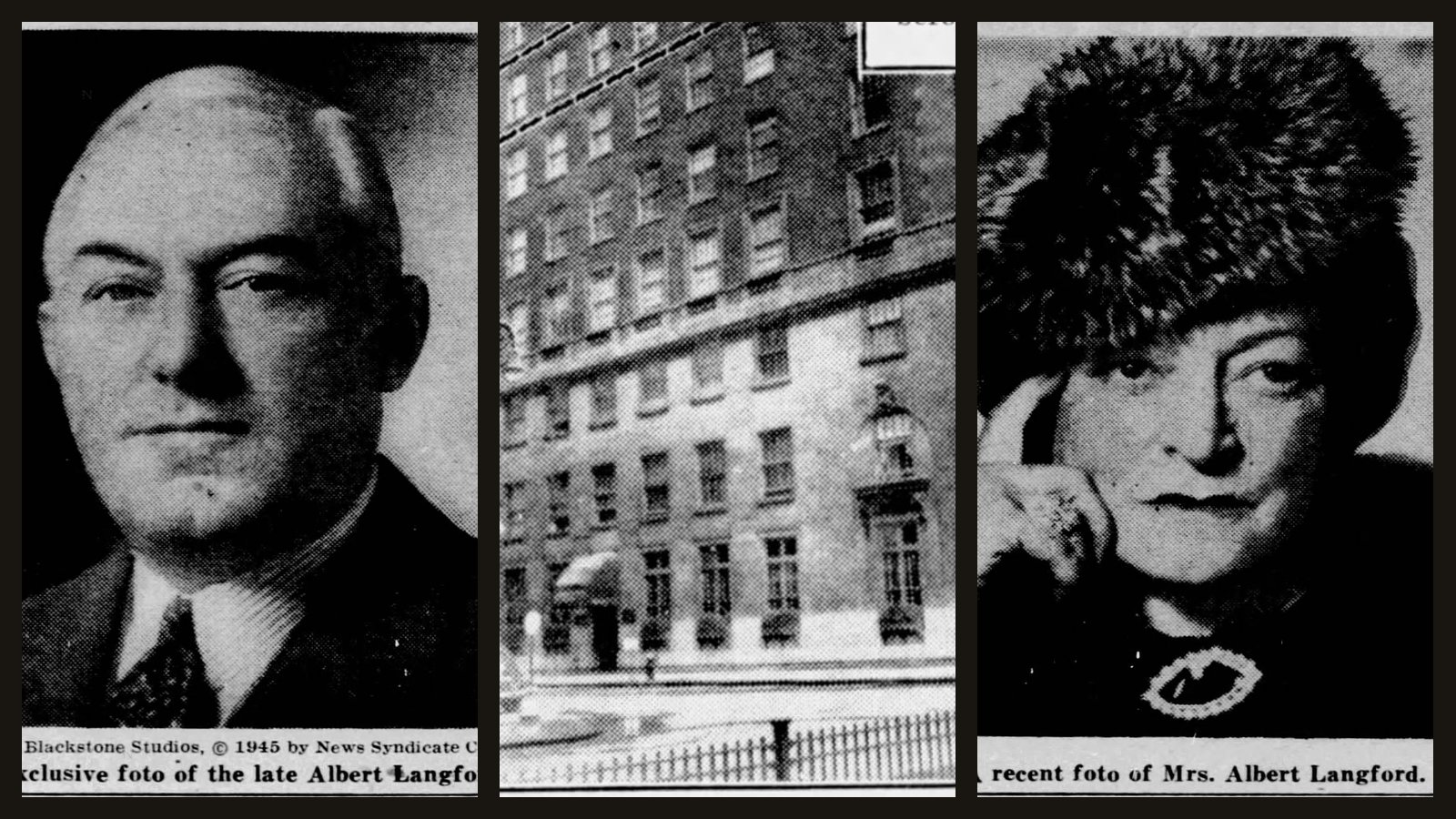
The Hotel Marguery was six buildings around a garden on Park Avenue at Forty-Seventh Street. People didn't visit the Marguery. They lived there, in suites, with maids.
On the evening of Monday, June 4, 1945, an elevator operator named James Delamater was sliding his door open when two men stepped quickly into the car. He had never seen either of them before. Later he told the Sunday News exactly what happened:
A well-dressed woman of about thirty got in behind them, and he let her off at three. At seven the two men walked straight ahead and turned right. Both wore soft dark hats and dark suits. One was about five foot seven. The other was a little shorter, and stout.
Up on the seventh floor, in apartment 705, Marion Langford was in bed, not feeling well. Her husband Albert was with her. A little later, at about a quarter to nine, their Pekingese started growling at one of the apartment's side doors, a door they never used.
Albert went to see. He came back and said there were two men out there who wanted to see her. As the police repeated her words to the Associated Press two days later:
Rafaelo Diaz was a tenor who had sung at the Metropolitan Opera. She had helped pay for his career. He had died in December 1943.
Mr. Millionbucks
Albert Edward Langford was born in Brooklyn on November 4, 1881, the date he later wrote on his draft card. At eighteen the census listed his job as "Broker. Sugar." By 1910 he was a bookkeeper in a cotton house, and he stayed in textiles, one way or another, for the rest of his life.
In June 1913 he married Bernice Glanding at the Fourth Presbyterian Church in Philadelphia. By 1940 she was gone. That spring the census found Albert, widowed, at fifty-nine, lodging in another man's house in Pelham Manor and working as a salesman.
Then in the spring of 1942, every man up to sixty-four had to register for the draft. Albert gave his address as the Fifth Avenue Hotel. On the line for his employer he wrote one word: "Unemployed."
Four months later, on August 26, 1942, he married a Park Avenue heiress. The hotel staff at the Marguery, the Sunday News reported, came to call him "Mr. Millionbucks." The money was all hers.
Lady Bountiful
She was born Eugenie Marion Mayer in Buffalo. Her father, Joseph Bell Mayer, was a retired judge with a fortune in streetcar lines and oil. He lived five floors up in the same hotel. Her husband before Albert, the lawyer Robert H. Grimes, had died in Cannes, in 1936 according to the Sunday News and in 1938 according to her.
A good deal of that money went to singers. A Chicago paper said she was known as a "Lady Bountiful" to the musicians whose careers she had helped. Her best-known protégé was a baritone named Reed Lawton, who said she had heard him at a 52nd Street club in 1934 and moved him up to the Rainbow Room.
There are three versions of how she came to marry Albert Langford. Lawton said a self-styled baroness and a self-styled Cherokee chief had arranged the match for a $25,000 fee. The chief, Robert Redwing, said there had been no fee, but he remembered the baroness, Beatrice Coleman, saying to Albert after the party where it started:
Marion said there was no plot. She had known Albert for years. Asked by the district attorney's office why she married him, she said, "He was a friend of my late husband, a very nice man and easy to get along with. I wanted companionship." Her father had told her not to be silly, that anybody who wanted to marry her at her age would only want her money. She never told him she had married. She had a room added to her suite for Albert's bed.
The foyer
On the last afternoon, her friend Vilma Kempton came over and they played gin rummy. Mrs. Kempton lost $16. Her fiancé, the producer Frank Teller, stopped in too. At about six, Albert came home. The Sunday News, piecing the day together weeks later, noted he was carrying "a small, loosely-wrapped parcel, which contained none knows what." Nobody ever said what was in it. Then the visitors left, and it was just the two of them and the dog.
What happened after Albert went back out to the foyer depends on which account you read. On the night itself, the Daily News reported, she said she heard three men arguing, then a scuffle, then a shot. In the version the police gave the wire services, there was only a thud and a groan. From then on she insisted she never heard a shot. A guest in apartment 716, across the hall, heard two sounds "which sounded like 'pop,'" no louder, she said, "than the sound of a knocker striking a door." The police took that to mean silencers.
The hotel operator reported that Marion called the switchboard and said:
The night manager, Gregory St. John, went up and found Albert on the foyer floor, unconscious and bleeding. He made a pillow for him out of scatter rugs. When the family doctor, Shirley Sprague, arrived about ten minutes later, Albert Langford was dead. He had been shot once in the face with a .38. A .32 had been fired too and missed. The guns were never found. Nobody saw the two men leave, and the police decided they had gone down the back stairs.
Her gallery of friends
By Tuesday morning the story was on the front page of the Daily News under "Murder on Park Avenue," and the picture they ran was of Marion, at a table with the silent-film star Carlyle Blackwell. More than seventy people were questioned in the first day, Evelyn Nesbit of the 1906 Stanford White case among them. Police called her questioning "merely incidental." The Chicago Tribune put her on page one anyway, and called the dead man Alfred.
Even the elevator came out two ways. The Daily News first reported that the operator remembered carrying no passengers to the seventh floor at that time, while the wire services said he had taken two strange men up. Two days later the Daily News reported the two men too. The first version was never explained.
Then the detectives found the books: a telephone book, an address book, and a gift book with more than two hundred names in it and a dollar amount beside almost every one. Reed Lawton's figure grew from $15,000 to over $100,000 as the week went on. Lawton said they were loans. Hotel staff believed she kept a recording machine to take down her protégés' requests for money. The police found no machine. When the district attorney's office asked her why she had given so much away, she said:
In her bedroom dresser, that night and the next day, were diamonds, rings and pearls her lawyer, Carl Rood, valued at more than $100,000. Nobody had touched them. Rood had his own theory:
Lawton flew in from Chicago with an alibi: a telegram sent that afternoon from Kendallville, Indiana. He and Redwing were questioned for hours, and nothing came of it. On Friday, June 8, Albert was buried from the Frank E. Campbell Funeral Church. The day before, Marion had told reporters she wouldn't go: "Oh, good God, no." She went anyway, with Albert's brother Howard. That evening she offered a $10,000 reward and told the Daily News how old she was:
The papers had printed her age as seventy. When she died in 1956, the state death index gave her age as eighty-one.
Short on clues
On June 16 the Daily News reported that Delamater said the police had his time wrong. He had taken the two men up between 7.40 and 7.45, not at about 8.35. If those two men were the killers, the paper said, a gap of fifty-five to sixty minutes "must be somehow explained." Nobody ever explained it. The woman who had ridden up with them was found, and she "firmly states that she saw no men on the elevator."
By the middle of July, the Sunday News put the whole case in one sentence:
The case went quiet for more than two years. Then in November 1947 detectives held a theatrical booking agent named Joseph Rosenzweig, known as Mickey Owens, as a material witness on $5,000 bail. He was never charged with anything. The same story mentioned that police were checking three suspects, one of them "a convict who is about to finish a prison term imposed since the slaying." The paper said: "He has refused to talk." It didn't print his name.
The fingerman
On the night of March 21, 1950, detectives picked up a man at Ninety-Fourth Street and Columbus Avenue with seven picklocks, four celluloid strips and seven master keys in his pockets. He was forty-four, and his record went back twenty-six years. His name was Edison Cable. At first the police said he was "one of many men" they wanted to question, "not considered a suspect."
A month later Cable's lawyer went to court to get him out on bail. To keep him in, Assistant District Attorney George P. Monaghan had to say what his office had been working on since May 1946, when the Daily News had brought it a tip from underworld sources:
As the Daily News told it, Cable had planned a robbery of the $100,000 in jewels, and two of his associates went up to the apartment. It didn't go to plan. Albert Langford "put up a fight in the foyer of his seventh-floor apartment," and they shot him. The paper also printed a floor plan of the suite. It showed the foyer where he fell and two fire exits, one to Vanderbilt Avenue and one to the Park Avenue gardens.
Cable's lawyer, Bernard Alderman, said that since Cable got out in 1948, "they have trailed him every step of the way," but had never arrested him for the murder. The judge kept Cable in jail without bail. When detectives brought him to Monaghan's office, Cable said, "Well, you haven't convicted me yet."
Even if the theory was right, it left something out, and the Daily News said so the next day:
Inmate 104156
There is something the 1950 stories never mention, and it's in the records. On January 21, 1945, Cable and two other men tried to break into a store in the Bronx. He was sentenced for it in Bronx County Court on June 29, 1945, twenty-five days after the murder, to two to three years. Sing Sing received him on July 9 as inmate 104156. He had nine cents on him and a Waltham pocket watch.
Two to three years from the summer of 1945 runs out around late 1947, when the Daily News wrote about the convict who wouldn't talk. The papers never named that convict, but it was very likely Cable. In 2020 the Daily News, looking back, said Cable had taken a plea on the break-in so that Sing Sing would be a safe haven. The blotter shows he went to Sing Sing within weeks. It can't tell us why.
One line on the form doesn't fit easily. It says "jail time 31 days." If those days are counted back from his sentencing, Cable was already locked up before June 4. If they're counted back from his arrival at Sing Sing, they start four days after it. The form doesn't say which way it counts.
On October 31, 1950, Cable was convicted of possessing burglar's tools, and on December 6 he was sentenced to five to ten years. Nothing on record shows he ever said what he knew about the murder. He was never charged with it.
Buddy
Marion Langford married again, to Dr. Walter Von Elvers. In April 1950 the Daily News ran a photograph of the couple taken after they announced their marriage at a party in the murder apartment. She died at Freeport, Long Island, on July 10, 1956. The Marguery came down in 1957, and nothing of it is left.
Edison Cable died in a Richmond hospital on January 3, 1969, at sixty-three. His death certificate lists him as a retired service-station attendant. The Richmond Times-Dispatch ran a short death notice: "Edison (Buddy) Cable died January 3, 1969." It listed a sister, two brothers and two nephews, and it didn't mention New York.
No one was ever charged with the murder of Albert Langford. The district attorney named the man he believed had set it up and never charged him with it. The two men in the soft dark hats were never identified.
Who the two men were. They are not named in any record found, including the 1950 press account and the FBI's file on the Carlo Tresca case, which asked about a link in 1946.
Who told anyone about the jewels in the bedroom drawer. The Daily News asked in 1950, and nobody answered.
Whether Edison Cable was a free man on June 4, 1945. The Sing Sing blotter's "jail time 31 days" could put him in custody a week before the murder. The Bronx County court file would settle it and has not been seen.