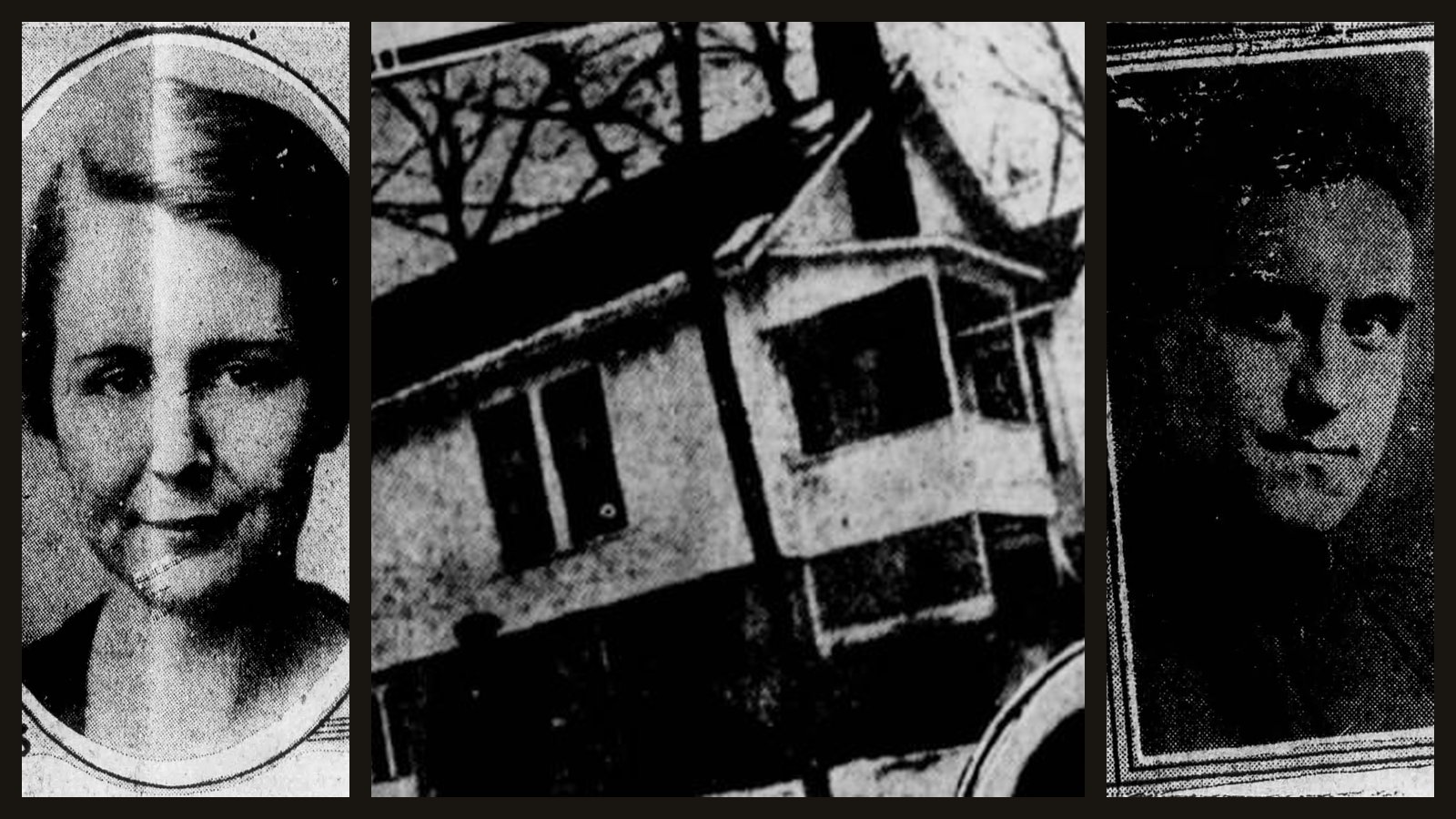
Ridge Avenue
Frances Catherine Drake was born at Christiansburg, Ohio, and grew up in Troy, the county seat of Miami County, about twenty miles north of Dayton. At Ohio State she was the women's tennis champion three years running. Before she finished college she went to work selling the Kitchen Aid, the electric mixer made right there in Troy by the Hobart Manufacturing Company, and by 1926 the Dayton Daily News could call her "the oldest and most valued saleswoman employed by the concern."
Jacob Nesbitt had lost both parents as a boy and was raised by a Troy couple, Mr. and Mrs. Samuel Hottle. He went to Ohio State too, played varsity football and graduated in 1923. Her mother said later that he had been Frances's sweetheart for eight years before they married.
They were married on January 24, 1925, at the First Presbyterian Church, by the Rev. I. L. Dungan. After the wedding Jake joined her in the Kitchen Aid business. In the summer of 1925 they moved into a small cottage at 1146 Ridge Avenue, in the Highland Park section of town.
The last two days
On Wednesday, February 17, 1926, they had friends to stay: Waldo Prentiss Brown and his wife, from Columbus. There were not enough beds, so they borrowed a cot from Frances's mother.
On Thursday Jake drove to Dayton, where he was running the Kitchen Aid display at the Pure Food Show. Frances came down later by bus. They had supper together, she went to a show at Keith's, and they drove home late in the Ford coupe through fog and rain. That, at least, is how Jake told it a few days later:
He said he got up at seven on Friday, tended the furnace, kissed his wife goodbye while she lay "about half asleep," swept the porch and walk, loaded a Kitchen Aid into the car, ate at Weirauch's restaurant and drove to Dayton. She was to join him there. She never came. He worked the show until about half past ten that night and then drove home.
A little after eleven
He went first to her parents' house on West Canal Street. Frances had not been there all day. He telephoned his own house and got no answer, stopped at Weirauch's for a cup of coffee, and drove out to Ridge Avenue. The house was dark. The key was not where it was usually kept, and the front door was unlocked.
Inside there was blood on the floor. He found Frances in the bathroom, in a tub half filled with water, in her nightgown. He called the telephone exchange for the police, then the family doctor, L. N. Lindenberger, then the neighbor, Johnson West, then "Mother Drake." West came over, lifted the body partly out of the tub and washed her face.
She had two fractures in her skull. Coroner G. J. Hance found that she had died of a blow from a blunt instrument, that she had been "severely choked," and that she had not been the victim of a criminal attack. Her jewelry had not been touched, and there was money lying in the bureau drawers. Her wrist watch had stopped at two minutes to twelve, its crystal broken and its hour hand bent, and the papers took that to mean she had been killed at noon.
Some of the papers said she was 25, some 26. Her obituary said she would have been 27 on March 20.
"All judgment as to his guilt should be suspended"
Troy had about eight thousand people, and the Enquirer said it had not had a crime of violence in 22 years. Over the weekend thousands of cars drove past the house on Ridge Avenue while a patrolman stood guard at the door.
The funeral was held at the Drake home on Monday afternoon, February 22. About five hundred people waited at the grave in Riverside Cemetery, and the grave had to be guarded against souvenir hunters. Jake wept as he left the house and covered his face with a handkerchief.
The questions had already turned toward him. He had retained a Troy lawyer, L. H. Shipman, on Sunday evening, and Shipman put out a statement to the public:
The next day Shipman handed reporters twelve copies of a long statement in Jake's name, an account of every hour of February 18 and 19. "Take it for what its worth," the lawyer said. It began: "It comes as a shock to me that I am suspected of the murder of my wife." It also said, "We have never had any domestic trouble of any kind," and of Thursday night, "Nothing happened during the night at all."
The prowler and the inquest
Coroner Hance offered another picture. The basement door had been found unlocked, and he thought a prowler might have slipped in on Thursday night and hidden until Jake left. Whoever it was, Hance said, "knew her well." Dayton's fingerprint man found only two faint streaks on the bathroom door casing, and the investigators began to think the killer had worn gloves.
A girl told the sheriff that a Troy man had threatened Frances the autumn before, after she chased his child away from a scrap in front of the house. The papers never named him, and nothing more came of it in the coverage on file.
The inquest was held at the courthouse on Wednesday, February 24, from ten in the morning until after five. Jake testified that he had no suspicion of anyone. A chemist found no undigested food in her stomach. Her brother Russell said he had found live coals in the furnace after midnight. None of it settled when she had died.
Three suspects, a party and a man in the street
For the next two weeks the papers ran on rumor. An unnamed official said the authorities knew who had done it and what the weapon was. A former county prosecutor, Alva B. Campbell, was brought in to help Prosecutor L. E. Harvey take the case to a grand jury. The Dayton Daily News wrote of three suspects: one a man, one who "may be a man and may be a woman," and one who had never been questioned.
On March 3 the Enquirer reported that the inquiry had centered on a house party on the day of the crime, "a story of gaiety and of a quarrel." The same day a neighbor, Ora Koch, said he had seen a stranger walk down the middle of Ridge Avenue at 6.30 that Friday morning, stop in front of the Nesbitt house, look at it, and turn back. The party guests and the stranger were never named.
Harvey admitted that "certain links of this chain are not completed." Through all of it Jake lived with Frances's family, and Mrs. Drake defended him.
The man from Cincinnati
On March 5 a Troy Citizens' Committee, chaired by Mayor G. H. Stokes, raised the money to hire Ora E. Slater of the Crim & Ryan Detective Agency in Cincinnati. His chief, Cal Crim, said he was "the highest-priced private detective in the United States."
Slater did not arrest anybody. He went riding around with Jake Nesbitt and took him on an overnight trip to Warren, talking the whole way. Back home, Jake told friends: "Slater is just like an auctioneer, he talks all the time." Slater noticed that Jake could not understand a joke, and that his manner changed on the drive back. He went to the prosecutor and said: "That man is guilty."
There was one more thread. The Browns, the guests of February 17, recalled that Jake had worn blue pajamas that night. After the murder those pajamas could not be found, and at the inquest Jake had denied wearing them.
On the night of March 11 the officials arranged the cottage as it had been when Jake "found" the body. The next afternoon Slater took him there with two of Jake's friends from Hobart, Herbert Johnson and C. C. Willard, who were present, the Enquirer said, to see that no "third degree" was tried.
"I saw red"
They talked for more than two hours. Then Johnson said, "Jake, I believe you did it." Jake answered feebly, "We have been having considerable trouble." After five hours in all, in the front room a few feet from where Frances had stood, he broke down.
A court stenographer was sent for, and Shipman, and with the officials in the room Jake dictated a statement. He said they had quarrelled for months over the Kitchen Aid work. Dayton had been her territory until a new contract gave him Springfield and Xenia. She told him he wasn't making enough and should get out of the business. On Thursday night it got so bad that she would not sleep with him, and he slept on the cot in the front room. In the morning it started again at the bedroom door:
He remembered standing in the bathroom "shaking like a leaf." He did not know what he had struck her with. He thought he must have put her in the tub. He burned his bloodstained pajamas in the furnace, washed, combed his hair, and went to work. He set the time at about 6.30 Friday morning. That night, before he called anyone, he had hung a second, never-worn pair of pajamas in the bathroom closet. Asked why he had bought a new key for the car that morning instead of going back into the house for one, he said, "I wanted to get away, I was afraid."
He finished with this: "I don't want Frances to be blamed for any of this. It is all my fault and no blot against her character."
The papers did not agree on every detail. The Enquirer's pajamas were blue and a gift from Frances at Christmas; the Urbana Daily Citizen's were purple, and it added that he burned her red dressing gown too. The Enquirer's own summary said he hit her with his fist; in the questions and answers he said his open hand.
"If he killed Frances we know that he is insane"
When reporters came to the Drake house that night, Frances's mother stamped her foot. "I refuse to believe it," she said. Later the family put out a statement: "Since Jake has confessed the crime we believe that he committed it. But … if he killed Frances we know that he is insane."
"There was never any other suspect at any time in the case," Sheriff Mont Spillman said. Police Chief John Sharits said they could never have convicted Jake without the confession.
On March 13 he was charged with first-degree murder in the mayor's court. Shipman said the defence would be temporary insanity. Prosecutor Harvey said he could prove premeditation. A new ax was missing from the cellar, and a silver vase from the house. In late March organizers tried to raise five hundred citizens to search the woods for the ax, and Harvey planned to drag the Miami River once the high water went down. Jake said he "believed" he had used a heavy stick of wood.
At Easter he was the only prisoner in the Miami County jail to get flowers. His wife's picture hung on the wall of his cell. By then Mrs. Drake had turned against him and wanted him punished.
Life
The grand jury took up the case on May 6, with 83 witnesses summoned. The Dayton Daily News reported that Harvey wanted a first-degree indictment and the electric chair. Instead, the grand jury indicted Jake Nesbitt for murder in the second degree. On May 19, 1926, he asked to change his plea, pleaded guilty and was sentenced to life in prison. He would have to serve ten full years before he could be considered for parole.
That evening he was booked into the Ohio State Penitentiary in Columbus, and assigned as a teacher in the prison classes. He had said once that if he were ever an inmate, he would want to teach the convicts.
He was an honor prisoner. He worked in the prison hospital and the personnel office, and for about two years drove for the state Welfare Director, John McSweeney, who took up his cause. Late on Wednesday, January 9, 1935, as one of his last acts in office, Governor George White commuted the life sentence to thirteen years, with allowance for good behavior, and ordered Jake released at once. The Troy Daily News called it a pardon. The judge who had sentenced him and the former prosecutor told McSweeney they would not oppose it.
"One mistake"
Jake Nesbitt went to friends in Columbus, and later to Cincinnati. He married again in 1943, managed chain stores, and bought a delicatessen on Madison Road in O'Bryonville, where he worked fourteen hours a day. On March 31, 1954, he died of a heart attack while driving with his wife on a street in Oakley. Only then did his neighbors learn about Troy.
He had never hidden it from his wife. "He told me," she said, "that he had made 'one mistake.'" A woman who ran a restaurant a few doors away said, "There never was a nicer man than Jake Nesbitt." The Cincinnati Post's headline was "His 'One Mistake' Is Forgiven." He was buried in Spring Grove Cemetery.
Frances Nesbitt had been dead twenty-eight years.
What Jake struck her with was never settled. He said he didn't know, then that he "believed" it was a stick of wood. The prosecutor hunted for an ax and a silver vase. Nothing in the papers on file says either was found.
The front door. The first reports said he found unlocked a door he had locked that morning; another paper wrote of "the tale he told about failing to lock" it. His own statement says only that the key was missing and the door unlocked. The confession never takes it up.
The State's theory that he left her in the tub and went to fetch a weapon was never tested, because there was no trial. The second-degree indictment and the guilty plea closed the case.
Ora Koch's man in the middle of Ridge Avenue at 6.30 that morning was never identified.