Lake Road
Bay Village sits on the south shore of Lake Erie, about a dozen miles west of downtown Cleveland. In 1954 it was the kind of suburb young professional families were moving to: big trees, big lawns, and houses up on the bluff with wooden stairs running down to the beach.
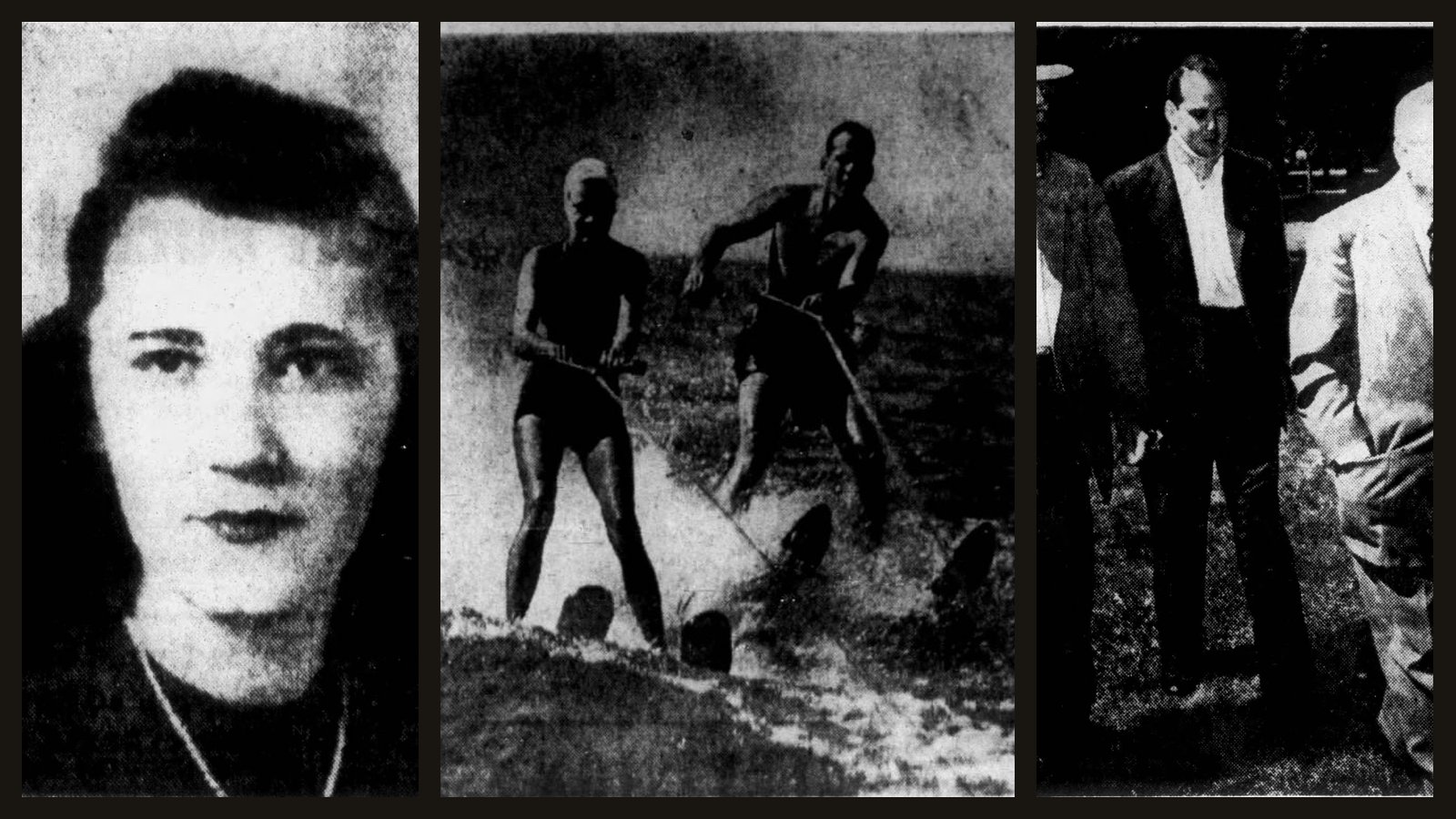
Sam Sheppard was one of those young professionals. He came from a family of osteopaths. His father, Dr. Richard A. Sheppard, and two of the sons had helped found Bay View Hospital, and all three sons were doctors. At Cleveland Heights High School, Sam had been the quarterback and the class president. The girl a year ahead of him was Marilyn Reese. Her mother had died when she was young, and a friend would say she had had "a rather lonesome childhood." She and Sam led the Grand March at the 1942 senior prom, married in California while he was in medical school, and came home to Ohio in 1951 with their son, called Chip.
They lived at 28924 West Lake Road, a rambling house on the bluff with a screened porch over the water. Marilyn bowled, was taking golf lessons, and ran the hospital's women's auxiliary. They both loved water skiing. That summer she was four months pregnant.
Saturday night
On Saturday, July 3, Sam spent the day at the hospital. One of the holiday cases was a little boy who had been hit by a truck. Sam opened his chest and massaged his heart by hand for two hours, and the boy died.
That evening Sam and Marilyn had cocktails down the road with their closest friends, Don and Nancy Ahern, and then everyone came back to the Sheppards' for supper on the porch. Afterward the four of them settled in the living room in front of a movie on television. Around half past eleven Sam lay down on the couch and fell asleep. Nancy Ahern remembered what he had on, down to a white T-shirt under his brown corduroy jacket.
When the Aherns left, Marilyn saw them to the door. Nancy had locked the porch door on the lake side and put the night chain on. The front door she wasn't sure about.
Everything after that rests on one account. Sam said he woke to Marilyn crying out his name, ran upstairs, saw a pale form in the dark bedroom, and was struck down from behind. When he came to, he said, he heard someone downstairs, chased a figure out the back and down to the beach, grabbed him, and was knocked out again. He woke at the water's edge, climbed back up, and found his wife. Then he telephoned the mayor.
"I think they've killed Marilyn"
J. Spencer Houk was the mayor of Bay Village, a part-time job; during the week he ran a meat business. He lived three houses away. Under oath that August he described what he heard when he picked up the phone, not long before six:
Houk and his wife, Esther, found the front door open and Sam slumped in a chair downstairs, wearing wet trousers and no shirt. Esther went up the stairs. Marilyn was on her bed. The Plain Dealer's first story said she had been killed by "25 savage blows"; at the 1954 trial the autopsy pathologist counted 35 separate injuries.
What the coroner and the police found made sense to no one. Sam's medical bag was dumped on the hall floor and two desks had been gone through, but about two hundred dollars in cash was left around the house. In the weeds below the house a teenager found a green bag holding Sam's watch, ring and keys. His watch had blood on it and had stopped at 4:15. Marilyn's, found on the floor of his study, had stopped at about 3:10. There was no forced entry. The family dog had not barked. The weapon was never found, and neither was Sam's T-shirt.
The family closes the door
Sam's family took him to their own hospital that morning. His brother Stephen said X-rays showed a fractured vertebra; the doctor the police called in found a black eye and a swollen face and no sign of a neck injury. On July 5 the family brought in William J. Corrigan, one of the best-known criminal lawyers in Cleveland, and Sam's room was closed to visitors.
The men running the case lost patience fast. Assistant Prosecutor John Mahon, who took over the investigation that week, told the Press:
The same day Sam overruled his lawyer and agreed to talk. Asked whether he had killed his wife, he answered: "Oh, my God, no. Why should I? I loved her." He did admit one "major misunderstanding" in the marriage: he had once bought a watch for a former hospital employee and not told Marilyn.
On July 13 the Cleveland Press put that employee's photograph on its front page. Her name was Susan Hayes. She was twenty-four, living in California, and she told the Los Angeles district attorney under oath that she and Sam were casual acquaintances.
The Press did not let up. It asked the city's detective chief to pick apart the investigation; he called it "the neatest burglar ever." On July 21 it printed a front-page editorial demanding an inquest, and that same day the Cleveland police took over the case. Their chief, Frank Story, told the paper he was convinced he knew who the murderer was.
Normandy School
The coroner, Dr. Samuel Gerber, opened his inquest the next day in the assembly room of Normandy School in Bay Village, in front of about two hundred spectators. Sam's lawyers could watch but not object or ask questions. Gerber asked them all himself.
Sam testified for most of two days. He could not say why his jacket was folded on the couch or where his T-shirt had gone. When he couldn't place the light switch on the stairs, Gerber pressed him, and Sam snapped back.
Then Gerber asked about California. Had he slept in the same bedroom as Susan Hayes? Had he had a sexual relationship with her? Sam said no to every question. He walked out after almost five and a half hours and told reporters, "That was rough." The inquest adjourned on July 26 without a finding.
"Quit stalling"
On July 27 Susan Hayes flew back to Cleveland with an assistant prosecutor and spent three hours in Chief Story's office. According to the police and prosecutors, her signed statement said she and Sam had been intimate in California that March, that the watch was one of several gifts, and that he had talked of marriage. Every point ran against what Sam had said under oath.
On July 30 the Press ran another editorial across the top of page one under the headline "Quit Stalling and Bring Him In!" Cleveland's mayor told Bay Village to arrest Sam or the city would pull its police off the case. That night the president of the Bay Village council signed a warrant, and at about 10:15 Sam Sheppard was charged with the first-degree murder of his wife.
Over that first weekend in jail, the Press reported, Sam admitted to detectives that he had been intimate with Susan Hayes. On August 3 Story's men went back to the house with a fluorescent "black light" and traced blood from the bedroom through the house. Story said what that did and didn't show:
The trial
On August 17 the grand jury indicted Sam for first-degree murder. He pleaded not guilty and was held without bail. The trial opened on October 18 before Judge Edward Blythin, who refused to delay it. The election was two weeks away; Blythin was on the ballot, and so was Mahon, running for judge.
The courtroom was twenty-six feet by forty-eight. A press table for about twenty reporters was set up inside the rail, one end of it less than three feet from the jury box. A radio station broadcast from the room next to the jury room. Twelve jurors were sworn on November 1.
The State argued that Sam and Marilyn had quarrelled over other women, that he killed her, and that the burglary was staged. The coroner told the jury that a bloodstain on Marilyn's pillow was "the imprint of what I believe to be a surgical instrument." On cross-examination he agreed that "no specific object or instrument was picked out as being the weapon."
On December 1 Susan Hayes testified for the State to the affair. On cross she agreed she had denied it to the Los Angeles authorities for two weeks. Sam took the stand on December 9 and told his story again. Under Mahon's cross-examination he admitted the affair, and admitted the inquest denial:
Asked whether he had beaten his wife that morning, he said, "No, sir."
Second degree
The jury got the case on December 17 and deliberated for five days. At 4:33 on the afternoon of December 21 it found Sam Sheppard not guilty of first-degree murder and guilty of murder in the second degree. Blythin asked whether he had anything to say.
"All right," the judge said. "But the jury has found otherwise." He sentenced Sam to life in the Ohio Penitentiary.
On January 7, 1955, Sam's mother died by suicide. On January 18 his father died at Bay View Hospital. Four days after that a criminologist from the University of California, Paul Leland Kirk, arrived to examine the house for the defense. He concluded that the blows had been struck left-handed and that a blood spot on the wardrobe door was neither Sam's nor Marilyn's. A motion for a new trial on his findings was denied, and every appeal through 1956 failed.
A mockery of justice
Sam spent nearly ten years in prison. In 1963 a young Boston lawyer, F. Lee Bailey, took the case to federal court, arguing that Sam had never had a fair trial. On July 15, 1964, Judge Carl A. Weinman agreed, finding five separate violations of his constitutional rights: "the trial can only be viewed as a mockery of justice." Sam was released on bond. An appeals court reversed Weinman in 1965, and Bailey went to the Supreme Court.
On June 6, 1966, the Court ruled eight to one that Sam Sheppard had been denied a fair trial.
Ohio tried him again that fall before Judge Francis Talty, with the press kept outside the rail. Sam did not testify, and Susan Hayes did not appear. Gerber admitted under Bailey's cross-examination that he had never found an instrument to match the pillow stain. On November 16, 1966, the jury found Sam Sheppard not guilty.
After
What came next went badly. Sam went back to surgery, was sued, and resigned from the hospital staff. He tried professional wrestling. He died at home near Columbus on April 6, 1970, at forty-six.
The question of who killed Marilyn did not die with him. In 1959 a window washer named Richard Eberling, who had worked at the Sheppard house, had been caught with two of Marilyn's rings stolen from Sam's brother's home. He told police he had cut himself and bled in the house days before the murder, and a state polygraph that November found "no evidence of deception." Years later, Sam's son, by then grown, argued publicly that Eberling was the killer. Eberling denied it, was never charged with Marilyn's death, and died in prison in 1998. In 1998 the family's lawyer announced DNA results he said excluded Sam; the State disputed them.
In 2000 the Sheppard estate sued the State of Ohio for wrongful imprisonment. To win it had to prove Sam innocent, and the State argued again that he had killed his wife. On April 12, 2000, the jury found for the State. In 2002 an appeals court affirmed, and said the case should never have gone to trial at all: the claim had died with Sam in 1970.
So the record stands like this. A jury convicted him in 1954. The federal courts said that trial was unfair. A jury acquitted him in 1966. A jury in 2000 said his estate had not proved him innocent. Nobody else has ever been charged with the murder of Marilyn Reese Sheppard.
Where the weapon and Sam's T-shirt went. Both were searched for, in the house, the lake and the yard, and neither was ever found.
Why the two watches stopped an hour apart, Marilyn's at about 3.10 and Sam's at 4.15, and whether the house was lit at 2.15 in the morning, as one couple swore, or dark at 3, as two other witnesses said.
Whose blood was on the wardrobe door. Kirk said it was neither Sam's nor Marilyn's; the State's experts disagreed in 1966, and the 1998 DNA results were disputed in 2000.
Who Bailey meant. A week after the acquittal he wrote to the Bay Village police chief that the killer was "no stranger" and laid out a case against the Houks. They were never charged with anything, and no court ever weighed it.