Robinson Street
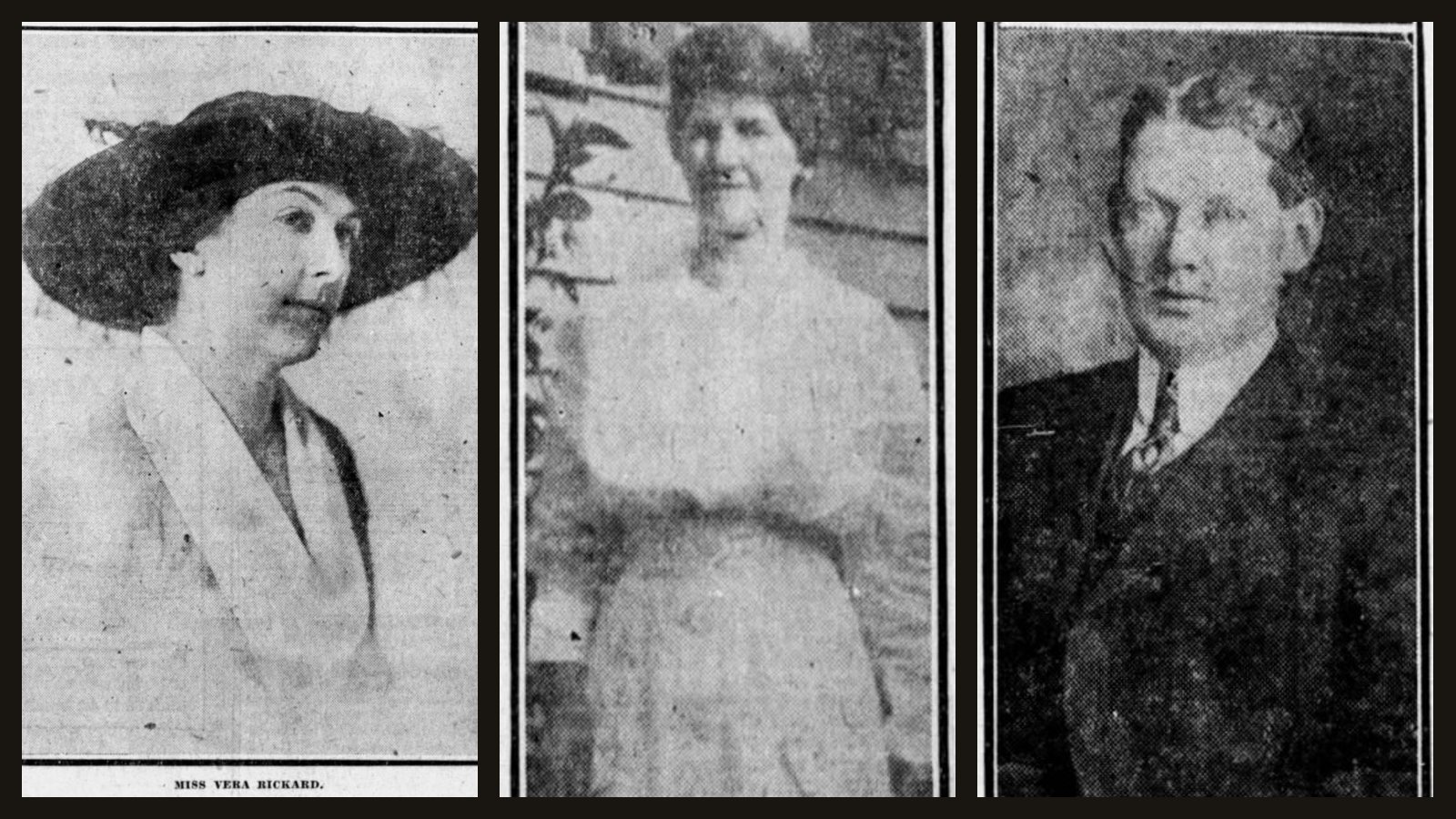
At the end of July 1919, the Rickard family came to Binghamton from Honesdale, Pennsylvania. The father, Frederick G. Rickard, had owned a livery stable and was now working in the railroad car shops at Port Jervis. It was Vera who rented the house: 208 Robinson Street, on the East Side, a plain frame house for her mother, who was not well, and her sister Lulu, who had a new teaching job in the city.
On Monday night, the fourth of August, the family had just finished getting the place in order. Friends had come by for a house-warming. The kitchen stove had gone up that evening, and Donald Loomis was there to help with it. The last guests were saying goodnight on the front walk at about a quarter to ten.
That is when a man came up the front steps and went inside. Everyone in that house knew him.
Soupe
His name was Newell Yale Evans. He was from Deposit, a railroad town east of Binghamton, and he was in his late thirties. Some people called him "Soupe."
He had worn a badge. Evans had been a patrolman for the Erie Railroad's police in Binghamton, had been promoted to lieutenant in Jersey City, and then had been brought back down. On July 2, 1919, the Erie let him go. That February his wife, Hazel, had won a divorce decree against him, charging that he had been living with another woman in Deposit. The papers would report two arrests for drunkenness, in 1914 and 1916.
He had known Vera for about two years. By his own account he met her in January 1917 at the Allen House in Honesdale. Her mother did not like him. He drank, and he and Vera quarrelled, and when they did he swung between threatening to kill himself and threatening worse. The Binghamton Press, two days after the shooting, put it this way:
"Which is it to be"
Donald Loomis had been engaged to Vera before the war. He went to France with Battery C of the 104th Field Artillery, came home, and that summer the engagement was on again. In late July Vera visited his camp on the Chenango River. Evans, it came out later, had hired a detective to watch it.
On Monday afternoon, August 4, Evans came in from Deposit and met Vera at the Erie station. He had been drinking. According to a relative, Clara Fitzpatrick, the ultimatum he gave Vera was: "Which is it to be, Loomis or I."
He took a room at the Lewis House. At about a quarter to nine that night he went out in Ely Haight's taxi with four women, and when a roadhouse on Burr Avenue refused to sell him whiskey, he raged at the door. At about 9:33 the cab set him down by the fire station on Robinson Street.
A quarter to ten
Evans walked into the house with an old Smith & Wesson revolver and fired four shots. One hit Vera at the tip of the left shoulder and went through her lung and windpipe. The other three were fired at her mother. Two of them hit her.
Donald Loomis was out on the back porch. He came in, got his hands on the gun, wrestled it away and beat Evans to the floor. Evans got loose and ran.
Vera died on the floor of the small back room off the porch. Her mother was taken to City Hospital, where she died at 12:25 the next afternoon.
Two blocks away, Patrolmen Lacey Abel and William Shinners found Evans hiding in the tall grass behind a billboard. He slashed at Abel with a penknife before they took him. He had a whiskey bottle in his pocket, and his Erie badge was pinned to his suspenders. In his cell that night he told them he couldn't have done it:
Vera and her mother were buried together in the family lot at Honesdale on August 7. The next day Evans pleaded not guilty. He had collapsed in custody and said he remembered nothing. But the morning after the shooting he had signed a statement, and the prosecution meant to build its case on that statement and on the one man who had seen everything.
The only witness
At the preliminary hearing on August 13, Donald Loomis took the stand and swore that Newell Evans was the man who fired the shots. Evans was held for the Grand Jury and moved to the county jail that evening.
Ten days later, on the morning of Saturday, August 23, Loomis was up a pole at the corner of Hawley and Exchange streets, splicing a wire. He touched a live one and died there. A Press photographer took a picture of the bare splice a few minutes afterward.
That left the District Attorney with an unsigned transcript of Loomis's hearing testimony, which other lawyers in town called "absolutely useless as evidence." It left him a taxi driver who would not swear to Evans's face, and Evans's own signed statement.
"N. Y. Evans or Soupe, as he is called"
On September 5 the Press printed what the neighbours had heard that night. Before she was carried out of the house, Isabel Rickard had answered a patrolman's questions. William B. Ford had his notebook out.
On September 26 the Grand Jury handed up two indictments for murder in the first degree, one for each woman. Evans pleaded not guilty to both before Justice Abraham L. Kellogg in a crowded courtroom. In November his family brought in a second lawyer, Thomas J. Mangan, to join Harry J. Hennessey for the defence.
Five hundred men
The trial opened on November 10, on the indictment for Vera's death. Her mother's was held back. It took a week, six panels and about five hundred talesmen to find twelve men who had not already made up their minds.
The defence was drunkenness. Hennessey read the penal code on intoxication to the court. The District Attorney, Urbane C. Lyon, opened by promising the jury "the story of the most fiendish murder in the history of this fair county." Vera's father and sister testified. A Lewis House bartender said the couple had quarrelled three hours before the shooting. Then the three women from the taxi swore that Evans had been staggering drunk. Loomis's hearing testimony was read to the jury after all.
On November 20 Kellogg confined the trial to Vera's murder alone. That was believed to shut out Isabel Rickard's dying words, and nothing in the closing coverage shows them read to the jury. So the case came down to Evans's own words.
Patrolman Shinners told the jury what Evans had said when they found him in the grass: "For Christ's sake don't kill me." Then: "I loved her and she jilted me." Shinners said he had arrested about a thousand drunks, and Evans "appeared absolutely sober." A Port Jervis mechanic, John A. Barr, swore he had heard Evans say in August 1918, "If I can't have Vera Rickard, no other man can, if I have to kill her and the whole damn Rickard family."
And there were the letters. Three days before the shooting, Evans had written to Vera: "I am afraid it is all up with me. I hope I don't loose my little girl."
"Give the booze up"
The people rested on November 25, and that afternoon Evans took the stand himself. He told the jury about the ring. "I bought the ring intending to make her my wife," he said. "My wife at that time was getting her divorce."
Then his lawyer read Vera's letters aloud, and Evans wept. In one of them she had begged him: "Give the booze up. I have seen too much trouble from it."
On November 28 Mangan argued for Evans's life from 11:20 in the morning until 4:50 in the afternoon. The next day, Saturday, the District Attorney summed up from eight until nearly noon, with one juror sitting ill with tonsilitis and the courtroom afraid of a mistrial. Kellogg cleared the room and charged the jury. It went out at 4:07, had supper at the Carlton Hotel, and at 8:50 sent word that it had a verdict.
At about 9:36 the foreman, Ollin Schermerhorn, read it: guilty of murder in the second degree. Not first. There would be no electric chair. Kellogg denied a motion for a new trial on the spot, and at 9:45 he gave the maximum, twenty years to life in Auburn prison.
The lifer's tier
On Tuesday morning, December 2, Sheriff Bartlett Holcomb delivered Evans to Auburn. He thanked his jailers. He was told he could be out in fourteen years and six months, less the 117 days he had already spent in the county jail. They gave him a cell "in the lifer's tier."
He never came out. Newell Evans is listed as an inmate at Auburn, number 37366, in the census of 1920, and again in 1925, 1930 and 1940, long past his minimum. He worked as a cabinet maker, then as a laborer, then on the ice machine in the prison kitchen. He died there on July 17, 1947, twenty-eight years into his sentence.
Evans gave his birth year as 1880 before the murder and 1882 after it. Both appear on official records, so this page gives neither.
Isabel Rickard's dying statement was the strongest thing the prosecution had once Loomis was dead. Kellogg's ruling of November 20 is believed to have kept it from the jury, but the court file has not been pulled to confirm it.
Why Evans was never paroled after his twenty-year minimum, around 1939, is not in anything found so far. His Auburn case file, number B0029-77, may answer it.