The chair by the door
Arley Keck ran a grocery and filling station on a corner in Weleetka, in Okfuskee County, Oklahoma. The papers said he had been in business there since 1934, after years on the Fort Smith & Western railroad. He was a Mormon, a Mason of twenty-five years, and the father of nine. One son, Truman, had been a prisoner of the Japanese since the fall of Guam. Another, Ford, was in the navy.
He slept in the back of the store and kept the pump running all night for the truckers, which is why he sat by the front door with the radio on. His daughter, Mrs. Frank McKinney, worked beside him that Friday night and went home sometime between ten and midnight.
At about five past eight on Saturday morning, March 18, 1944, Albert Gardner brought the milk. The store was dark, but the door was unlocked. Two years later the town paper told what happened next from Gardner's side of the door:
Arley Keck was lying eight or ten feet inside the door, feet toward it. He had been struck on the head with something blunt and then with a meat cleaver. The papers gave his age as "about 65." He was sixty, born in January 1884.
Red pepper
His pockets had been turned inside out. But whoever did it had missed two places where Keck kept money and had never got the cash drawer open.
And there was pepper everywhere. Bloodhounds came up that afternoon from the state penitentiary at McAlester, and the Muskogee paper reported what they did:
An empty pepper can turned up some distance from the store. Along the trail the officers saw footprints that looked to have been made by "high heel cowboy boots or by a woman." A fingerprint expert was called from Oklahoma City, and officers hoped he had found clear prints on the can and the other things the killer had handled.
There was no coroner's inquest. The county said there was no question about the cause of death. Weleetka physicians looked at the body at about ten that morning and put the killing at around one or two o'clock. That is the whole of the medical record. Most 1944 papers give the date as March 18; Keck's grave and a few later stories say the 17th, the night his daughter left him.
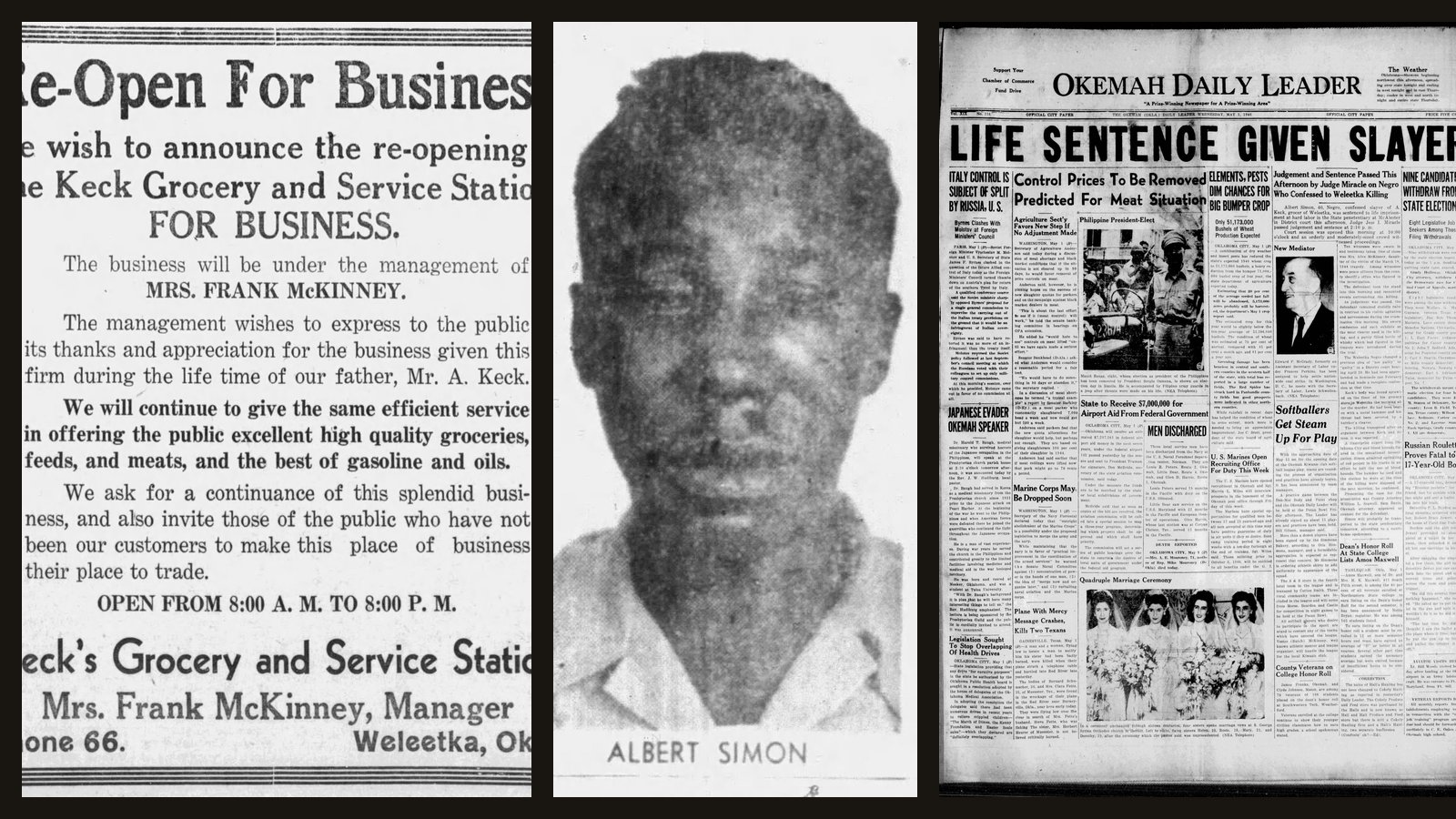
That Wednesday Arley Keck was buried out of the First Christian church in Weleetka, by the Baptist pastor, assisted by the Methodist pastor, with the Masons at the graveside. A week after that the family took out an advertisement in the Weleetka American: the store was open again, "under the management of MRS. FRANK McKINNEY," from eight in the morning to eight at night.
The man they let go
Officers picked up several people that first week. One of them was a Weleetka man named Albert Simon. The Muskogee paper said the man in custody was held "more in the hope that he might have been seen or heard something that would throw light on the case rather than because of suspicion that he might have been involved." He told them he knew nothing about it. He was kept a number of days, and released.
Nine days in, Undersheriff Sullivan Thompson told a reporter where things stood:
The man from the other county
On April 3, 1944, about sixty miles west, three people were killed in one afternoon: Mrs. Walter Gorski and her three-year-old daughter Martha, and a farmer named Roy Schat. On the night of April 7 a posse and a party of sailors took a man named Amon Johnson out of the brush near Shawnee.
A Muskogee paper reported that his parents lived in Weleetka. That same night County Attorney William Seawell, Sheriff Wes Kennedy and two deputies drove to Shawnee to ask him about Arley Keck. Officers said he had not confessed to it "and had not thrown any light on the matter." The next day the United Press carried the line that seemed to settle it:
On April 10 Seawell called Johnson a "very likely suspect" and said one of Johnson's shoes, tried in a footprint near the store, was "very similar," if not "identical." But no charge was filed. Johnson confessed to the three other killings and never to this one. He was executed at McAlester for them on March 23, 1945.
That same week Seawell, Undersheriff Harlan Avey and Sullivan Thompson, now a deputy, went to Little Rock, Arkansas, to question a man named James Hall, held there on five murder charges. Seawell had called him a "likely suspect" too. Hall had been working in Little Rock when Keck was killed. "The officers have discovered he is not the man," the Okmulgee paper reported on March 28. On March 29 the county's own weekly ran the headline "Suspect Found In Keck Murder Case."
The box of black pepper
By early 1946 the state was working the case. Agents C. C. Crabb and W. D. "Deck" Fuller of the State Bureau of Investigation had joined the county men. The Black Dispatch, Roscoe Dunjee's paper in Oklahoma City, later told what Fuller had seen in the two-year-old reports. Red pepper had been thrown over the body and the tracks, and the killer had also opened a box of black pepper and then not used it. From the reports, the Dispatch said, Fuller suspected "an ex-convict from Illinois with escape methods." The papers of 1944 mention only the one pepper can; the black pepper box comes to us from Fuller, by way of the Dispatch.
The Dispatch said Fuller worked "purely on circumstantial evidence." In the third week of February 1946 officers arrested Albert Simon, most papers said at Seminole on Tuesday the 19th; the Dispatch said Wewoka, on the 18th. The papers gave his age as 32, 39 and 40. His grave marker says he was born on June 16, 1906, which made him thirty-nine.
He was the man they had held in 1944. The county attorney now said Simon had been "picked up by the sheriff's office as a suspect," and something more:
In 1944 the county had said he was held as a possible witness, not a suspect. In 1946 it said he was held as a suspect. Both statements came from the same office.
Five hours in Tulsa
Some days before, officers had shown Simon a photograph. It seemed to show a dead man's eye with the face of his killer fixed in it, a folk belief the officers counted on. The Tulsa Tribune printed the picture, and its story said plainly what it was:
Simon looked at it and said he could see "the man in the eye" plainly, "but that the picture was not of him."
On Friday, February 22, they drove him to Tulsa and the police department's new lie detector. He seemed willing. "I want the truth and nothing but the truth to be known," he said. He began shortly before noon and came out a little after four, "trembling with nervousness." The Tribune called him one of the most difficult subjects ever tested there, and said he "showed little reaction except that he became very nervous as the hours went on."
Then a Black Tulsa detective, John Smitherman, talked with him for a few minutes.
And while he was confessing he said: "I guess you know all this. That little needle in there has been writing down what I've been thinking. I know it."
The Black Dispatch printed one more fact that the other papers left out. Simon was illiterate. It said he admitted opening the box of black pepper "due to his inability to read."
Two confessions
In Tulsa, Simon said Keck had come at him with the hammer first and there was a struggle. Back at Okemah he made a longer statement, and an officer the Tribune named as L. S. Thompson said it contradicted the first on that point: Simon had been the aggressor. The motive changed with the paper you read. It was robbery, a food bill, or a $10 debt.
The officers' retelling ran in the Okemah News-Leader. Simon had argued with Keck over the debt, taken the hammer from him and struck him, then used the cleaver; searched for money, even under the pillows of the bed in back; sprinkled red pepper from the shelves; broken the front window, then gone out a side door; thrown the hammer into Alabama Creek the next morning and burned his clothes. The water was told two ways in the same week. In Okemah he threw a bucket of it on Keck's face "to try to revive him." In the Holdenville paper he "soaked his body with water to erase possible fingerprints." And the 1946 versions said the pepper had beaten the dogs, though the 1944 papers said the dogs followed the trail to the tracks.
The Okemah paper said Simon "is credited with having said: 'I just want to get it off my mind.'" Seawell and his assistant, Dane Seran, said the lie detector "was used to a great advantage." The Dispatch had its own complaint. The Associated Press had credited the arrest to Sheriff Kennedy and Agent Crabb; the Dispatch said it was Fuller's, under the headline "Need For Negro Press Re-Affirmed." It did not question the confession. Its complaint was the credit.
Sixty-seven days
Seawell filed the murder charge on Saturday, February 23. The case would be over in sixty-seven days. Simon pleaded not guilty when he was arraigned. He was taken to the penitentiary at McAlester, the papers said, for safekeeping; by April they said it was "for fear of possible mob violence." On March 4 he waived his preliminary hearing, where the state would have had to lay out its case in open court, and was bound over without bail.
On April 20 he changed his plea to guilty before District Judge Jess I. Miracle. County Attorney Seawell asked for the death penalty.
On May 1 court opened at ten. Ten witnesses were sworn, among them officers from the sheriff's office and Mrs. Alice McKinney, Arley Keck's daughter. The exhibits were the meat cleaver, Simon's sworn confession, and "a partly filled bottle of whisky which had figured in the tragedy." Late in the morning Simon took the stand and "recounted events surrounding the killing." Nothing in the report suggests he took the confession back. Sam Davis of Okemah appeared for him.
At 2.10 p.m. Judge Miracle sentenced him to life imprisonment at hard labor. Ten weeks earlier, in Tulsa, he had said, "If you'll give me life I'll confess."
The paper's account of the day mentions the fingerprints once: "A fingerprint expert from Oklahoma City and blood hounds figured in the sensational investigation." Nothing on the record says the prints matched him, or that they didn't.
Plot fifty
The penitentiary received Albert Simon on May 1, 1946. His record gives his occupation as porter and no alias. No appeal has been found, and nothing found so far shows he ever took the confession back.
Shortly after three in the morning on September 8, 1954, he had a heart attack in his cell and died in the prison hospital. He was forty-eight. The McAlester paper gave him two paragraphs.
He is buried in the Department of Corrections prison cemetery at McAlester, plot 50, under a flat stone with his name and two dates. Amon Johnson, the first man the county looked at for Arley Keck's murder, is in the same ground, plot 118-D.
Were the fingerprints from the store ever compared with Albert Simon's? Experts worked on them for weeks in 1944, and on the day he was sentenced they were one clause in a sentence.
Did anyone search Alabama Creek for the hammer he said he threw there? A weapon found where he said would have backed up the confession. Nothing says anyone looked. Nor does any 1944 account of the scene mention the broken front window the confession describes.
When was Sam Davis appointed? Simon could not read. Whether he had a lawyer when he waived his preliminary hearing on March 4, 1946, is in the Okfuskee district court file, which has not been pulled.
Who else was picked up in the first week of March 1944, and where did they go?