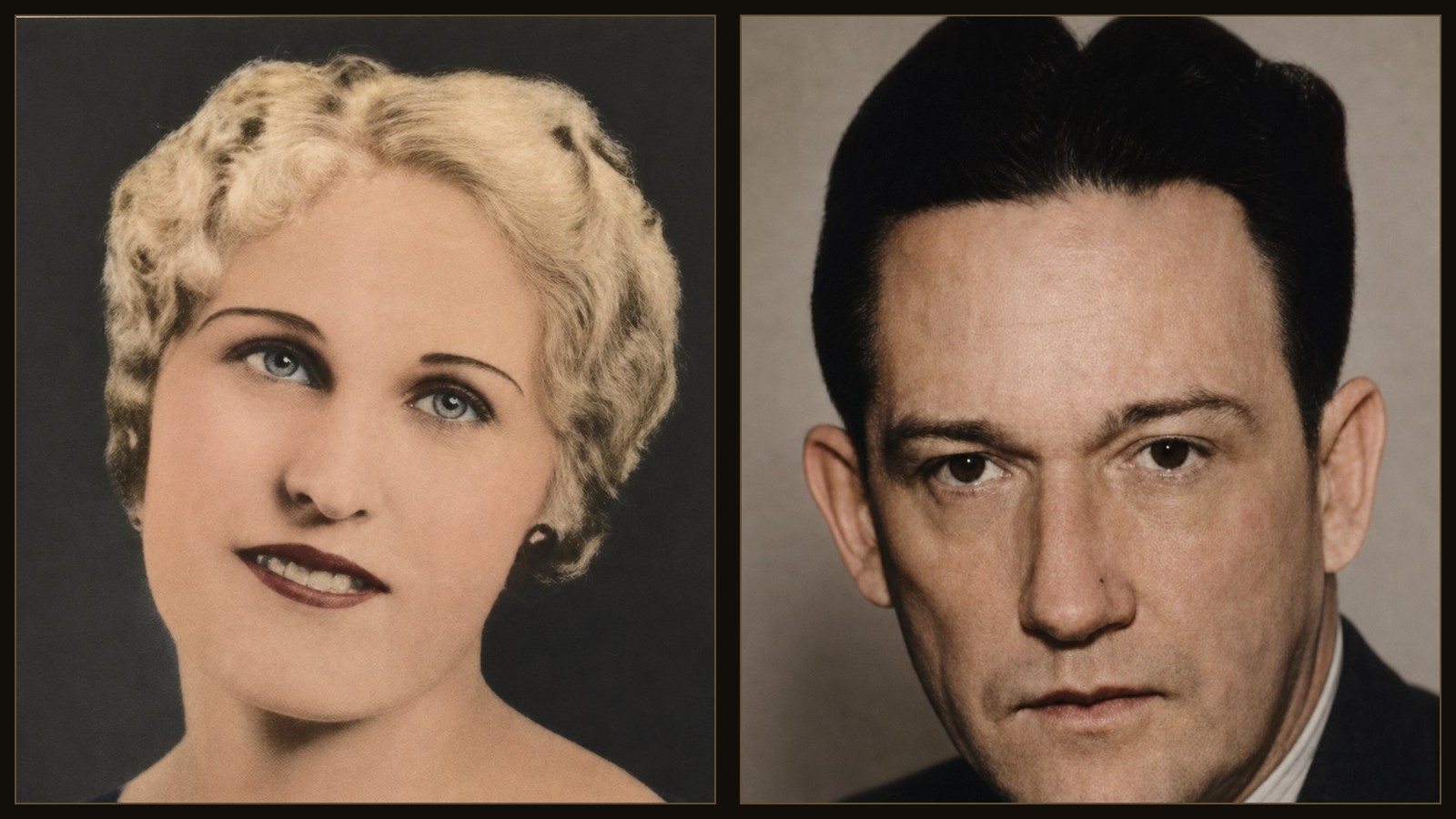
The house at 1329 Verdugo Road had a fish pond behind it, and on the evening of August 5, 1935 a Los Angeles barber came home with dinner guests to find the place dark. He handed out flashlights. It was one of the guests, a cement-gun operator named James Pemberton, who walked back through the shrubbery and found the barber's wife face down at the edge of the water, her head and shoulders under fourteen inches of it.
The barber cried. The Pembertons helped him into the house. A deputy from the Montrose substation arrived at half past eight, turned a spotlight on the pond, and wrote down what he saw: fourteen inches of water, and a left leg swollen and very blue.
Her name was Mary. She was 28 years old, and she was six weeks pregnant, and she had been dead since about four o'clock that morning.
The woman in the pond
Los Angeles printed her first as a beauty parlor assistant, then — by day six — as a La Crescenta housewife, and finally as a native of Champaign, Illinois, aged twenty-seven, survived by her husband and one sister. Almost none of that was right.
Two days after she died, a newspaper in a small Illinois town printed the life that Los Angeles never got around to. Mary Busch was born February 28, 1907 at Burt, in Kossuth County, Iowa — the seventh of eight children of Oscar Busch, a German immigrant who rented and worked a general farm, and his Illinois-born wife Anna. The family moved to Alexandria, Minnesota when she was about five, and she was raised and educated there for fifteen years. In 1926 they moved again, to Geneseo, Illinois. In 1928, at twenty-one, she left for Wyoming by herself. Her father died the following winter.
She was a beauty operator by trade. In March 1935 she turned up in Los Angeles and took a job as a manicurist in a barber shop. The shop belonged to Robert S. James.
The hometown obituary and the 1910 federal census agree with each other and disagree with Los Angeles. She was 28, not 27; born in Iowa, not Illinois; and she left behind a mother, three sisters and three brothers across four states. The Los Angeles funeral notice reduced all of them to “one sister.”
Within a month or two of hiring her he put her through a wedding ceremony. It was not a legal one — he still had a living wife and an annulment pending — and she never learned that. They lived together from early May. In late May, applications were taken out on her life. By late June there were policies with his name on them as beneficiary — the trial would itemize about $10,700 in face value — and exactly one premium had been paid on each.
On July 19, 1935 the annulment finally came through and they drove out of Los Angeles County to Santa Ana, in Orange County, and were married in front of an acting justice of the peace. The certificate was recorded at 4:58 that afternoon. Her half of it runs nearly true: Iowa; Oscar Busch, born in Germany; her mother's maiden name, Anna Hollatz; occupation, beauty operator; residence, his address, already hers. The one thing wrong on her side is her age, entered as twenty-seven when her own birthdate makes her twenty-eight. On his half he swore he was a widower, and that this was his second marriage.
Seventeen days later she was dead.
Three days, three theories
The first headline asked whether it was suicide. The second called it a mystery. By the third day the papers had moved on to a burglar.
None of the three was the husband, and it was not for want of looking. The autopsy failed to fix a cause and the surgeon ordered a stomach analysis. A deputy found bumps on the top of Mary's head — the wrong place, the investigators said, for a fall into a shallow pond. Another paper reported bruises on her arms. A real estate man remembered that the note James said he'd left on the door had been pinned up at five o'clock Sunday afternoon — hanging there, in other words, while Mary lay inside the house.
Then Mary's sister arrived from Las Vegas to grieve, and told deputies that she had received three letters from Mary in the final week, every one of them describing fainting spells. There was a fourth letter, unfinished, found in the house that night. The Times printed its words:
It was not in her normal handwriting — that much was noted the night it was found. What sat opposite it in the file was a grieving sister who believed the fainting story completely, and the headline that produced: Victim's Kin Substantiates Fish Pond Death Theory.
Held, and released
On August 9 they questioned him all day, and it worked. Robert S. James admitted that he had been married five times and that his name was not James at all — it was Major Lisenba, and he had been born in Alabama. The deputies now had a list of wives, and a tally: about $13,000 collected through the deaths of former wives, and $16,400 riding on Mary. Late that day Captain Norris G. Stensland ordered him held.
The next morning the chief criminal deputy, William J. Bright, peremptorily ordered his release, declaring that the investigators had found nothing to warrant taking James into custody. The disagreement ran on page one. James walked out saying his conscience was clear.
Four days after that, on the eve of the inquest, the same chief criminal deputy told reporters that no poison had been found and that he expected the coroner's jury to find accidental drowning. In fairness to him, the chemistry really was negative — but that is because the venom had failed, and she had been drowned.
The jury that wouldn't say
The inquest opened at 9:30 on the morning of August 15, and it did not go the way it had been predicted in print. The autopsy surgeon testified to drowning and to an acute cellulitis of the left foot, caused by the sting of a poisonous insect — possibly, he said, a black widow spider. He described a normal condition of six weeks pregnancy. He offered his own belief that she had suffered a fainting swoon at the edge of the pond. Deputies testified that they had found no evidence to indicate anything other than accidental death; the head bumps and the arm bruises simply evaporated from the record.
And then five of the seven jurors refused to sign any of it. They could determine drowning, and nothing else — not accident, not suicide, not homicide. Two held out for accidental. The predicted mishap ruling never came, and homicide stayed on the record.
The deputy district attorney gave no indication of any plans for further investigation.
Mary was buried at Forest Lawn on August 19, two weeks after she died. Then nothing happened for eight months.
What woke it up
What happens next begins with money. James claimed double indemnity; the insurers refused to pay; suits were filed; and one of them settled — $3,500, paid to him.
Exactly how that turned back into a murder investigation is the one hinge in this case that the record tells two different ways, and it is worth being honest about. The United States Supreme Court, writing in 1941, said flatly that as a result of the insurance activity, a fresh investigation of Mary James's death was instituted. The California Supreme Court, writing two years earlier, said something else: that James was placed under observation in April 1936 for suspected incest involving his niece, and that it was then that the authorities uncovered the criminal character of the deceased's death.
Both accounts are in the official record and this archive does not pick between them. The likeliest reading is that they describe the same eight months from two ends: the insurance suits drew the eyes, and the other charge opened the door. What is not in dispute is the date — he was arrested on April 19, 1936, and the charge he was arrested on was not murder.
What Hope told them
In June of 1935, in the barber shop, James had asked a man he'd known about seven years whether he knew anything about rattlesnakes. A friend of his, he said, wanted a wife killed. The fee was $100 and expenses.
Charles Hope — “Chuck,” an ex-sailor — bought snakes from three separate dealers that July: three at Long Beach, three more from a dealer named Kirby along with a jar of crystallized venom, and one picked out at the Ocean Park Snake Pit. They were tested in the garage on chickens and rabbits. None of them were judged hot enough. On July 28 a cabinet shop made two boxes to order with sliding glass tops. On Saturday, August 3, Hope paid $3 to a Pasadena dealer known as Snake Joe for two diamondbacks that were.
Mary had been told that Hope was a doctor and that he would perform an operation on Sunday. On Sunday afternoon she was put on the kitchen table in her nightgown, her eyes and mouth taped, and strapped down. Her left foot was pushed into the box with the snake in it. At three o'clock Hope resold the snakes to Snake Joe at half price and threw the glass-topped boxes out along the road.
She did not die. At half past one in the morning the venom still had not killed her — she was not, Hope said, even sick. I am going in and drown her, James said. At four o'clock he came back out and said: that is that. At half past six they carried her toward the pond. Hope refused to put her in the water. James laid her face down at the edge of it.
Then he went and opened the barber shop for the day.
Colorado, 1932
There was one thing the 1935 deputies half-knew and never chased. A Colorado Springs sidebar had run the day after Mary died, and it said that this was the second time a drowning had taken a wife from Robert James.
Her name was Winona Wallace. In 1932 James had brought her to a Prudential agent, wanted $5,000 policies on each of them, and asked to be named her beneficiary. He was told that a beneficiary would have to be her husband. So he married her, about that July.
On the evening of September 21 their car went off the Pikes Peak Highway above mile post 13 and down 150 feet. What the 1936 jury heard about the wreck was not what the wire had printed: her body was on the right side of the car, there was blood on the right cushion, there was a hammer covered with blood on the floor, and the X-rays showed her skull fractured by two blows from a hard, moving object. There were footprints where the car left the road. James, who said he had rolled down the mountainside and lain exposed for hours, was uninjured, and the highway superintendent described his clothes as neat.
She was expected to die. She survived three weeks in a hospital. Before she had fully recovered, James moved her to a cottage at Manitou Springs, and on the afternoon of October 14 he brought the grocery delivery boy home with him and discovered her drowned in a half-filled tub of lukewarm water. The coroner suggested an autopsy. James said he couldn't permit anything of that sort. He then wrote the coroner letters asking that the drowning be papered over toward the crash injuries, and he collected double indemnity.
The pattern is the whole case: insure, marry, murder — and when the first method fails, water finishes it.
Forty-two hours, and a plate of supper
He was arrested at his home at nine on a Sunday morning, without a warrant. They showed him the dictaphone they had installed in the house next door on La Salle Street. Then they questioned him in relays for roughly forty-two hours without sleep. Around four on Monday morning an investigator named Southard slapped him. By half past three on Tuesday morning he was falling asleep in the middle of questions.
He denied everything, the entire time. There was no confession.
He was booked, arraigned, and committed to the county jail, and his lawyer told him to answer no questions without him. Then eleven days passed with no questioning and no contact at all — that much has never been in dispute.
On May 1, Charles Hope was arrested, and told the whole story. On May 2 they read Hope's statement to James in the chaplain's room and asked if he had anything to say. He said: Nothing. He was taken to the death house on a court order of doubtful authority, then to the district attorney's office, where the doors were locked and the questioning ran to midnight. His attorney was out of the city and the substitute was never summoned. Near midnight he said: Can't we go out and get something to eat — if we do I'll tell you the story.
The story came over supper and cigars, and then in front of a stenographer from half past one until half past three in the morning. In it he cast Hope as the killer and himself as the man who walked away, and he let something slip — that he'd had a wife drown in a bathtub in Colorado Springs a little while ago. He also said there weren't enough men in the district attorney's office to make him talk. He was right about that. It was Hope who made him talk.
Southard — the man who had slapped him — signed the confession as a witness.
The snakes come to court
The trial opened on June 22, 1936 before Judge Charles W. Fricke, and it ran five weeks. James sat nattily dressed and unhandcuffed between his two lawyers, looking at his hands. The district attorney's office said it would insist on the gallows. When Fricke asked the panel whether any of them held a prejudice against imposing the death penalty in a proper case, two women stood up and left the box. The jury that was finally sworn was ten men and two women.
Deputy District Attorney Eugene Williams pointed his finger at James once in a twenty-minute opening and called him a cold-blooded murderer who killed for money by means of torture. He described the kitchen table, the adhesive plaster, the bare foot in the box; the sixteen hours Mary spent in bed with her leg swelling to twice its size; the whiskey she was given so that she would write a note tending to exonerate her husband. And he made the jury a promise about the snakes: They are living still. We'll bring them into this courtroom and show them to you.
He did. On June 29 the snakes were carried in and identified, and the defense spent the afternoon juggling the venom vial and arguing that the puncture in Mary's toe had been an artificial cut dosed with crystals. Defense counsel dictated the courtroom's reaction into the record — excitement, sensationalism, alarm on the faces of the spectators — and Fricke answered in six words: The court does not agree with you. Later in the trial, the defense brought the snakes back in itself.
Snake Joe took the stand, looked at the defendant, and grinned that he had never seen him before in his life. He hadn't: every purchase had run through Hope. The dealer Kirby gave the jury a seminar on rattlesnake fangs, which he said were fifty-one times sharper than a good hypodermic needle. A spectator with no connection to the case cried out and fainted during the description of the body — that happened before the snakes ever arrived.
The Colorado witnesses came next, five of them, brought back from Manitou with a bundle of documents. Winona's cousin Grace Yarnell testified that James had kissed her and pressed his attentions on her while Winona lay at the point of death in a Colorado hospital. She had refused him.
As the snake day closed, James's niece Lois Wright took the stand. By then he already stood convicted on a separate charge involving her, and her testimony concerned his efforts to insure her life. It was ruled not pertinent. The next entry in the ledger was sitting in the witness chair, and the jury was sent away from it.
On July 6 the jury was excused for a day and James walked almost jauntily to the stand to try to kill his own confession, testifying that he had been so terrifically beaten by two officers that he was afraid of being beaten again. Then Southard took the stand and corroborated the slap, and gave his reason for it: James had called his dead wife a name, and he got mad and slapped him. That admission — the officer's own — is what the appellate courts would spend the next five years reading.
First degree or nothing
At 10:57 on the morning of July 24, after five weeks, Fricke charged the jury and left them no room at all: there was to be no compromise, no possibility of a manslaughter or second-degree verdict. The case, he said, was either first degree or nothing. They had three blanks: death, life, or acquittal — and a death verdict carried no recommendation and no discretion.
They came back at 8:09 that evening, in a sweltering courtroom. Guilty, first degree, without recommendation. James leaned back in a swivel chair without a twitch of his face while Fricke polled all twelve.
Afterward the foreman gave the jury room away. There had been four ballots — nine, then ten, then eleven, then twelve — and not a single not-guilty vote in any of them; the last holdout had wanted life, not acquittal. And then he said the thing that has stayed with this case ever since:
The dead wife in the bathtub, the bloody hammer, the five witnesses hauled back from Colorado — the jury discounted all of it. What convicted Robert James was the word of the man who bought the snakes.
On September 10 Fricke sentenced him to be hanged by the neck until dead. He took it stoically, in the same natty gray suit and brown necktie he had worn through the trial. Hope was sent to Folsom with a life sentence, having asked to be sent to any prison but James's — James, he said, exerted a hypnotic influence over him.
Five years, and the day after Pearl Harbor
The California Supreme Court affirmed in March 1939 over a dissent that ran fifty-four pages, and affirmed again on rehearing that October.
Then, at the end of October 1939 — nearly three years after the trial — Charles Hope swore out affidavits saying that his testimony had been false, coerced by threats and bought with promises of leniency. The witness the entire case rested on now called himself a liar. The courts compared the affidavits against the trial record and disbelieved them; the Supreme Court would later write that it entertained serious doubts as to their truthfulness. The habeas petition was denied on November 9.
This archive does not resolve the recantation and neither should anyone reading it quickly. Either an accomplice facing life told the truth in 1936 and lied in 1939 to save a man he feared — or he told the truth in 1939, and a man was hanged on the word of a witness who took it back. The courts chose the first. They were entitled to; the corroboration around Hope's story — the dealers, the cabinet shop, the policies — is real. But it is his story that convicted Robert James, and the record should say so.
The case went up to Washington twice. The first time, the Court divided four to four and affirmed by an equally divided bench; rehearing was granted and the affirmance set aside. It was reargued in October 1941 — the attorney general of California, Earl Warren, was on the State's brief — and decided on December 8, 1941, the day after Pearl Harbor, with the country reading war news.
Justice Roberts, for the majority, held that the officers' conduct had been illegal and that their lawless practices took them close to the line — and let the confession stand. Justice Black, joined by Justice Douglas, dissented. His line about the house on La Salle Street is the one that survives:
The last man
He ate ham and eggs, slept soundly, and walked to the gallows on the morning of May 1, 1942 beside a chaplain he had said he wouldn't need. His lips, the wire reported, were fixed firmly in a set smile as he climbed the steps. He went through the trap at 10:01½ and was pronounced dead at 10:14 — twelve and a half minutes, longer than the gas chamber down the hall took, a comparison the wire story made itself.
He was on a rope at all only because his crime predated California's 1938 switch to lethal gas. The headline said it plainly: Last to Hang Here.
His last words were that he knew he had led a bad life, that he had asked for God's forgiveness and was sure he would get it, and that the only thing worrying him now was his family. He died maintaining his innocence of what the governor, refusing clemency, had called a most abhorrent murder.
What the file still won't say
Plenty. He gave police five marriages in 1935 and a court alienist six in 1936, and the sixth came with a son he said must be more than twenty years old — a wife and a child who appear nowhere else in the record. Nobody has settled his middle name; the court caption and his grave listing disagree, and this archive won't guess. Nobody knows what became of Charles Hope. Nobody has found who Winona Wallace was before James found her, or why Colorado never prosecuted anyone for what happened in that bathtub. And nobody has explained why the deputies who had his real name, his wife list, and his money tally on August 9, 1935 turned him loose on August 10.
Mary Busch is buried at Forest Lawn. She was 28. She had a mother and six living brothers and sisters in four states, and a Los Angeles newspaper gave her one.