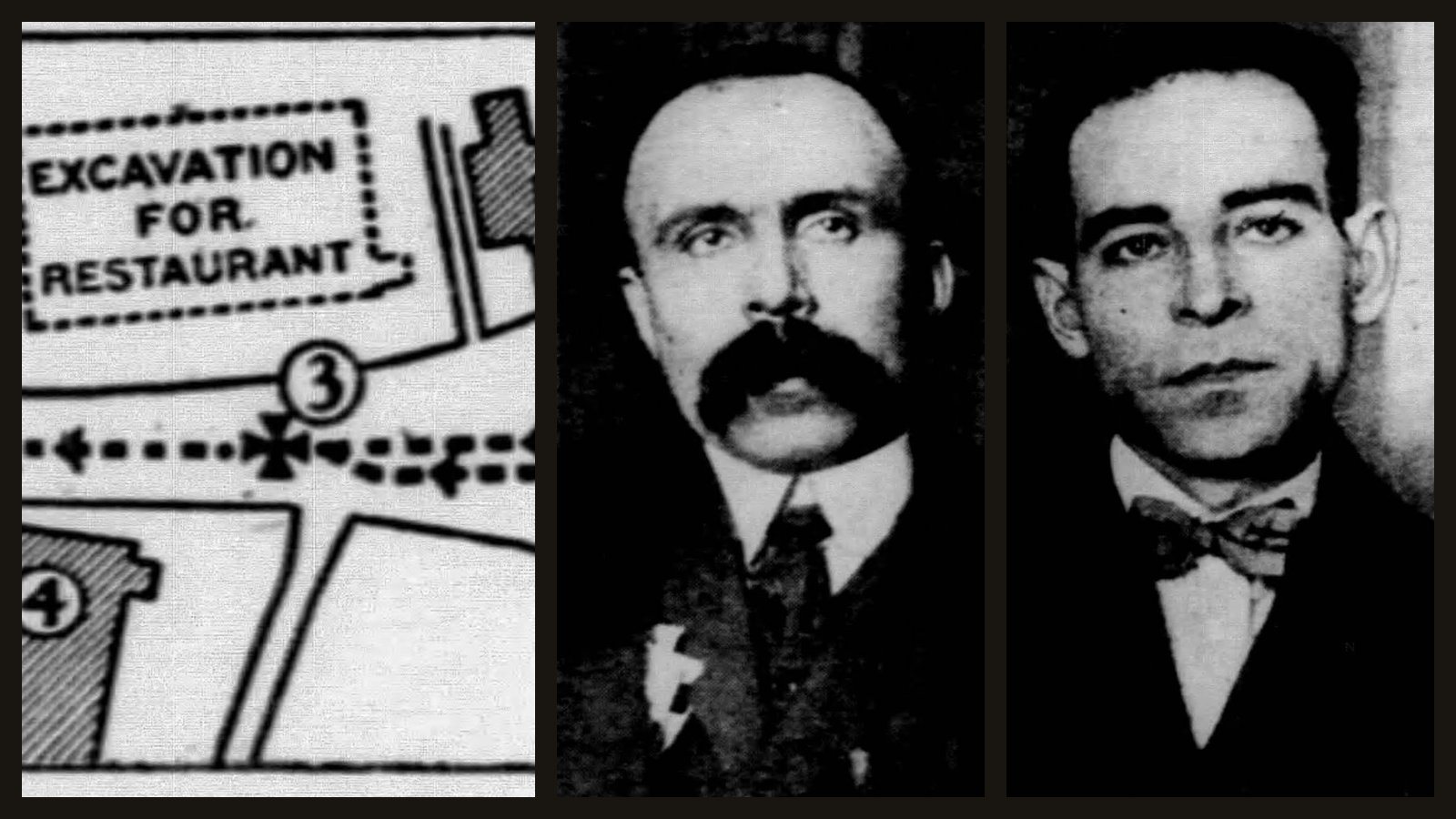
Pearl Street
Every payday the money came in on the train. On Thursday, April 15, 1920, it reached the station at South Braintree, Massachusetts, at about half past nine in the morning, and an express agent carried it down the street to the offices of the Slater & Morrill shoe company, where it was packed into two boxes.
In the afternoon it went out again, on foot. The paymaster, Frederick Parmenter, and Alessandro Berardelli each carried one box, bound for another company building down Pearl Street. It was about three o'clock. They had gone only a few feet when someone opened fire.
Thirty-three years later, a New York Sunday paper told what happened next in two sentences.
That was nearly all the paper had to say about the two men who were killed. It called Parmenter "Fred" and Berardelli "Alex" and "his guard," and it put the company down as "Slater & Merrill." It printed the payroll as $15,773.59. The Supreme Judicial Court of Massachusetts, in its own opinion on the case, gives $15,776.51.
The paper also had the wrong idea about who Berardelli was. His autopsy report, written the next day, gives his occupation as "Special Officer, Braintree Police." He was on duty with the paymaster that afternoon, in the service of the company, and he was wearing the badge.
Four wounds
The 1953 paper has Berardelli falling to the first bullet. The autopsy report on him runs to thirteen pages, and it counts four.
One went in at the back of his left upper arm and crossed his chest. One went into his back on the left and stopped in the muscle of his chest. A third went into his back lower down, through the bone of his pelvis. The fourth went in at his right shoulder, through a rib and his right lung, through his aorta, his intestine and his left kidney, and stopped in the muscle at the top of his left leg.
The report's history of him is short. He was 44, married, and lived in Quincy.
The examiner listed what was on him. A cheap gilt watch. Four dollars and fifty cents in a leather purse, and a wire tenpenny nail. A pair of police twisters. A white leather cigar case with "Alex Berardelli" written on it in script. And a pay envelope marked "Berardelli 37 50," still sealed. His week's pay had not been opened.
Fifteen hours
Parmenter's report is eight pages long, and it says he was shot twice, not once.
The first bullet went in at the front of his chest on the left and out again at the front, nearly level. The probe through it, the doctor wrote, "lies at an angle of about 5 degrees above the horizontal plane." That wound did not kill him.
The second went in at his back, on the right, above the hip. It travelled forward and inward, opened the vena cava inferior, the great vein that carries blood back to the heart from the lower body, and stopped under the skin of his belly on the left. So the paper's four words turn out to be the forensic finding. He was shot from behind. He was hit running.
He did not die on the street. He reached Quincy Hospital at about four o'clock, conscious and in shock, and at five a surgeon, Dr. Nathaniel S. Hunting, began an operation that lasted until a quarter to seven. They found the bullet and took it out.
Twelve hours after he reached the hospital was fifteen hours after he was shot. He was 45. He left his wife, Hattie, a son, Richard, born in 1909, and a daughter, Jeannette, born in 1913. Hattie died in 1925, two years before the case ended.
"The murder car!"
A Buick, stolen, was found abandoned two days later in the woods near West Bridgewater. The 1953 paper says the police found a 12-gauge shotgun shell in it. That detail is disputed: the case file notes that the court record and several detailed accounts list what was in the car without any shell.
The paper stopped there to remind its readers what 1920 had been like: the Red Scare, raids, foreigners "seized and deported by the boatload." The police decided the South Braintree gang was the same one that had tried to rob a payroll truck at Bridgewater the Christmas Eve before.
The trolley
They had their eye on a car. It was an Overland belonging to a man the paper calls Mike Boda, of West Bridgewater, and it was in a garage being repaired. The police told the garage man, Simon Johnson, to call them if anyone came for it.
On the night of May 5, four men came. Boda arrived on a friend's motorcycle; two more came by trolley. Johnson stalled them, saying the car had no 1920 plates, and Mrs. Johnson slipped out to telephone the police. Boda rode off. The other two caught a trolley for Brockton, and a police officer and a second man boarded it and arrested them, in the paper's words, "on some pretext or other."
They were Nicola Sacco and Bartolomeo Vanzetti. Sacco had a .32 Colt pistol and 23 cartridges. Vanzetti had a .38 Harrington & Richardson revolver and a number of 12-gauge shotgun shells. Sacco was 28 on the day of the shooting and Vanzetti 31; the paper gave their ages for the year, 29 and 32.
Both men were anarchists. Sacco had gone to Mexico in 1917 to avoid the draft, and Vanzetti had left Massachusetts for the same reason. The paper said neither had ever, "so far as anybody knew," been involved in a crime of violence. Their explanation for that night was that their radical society expected more Government raids and they wanted Boda's car to collect and hide its literature. Vanzetti told the police he had been peddling fish in Plymouth on April 15. Sacco said he had spent the day at the Italian consulate in Boston about a passport. The paper also said Vanzetti lied when he denied knowing Boda; that was the 1953 writer's own judgment.
Two trials
Vanzetti was tried first, alone, at Plymouth before Judge Webster Thayer, for the Bridgewater attempt. He was convicted on July 1, 1920, and sentenced to twelve to fifteen years. On September 11, 1920, both men were indicted for the South Braintree murders.
The murder trial opened at Dedham on May 31, 1921, with Thayer presiding again. Seven witnesses identified Sacco and four identified Vanzetti. Some of them, the paper said, had improved their memories since their first statements. A bookkeeper who had looked out of a factory window for an instant had said at the preliminary hearing, "I will not swear positively that he is the man but if he is, he was firing a gun." At the trial she was positive. The arresting officer, Connolly, now swore Vanzetti had reached into his pocket as if to draw a gun. Vanzetti shouted "Liar!" across the courtroom. The paper set its own verdict on the identifications apart, in italics:
A cap, a spring and four bullets
Berardelli's widow, whose first name the paper never gives, testified for the prosecution. She said her husband's revolver had a repaired broken spring, and that the gun taken from Vanzetti looked like the one he carried, "thus intimating that Vanzetti picked it up along with the money box." The paper's next sentence: "No one examined the spring in court to say it had, or had not, been repaired."
A cap found near Berardelli's body was shown to the superintendent of the factory where Sacco worked, who said Sacco wore one similar in color.
Then the bullets. Captain William H. Proctor testified that "a bullet" from Berardelli's body was "consistent" with test shots from Sacco's .32. Charles Van Amburgh was "inclined to believe" it. The defence experts said the bullets came from neither man's gun. Proctor's bullets came out of Berardelli's autopsy, and page two of that report records how they got to him:
The paper says one bullet. The record says four. And District Attorney Frederick G. Katzmann, who prosecuted the case, appears nowhere in the 1953 telling, though he had telephoned the night of the shooting to order this autopsy, "with the provision that the body should remain dressed."
Guilty
On July 14, 1921, both men were found guilty. Sacco held up two fingers and cried out, first in Italian and then in English, "I am innocent!" His wife, Rosina, rushed to him.
Thayer withheld sentence while the defence fought on. Years went by. The Supreme Judicial Court affirmed the convictions in May 1926. In November 1925 a Portuguese prisoner already under sentence of death, Celestino Madeiros, said he had been one of the South Braintree gang; Thayer said he had "confessed" only to prolong his own life, and refused a new trial. Felix Frankfurter, not yet a Supreme Court justice, wrote in the Atlantic Monthly that Thayer's opinion could not "be accurately described otherwise than as a farrago of misquotations, misrepresentations, suppressions, and mutilations." The paper's next line was "This didn't disturb the judge." On April 9, 1927, he sentenced both men to die.
Governor Alvan T. Fuller appointed a three-man committee. It reported that the trial had been fair.
Midnight
The governor's last respite ran "to and including Monday, August 22," 1927, so nothing could be done until it ran out at midnight. In the first minutes of Tuesday, August 23, three men were put to death at Charlestown: Madeiros at 12.09 a.m., Sacco at 12.19, Vanzetti at 12.26. The 1953 paper gives the date as August 22 and mentions only two.
Sacco cried out in Italian, "Long live anarchy!" Vanzetti spoke to the warden.
Where they went
The argument has never stopped. Francis Russell's book Tragedy in Dedham records that the seven surviving jurors, interviewed in 1950, had not changed their minds. In 1977 Governor Michael Dukakis signed a proclamation saying the trial had been marked by prejudice against foreigners and hostility to unorthodox political views, and that any stigma should be removed from the two men's names. It did not say they were innocent. Nobody has settled who fired on Pearl Street.
Sacco's ashes lie at the base of a monument put up in 1998 in his home town of Torremaggiore. Vanzetti's are buried with his mother at Villafalletto. Mike Boda, whose real name was Mario Buda, was never charged with anything and died at home in Italy in 1963.
Frederick Parmenter is buried at Melrose Cemetery in Brockton. His daughter Jeannette lived until 2005. Alessandro Berardelli is buried at Brass City Lodge Cemetery in Waterbury, Connecticut, under a stone that reads "Alexander Berardell."
In July 1953, a month after Julius and Ethel Rosenberg were executed, the Sunday News opened its retelling with "WHO were Sacco and Vanzetti? What did they do?" and closed it with a line about somebody else entirely: "It is too early to say how soon the Rosenbergs will be forgotten." It never asked who Parmenter and Berardelli were.
Parmenter's death date. The autopsy says 6 a.m. on April 16, 1920; his Find a Grave memorial says April 15. The death certificate has not been pulled.
Berardelli's age and birthplace. The autopsy says 44. A memorial gives a birth date that would make him 43 and a birthplace of Casacalenda, in Molise. Neither has been checked against his World War I draft card or death certificate.
The shotgun shell. The 1953 paper puts a 12-gauge shell in the abandoned Buick. The case file reports that the court record and other detailed accounts of the car do not mention one.
"Shelley Neal," the express agent who saw the Buick that morning and identified it at the trial, cannot be found in any record under that name.