An independent true crime research archive Case File No. OK-1938-011  ·  Filed Aug 17, 2026
The Case File

SECTION 29

Forgotten True Crime · Episode 11 · Streaming now

Like Father, Like Son

A woman burned to death in an outbuilding behind her own house, behind a door that latched from the outside, and a coroner's jury called it an accident twenty minutes after her funeral began across town. Nobody looked again for three hundred and fifty-six days. What finally reopened it was not a detective — it was the neighbours talking about how many other people in that family had died.

Durant, Bryan County, Oklahoma1880 → 198713 clippings4 court opinions~16 min read
Like Father, Like Son
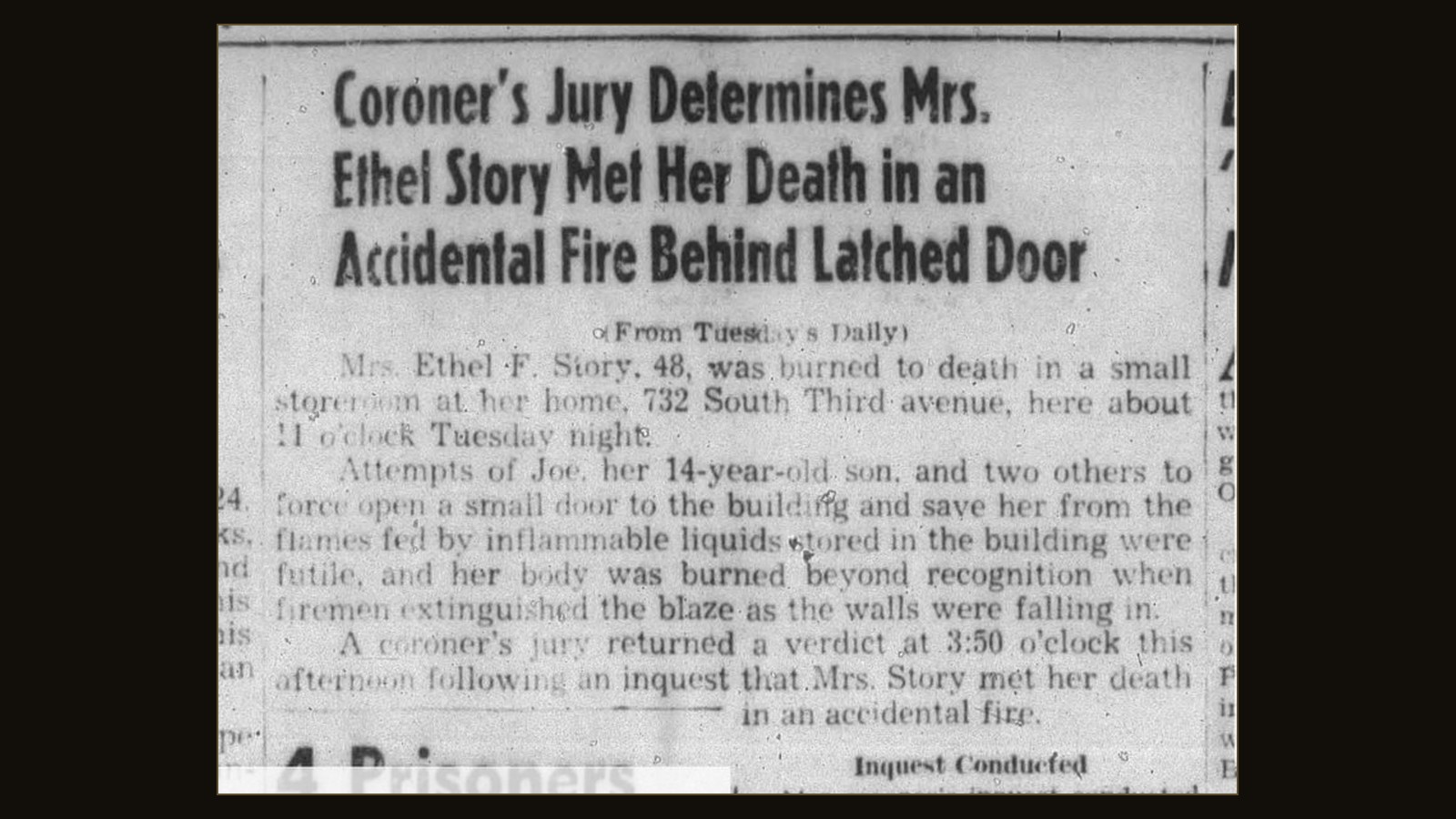
"Coroner's Jury Determines Mrs. Ethel Story Met Her Death in an Accidental Fire Behind Latched Door" — the Southeastern Oklahoma Citizen and Bryan County Democrat, August 25, 1938. There is no photograph of Ethel Story. The one photograph in this case is family-held and is not published here.
Hear the episode

Like Father, Like Son

Episode 11 of Forgotten True Crime — the case as Durant met it, and then as the record shows it. Everything below is the file the episode was built from.

Content warning

This case involves a woman burned to death and the deaths of three children. The Indiana material from 1883 to 1891 involves rape at gunpoint and a young woman killed by a forced abortion. It is documented, it is central to why the episode carries the title it carries, and it is set down here plainly and without relish.

The storeroom

About ten o'clock on the night of Tuesday, August 23, 1938, a fourteen-year-old boy named Joe Story fell asleep at 732 South Third Avenue in Durant, Oklahoma. His mother had not gone to bed yet. His father had gone into town for headache medicine, and his oldest brother Bill was downtown too.

An hour later he was woken by someone crying out. What he heard, he told an inquest the following afternoon, was Help, let me out!

Behind the house, about forty feet back, stood a small building — roughly eight feet by five, seven feet high — where the family stored things, including the oil and the materials his father used to mix the fly poison he sold door to door. The door latched from the outside.

The boy ran to it and forgot that. He pulled at the door and it would not come. He threw a bucket of water on the house. Then he remembered the latch, lifted it, got the door open — and watched it swing shut again and lodge.

A neighbour, Bud Simmons, woken by his wife, took an axe to the door and chopped at it until he dropped the axe with an injured foot. John Story came up while that was still going on, and — according to the testimony — asked: Do you know if she is really in there? Then he took an axe handle and set to prying. Another man coming home from the skating rink, known in the papers only as Shorty Sparger, picked up the axe and forced the door. By then the heat coming out of that doorway was more than anyone could walk into.

She was in there. The two men who got closest did not agree about how she lay: the one who forced the door said face down with her head toward it, the one who had been chopping said several feet further back. They disagreed on the record and it was never resolved. What both of them saw was a badly burned lantern with a two-inch hole in its glass chimney. The firemen put the fire out as the walls came in. The body was burned beyond recognition.

What that building was called

The contemporaneous Durant paper calls it a storeroom. Every 1939 wire story calls it a smokehouse. The charging information calls it an outhouse, meaning an outbuilding. All three are in the record and this archive does not pick one. What is not in dispute is the latch, and which side of the door it was on.

An alibi nobody reconciled

Joe testified that his father had gone into town for headache medicine around ten o'clock, and that his brother Bill was downtown as well. The 1941 appellate opinion records that the defendant was seen in close proximity and at the home just prior to the burning. Both statements are in the record. They do not fit. The file's entry on it ends: not reconciled.

A verdict, twenty minutes late

Her funeral was held at half past three the next afternoon, August 24, at Highland Cemetery in Durant. Rev. Jeff Shelton officiated. Holmes Funeral Home directed it.

At ten minutes to four — twenty minutes after the service began across town — a coroner's jury sitting at that same funeral home returned its verdict. Mrs. Ethel Story had met her death in an accidental fire.

She was already in the ground.

"Coroner's Jury Determines Mrs. Ethel Story Met Her Death in an Accidental Fire Behind Latched Door" — the Southeastern Oklahoma Citizen and Bryan County Democrat, August 25, 1938.

The inquest was not somebody's idle formality. It had been asked for, the paper says, by officers — because of some details of "mystery" concerning it. There were two questions they wanted answered: how she came to be inside that building, and how the fire started.

Peace Justice H. D. Sparger conducted it alongside County Attorney Ben Carter. Four eyewitnesses testified, the fourteen-year-old among them. The inquest report notes that the flames were fed by inflammable liquids stored in the building.

The boy gave them the only answer anyone ever offered to the first one. He thought his mother might have gone out to that building to drink some wine kept there in a thermos jug, and that she had carried the lighted lantern with her. That supposition, and the burned lantern, is the entire physical basis of the accident theory.

It was also all there was. Neither question was ever settled — not that day, and not for a year.

The inquest column in full. Four eyewitnesses, an outside latch, and a verdict of accidental fire.

The woman

Ethel Flossie Clements was born in November 1887 at Dahlonega, in Lumpkin County, Georgia — a gold-rush town up in the north Georgia mountains — to Joseph Benjamin Clements and Sabra Jane Beasley Clements. She was one of seven children, four of them still living in 1938. Her Georgia birth and her parents' are confirmed by the 1930 census.

She married John Oliver Story in 1920 and bore five sons between 1923 and 1930, across Texas, Arkansas and Oklahoma. In April 1930 the family owned a house on F Street in Ardmore worth eighteen hundred dollars, with all five boys alive in it. They moved to Durant in 1936. Four of the five were living on the night she died; Frank had drowned in Texas the year before, at ten.

The local paper puts her age at forty-eight. A November 1887 birth makes her fifty. This file carries both.

There is no photograph of her, and her burial plot has never been located — and there is a reason nobody has looked for it. Her Find a Grave memorial gives her burial as Cremated / Body destroyed in a fire. The contemporaneous paper contradicts that: it reported a funeral and an interment at Highland Cemetery. Because the memorial says she has no grave, no one has ever gone looking for the stone. Highland holds ten Story memorials and not one of them is hers — they belong to a different and prominent Durant family with the same surname.

The whole of the biography on her memorial was written by a descendant of the man who killed her. It reads: She was murdered by her husband in Aug., 1938, in Durant, Oklahoma. He burned her alive.

No autopsy appears anywhere in this case.

Eleven weeks

On or about November 12, 1938 — the date itself is approximate — a marriage licence was issued to John O Story 58 and Mrs Emma Mildred Chapman 58, both of Durant. Both stated ages were a year high.

It was issued at Madill, in Marshall County — the next county over, not their own. Why they crossed a county line to do it is nowhere stated in the record, and this archive will not narrate a reason it does not have.

Eighty-one days had passed since the fire — eleven weeks and four days.

The Madill Record printed it inside a cheerful item about the courthouse's improving wedding business, November 17, 1938.

Later that year he moved the surviving boys across the state line to De Queen, in Sevier County, Arkansas.

Three hundred and fifty-six days

On June 7, 1939, Joseph Cecil Story — fourteen years old, the son who had testified at his mother's inquest — died of a gunshot at De Queen. It was reported as a hunting accident. The county attorney would later say publicly that more than a thousand dollars in insurance was collected on him.

That is the sequence, and the sequence is all it is: no charge was ever brought over Joe's death, and no court ever tested it.

Ten weeks after that, the thing that had not happened for a year happened. The Associated Press put it about as plainly as it can be put: Story was arrested at De Queen, Arkansas after neighborhood gossip called the attention of authorities to other tragic deaths in his family.

Not a detective. Not the coroner. Not a witness who came forward. The neighbours started counting.

The arrest was August 14, 1939 — three hundred and fifty-six days after the fire.

The airtight case

A week later County Attorney Bill Steger gave the Associated Press his figures.

Story had collected $2,460 on Ethel's own death — the wire called her his third wife — and more than $1,000 on each of his sons who had died. In today's money that is roughly fifty-five to fifty-eight thousand dollars, and about twenty-three thousand apiece.

Steger said he had an airtight case. The wire story adds — in the Associated Press writer's words, not the county attorney's — that after protracted grilling the sullen soap peddler held to his statement that his wife's death was just an accident.

"Peddler Faces Airtight Case," the Bristow Daily Record, August 21, 1939 — the insurance figures, printed across the state two months before the trial.

On August 22 he pleaded not guilty, bearded and held without bond, before Justice Sparger — the same justice who had run the inquest a year earlier — to a charge of murdering his wife by locking her in a smokehouse and setting it on fire.

That was the State's public wording. The charging information quoted in the appellate opinion says something materially different: placing her in a certain outhouse. Locking and placing are two different crimes in a reader's ear, and both are in the record.

The justice who ran the inquest and the man who forced the door with an axe shared a surname. They were in all likelihood kin — in a town of eight thousand with a family that size that is arithmetic, not corruption, and it does not make the verdict crooked. Which Sparger carried that axe has never been established, and this archive does not name him.

What was never charged

Three of his sons died young: Charles Oliver Story, killed by a train; Frank Dewey Story, ten years old, drowned at Gainesville, Texas in March 1937; and Joseph Cecil Story, fourteen, shot at De Queen in June 1939. The county attorney told the Associated Press that insurance was collected on each of them.

Charley's death will not sit still. The family dates it 1913; the county attorney said in 1939 that it was twenty years earlier; the two accounts may not even be describing the same son. And he died in his mother's household in West Virginia, hundreds of miles from a father who had remarried twice by then. That cuts both ways and this file lets it.

No charge was ever brought over any of the three, and no court ever tested any of it. The family's own account says he murdered them. Both of those facts belong in that order, every time.

Indiana, 1883

There is a reason the episode is called what it is called, and it starts fifty-five years earlier.

On June 16, 1883, on the Newcastle & Rushville railroad track about half a mile north of Rushville, Indiana, a day labourer named James M. Story shot a man named Joe Bever dead in a quarrel over a woman. John Oliver Story was two years old.

Whose pistol it was is contested and stays that way here: the local account says Story told the woman to take his own pistol out of his own hip pocket and then snatched it back from her; the Indianapolis wire says the gun belonged to Bever.

He fled under a two-hundred-dollar reward and was caught the next evening. In October he was convicted at Rushville and given sixteen years. On December 1 he was tried again at New Castle, in Henry County, apparently on a change of venue, and convicted of voluntary manslaughter — ten years. Both verdicts are on the record; ten years appears to be what he served.

"Murder at Rushville" — The Weekly Journal, June 22, 1883.

In June 1890 his wife Lilly obtained a divorce at Rushville on the ground of his conviction for killing Joe Bever. Their son was nine.

He came out in early 1891. In April of that year he was back in the Rushville jail on a charge of criminal assault and procuring an abortion. Her name was Flora Carmichael. She had been raped twice at gunpoint and she was dying of the forced abortion. In June he was given fourteen years and a two-hundred-dollar fine — the same figure as the reward for catching him eight years before. His son was ten.

Two things this archive will not claim

That the 1883 shooter is beyond doubt the same man. The father-and-son relationship is established. The identification of James M. Story as the man on that railroad track fits the record at every point it can be checked, but it is not nailed shut, and it is set down here as a strong fit rather than a certainty.

That any of this explains the son. It is the obvious thing to reach for and there is nothing in the record to support it. Nobody documented what John Story thought of his father, or whether he loved him. The only place that thread lands with any evidence behind it is one generation further on — and in his son's handwriting, not his own.

The boy who swore he was twenty-one

On October 28, 1898, in Jackson County, West Virginia, Clerk Geo. B. Crow wrote down what the couple in front of him said. John Oliver Story swore he was twenty-one years old, born in Rush County, Indiana, and living there.

He was seventeen. Twenty-one was the age of majority, and a seventeen-year-old needed a parent's consent — and his father was in prison.

He married Etta Louella Lockhart, nineteen, the next day — October 29 by the register, though his own sworn complaint two years later gave the date as November 2, and this file keeps both. Their son Charles was born in West Virginia about a year later. By June 1900 they had separated.

That summer the census taker found him back in Indiana — "Oliver," nineteen, a day labourer, married two years, living in his grandparents' rented house on Shiell Street in Rushville, with neither his wife nor his infant son. That his elderly grandparents were the ones raising him is documented for 1900 and a reasonable inference for the years before it. His father was in the penitentiary. His mother had divorced and remarried.

In August he filed for divorce in Rush Circuit Court, cause No. 8243, and asked for custody of his nine-month-old son. Etta was out of state, so the suit was set to be heard and determined in her absence.

The notice to a non-resident defendant: Story v. Story, No. 8243, Rushville, August 1900.

Whether the divorce was ever granted is unknown — which leaves the question of what his later marriages legally were open rather than answered. The number of times he married is not settled either. The 1939 press said four. The family account says at least six. Five are named in this file, and no count is asserted.

The trial

He was tried in the District Court of Bryan County in October 1939, before Judge Roy Paul.

The defence moved for a change of venue on three affidavits from Durant citizens swearing to local prejudice. The county attorney answered with thirty saying there was none. Judge Paul denied the motion — and then drew the jury from a part of the county outside the city of Durant. The insurance figures had been in papers across the state since August.

Story testified in his own defence. He denied from the witness stand any knowledge of how his wife had got into the burning building, and said he had come home to find it ablaze and had tried to break in a door to save her.

Then a Frisco Railroad special detective, who was also a Bryan County deputy, testified that Story had admitted he was responsible for her death — and, asked whether anyone else was involved, had said there was not.

The jury visited the scene of the death, retired at four o'clock on the afternoon of October 12, and came back the next day, Friday, October 13. Guilty of murder. Punishment fixed at life imprisonment. He showed no reaction as it was read.

"Verdict Reached in Durant Case" — the El Reno Daily Tribune, October 13, 1939.

Judge Paul had instructed the jury that its choice, on conviction, was death or life imprisonment. Bill Steger — who had told the wire service two months earlier that his case was airtight — did not ask for death. Nothing in the record says why, and this file treats that as an open question rather than a solved one.

Judgment and sentence were entered on October 18, five days after the verdict. That is the date in all four appellate opinions, and the gap between the two is a correction the newspaper record forced on this file.

The rule that saved it from vanishing

The appeal was filed in April 1940 and decided on December 17, 1941. Affirmed.

The opinion records that Story was seen in close proximity and at the home just before the burning, was present while it burned, and made statements in the presence of others and to members of his family at the time of the fire — and that the evidence tended to show a motive for the crime. It never names the motive. None of the four opinions in this case ever names it.

What the court did say, and the reason any of this is still readable eighty-five years later, is this: an extrajudicial confession is not enough to convict a man without additional proof that the crime charged was actually committed. The corpus delicti here had been established independently, by circumstantial evidence, which is what made his statements admissible. They could not have convicted him on the confession alone — and they did not have to.

Lawyers kept citing that rule. That citation is the only reason this case was not lost completely. There is no book about it, no blog post, no podcast, and no indexed writing of any kind.

He went back three more times, in 1942, 1945 and 1947, and each time he filed alone, without a lawyer. Presiding Judge Barefoot wrote all four opinions. On the last one the court sent his papers over to the Pardon and Parole Board with an observation:

only the Pardon and Parole Board can give any relief to petitioner. Ex parte Story, 83 Okla. Crim. 426 (March 5, 1947)

What became of them

Emma, who took out a licence with him eleven weeks after Ethel burned, followed him to the prison town and died at McAlester in June 1943.

Tommy and Roy, twelve and ten, were sent nine hundred miles to Akron, Ohio, to their mother's sister Callie Reid — entered on the 1940 census as nephews in the household of her husband, William L. Reid, a rubber worker. Tommy was twelve and in the third grade.

Bill, seventeen, was in McAlester itself in 1940, at 729 South C Street, living with his stepmother in the town where his father was serving life. He had finished the sixth grade and was not in school. Emma is entered as head of household and gives her marital status as single; the next line down calls Bill her stepson.

In June 1942 Bill registered for the draft at Newcastle, Wyoming. He was working at the Castle Cafe and had no telephone. On the line asking for the person who would always know his address, he named his father — in the Oklahoma State Penitentiary at McAlester.

Mr. JOHN OLIVER STORY (Father) — 729 So. C St., McAlester, Oklahoma. Bill Story's draft registration, June 30, 1942, on the line asking for the person who would always know his address. His father was in the state penitentiary at McAlester, serving life for the murder of Bill's mother.

On the night of May 23, 1952 he was found on a retaining wall on Kersey Coates Drive in Kansas City, about thirty feet below the dead end of Thirteenth Street, on the bluff above the rail yards. He had no identification but a social security card. The police said he had apparently fallen.

He woke between the morning and evening editions and told them his name. The Kansas City Star, May 24, 1952.

He gave his address, said he had fallen, and was reported in fair condition with a broken back. He died on May 25, aged twenty-nine, of a fractured spine and head injuries.

How Bill died is not settled, and is not stated here

The police said he apparently fell. Bill himself said he fell. The box on the death certificate marked Accident / Suicide / Homicide carries an ambiguous mark and settles nothing. A family memorial written decades later says he jumped. There was no autopsy. This archive records all of it and declares none of it.

His body went unclaimed for ten days and was released to a college of osteopathy. John Oliver Story died at McAlester on September 13, 1952, aged seventy-one, thirteen years into his sentence — three months and nineteen days after his eldest son. He is buried in the prison cemetery, plot #141.

Tommy died in Ohio in 1970, Roy in Michigan in 1984. Both were Army veterans, both are buried under government headstones, and neither ever married. Callie Reid, the aunt who took the two of them in, died in 1987 at about ninety-eight, having outlived both boys she raised.

What the file still won't say

Whether the divorce in 1900 was granted, and therefore what his later marriages legally were. How many times he married. Where in Indiana he was born. Why the licence was taken out in Marshall County instead of his own. Why a county attorney holding what he called an airtight case did not ask for the death penalty. What the mark on Bill's death certificate was meant to be. Which of the three sons' deaths, if any, was what the neighbours were actually talking about.

And the two questions the officers asked for an inquest to answer in August 1938 — how she came to be inside that building, and how the fire started. A jury heard four witnesses, took a fourteen-year-old's guess about a thermos jug of wine, and returned accident. The court that convicted her husband thirteen months later never named his motive, and the county attorney who read the insurance figures to a wire service never had to prove them.

Ethel Story is somewhere in Highland Cemetery, in a plot nobody has been able to find.

The People

Three generations, and the woman at the centre
No photograph
in the file
victim

Ethel Flossie Clements Story

his wife of eighteen years

She died in the storeroom behind her own house about eleven o'clock on the night of August 23, 1938. The contemporaneous local paper gives her age as 48; a November 1887 birth would make her 50, and the file records both. Born at Dahlonega, Georgia; married in 1920; five sons, four of them living on the night she died. She was buried at Highland Cemetery the following afternoon and the plot has never been located.

No photograph
in the file
accused

John Oliver Story

door-to-door peddler of soap and fly spray

Born December 22, 1880 in Indiana — where in Indiana is contested, and he himself once told a census taker Kentucky. Convicted of murdering his wife in October 1939 and sentenced to life. He went to the Court of Criminal Appeals four times, the last three alone and without a lawyer, and lost every time. He died at McAlester in 1952, thirteen years in.

No photograph
in the file
the father

James M. Story

Indiana, 1883

An illiterate day labourer who shot a man dead on a railroad track north of Rushville, Indiana in June 1883, in a quarrel over a woman. He was convicted twice — sixteen years at Rushville, then voluntary manslaughter and ten years on retrial at New Castle. His son was two years old.

No photograph
in the file
first wife

Etta Louella Lockhart

married 1898, separated 1900

Nineteen years old and marrying a seventeen-year-old who had sworn he was twenty-one. They separated within two years; he sued for divorce in Rush County and asked for custody of their nine-month-old son. She remarried about 1906 and raised the children under her parents' roof at Ravenswood, West Virginia.

No photograph
in the file
witness

Joseph Cecil Story

her son, fourteen years old

He was asleep when the fire started, and it was his testimony at the inquest that put the outside latch into the record — he forgot it, could not pull the door open, threw a bucket of water on the house, remembered it, and got the door open. Nine and a half months later he was dead of a gunshot at De Queen, Arkansas, reported as a hunting accident.

No photograph
in the file
son

William Eugene Story

“Bill” — 1923–1952

Sixteen when his father was sentenced, and living in the prison town with his stepmother, sixth grade completed, not in school. In 1942 he registered for the draft in Wyoming and named his imprisoned father as the person who would always know his address. He died in Kansas City in 1952 at twenty-nine, three months and nineteen days before his father.

The Record

Documented, in order

Every line below rests on a court opinion, a census sheet, a vital record or a dated newspaper page held in this file. The act headings are the file's own. Where two records disagree, both are recorded and neither is resolved.

ACT I — INDIANA: THE FATHER (1880–1898)
June 1, 1880
The census finds James M. Story, 32, an illiterate day labourer marked unemployed, and his wife Lilly, 16, born in Kentucky, at Fugit Township, Decatur County, Indiana, married during the census year with no children yet. His brother Lewis C., 28, also illiterate, boards with them.
December 22, 1880
John Oliver Story is born in Indiana. The date is fixed by two federal records read together and is treated as settled; where in Indiana is not, and Kentucky, his mother's true birth state, is what he himself told the census in 1930.
June 16, 1883
His father shoots Joe Bever dead on the Newcastle & Rushville railroad track half a mile north of Rushville, in a quarrel over a woman named Minnie Helm. John is two. Whose pistol it was is contested and is not resolved: the local account off the Rushville Graphic's extra says Story told the woman to take his own pistol from his own hip pocket and snatched it from her; the Indianapolis wire says the gun was Bever's.
June 17, 1883
His father, who had fled under a $200 reward, is caught that evening — by Detective Carr and his son Grant Carr, per the Indianapolis Journal.
October 1883
Convicted at Rushville of shooting Bever; sixteen years at Jeffersonville.
December 1, 1883
Retried at New Castle, Henry County, apparently on a change of venue: voluntary manslaughter, ten years. Both verdicts are on the record and the file does not resolve which was set aside; ten years appears to be what he served.
June 6, 1890
Lilly Story obtains a divorce at Rushville on the ground of his conviction for killing Joe Bever. John is nine.
Early 1891
His father is released, having "just completed" the ten-year term. John is ten.
April 19, 1891
His father is jailed at Rushville on a double charge of criminal assault and procuring an abortion. Flora Carmichael, raped twice at gunpoint and then killed by a forced abortion, is dying. John is ten. This material requires a content warning.
June 1891
Fourteen years and a $200 fine — the same figure as the reward for catching him eight years earlier.
ACT II — WEST VIRGINIA AND THE FIRST FAMILY (1898–1919)
October 28, 1898
Clerk Geo. B. Crow of Jackson County, West Virginia certifies the licence, recording the couple's own answers. John Oliver Story swears he is 21, born in Rush County, Indiana, and living there. He is 17, and twenty-one was the age of majority — a seventeen-year-old needed a parent's consent, and his father was in prison.
October 29, 1898
He marries Etta Luetta Lockhart, 19, at Jackson County, married by Rev. J. M. Rardon. Contested: his own 1900 sworn complaint gives the marriage date as November 2, 1898, and the register is preferred without discarding his version.
About November 1899
Charles Oliver Story is born in West Virginia.
June 1900
They separate — "separated last June," per his own complaint.
June 18, 1900
The census finds "Oliver," 19, a day labourer, married two years, in his grandparents' rented house at 2 Shiell Street, Rushville, with neither his wife nor his infant son. That his elderly grandparents raised him is documented for 1900 and an inference for the years before it. His father is in the state penitentiary and his mother has divorced and remarried.
August 9–10, 1900
He files for divorce in Rush Circuit Court, cause No. 8243, through attorney John F. Joyce, and asks for custody of his nine-month-old son. Etta is a non-resident, and the suit is set for October 2, 1900 to be "heard and determined in her absence." Whether it was granted is unknown, which leaves the bigamy question open rather than answered.
1904 and 1907
Family account only, unverified — marriages to Grace Jackson Frantz and Maude Esther Biederman.
About 1903–1904
Minnie E. Story is born to Etta. Her paternity is open: the couple separated in June 1900, so she is unlikely to be John's unless they reconciled.
About 1906
Etta remarries — John E. Mullerhand.
April 28, 1910
Etta, 30, is home at Ravenswood, Jackson County under her parents' roof with her new husband and both Story children: Charles A., 10, in school, and Minnie E., 6. Both children are recorded with a father born in Ohio, almost certainly a clerical carry-over from Mullerhand.
1913, or about 1919
Charles Oliver Story is killed by a train. The family dates it 1913; the county attorney said in 1939 it was twenty years earlier. Insurance is said to have been collected. Not resolved, and they may even be two different sons.
ACT III — OKLAHOMA (1920–1937)
1920
He marries Ethel Flossie Clements. Contested against the 1930 census, on which he gave his age at first marriage as 42, implying about 1921 and erasing three earlier wives and eight children — if the family record is right.
February 11, 1923
William Eugene "Bill" Story born, Texarkana, Texas.
July 7, 1924
Joseph Cecil "Joe" Story born, Amarillo, Texas.
March 14, 1926
Frank Dewey Story born, Arkansas — corrected from Texas by the 1930 census.
February 11, 1928
Thomas Jefferson "Tommy" Story born, De Queen, Arkansas.
February 3, 1930
Roy L Story born, Ardmore, Oklahoma. The 1940 census says Texas; trust 1930.
April 1930
The census finds the family at 701 F Street S.E., Ardmore — home owned, worth $1,800, no radio, five sons alive, occupation "Salesman, toilet articles." He gives his own and both parents' birthplace as Kentucky and his age at first marriage as 42. Two doors up at 707 lives H. L. Moyers, 25, an insurance agent — a coincidence until proven otherwise, and it must never be said that Moyers sold him the policies.
1936
The family moves to Durant from Ardmore, per the 1938 inquest coverage.
March 8, 1937
Frank Dewey Story, 10, drowns at Gainesville, Cooke County, Texas. More than $1,000 in insurance collected, per the county attorney in 1939.
ACT IV — THE FIRE AND THE INQUEST (August 23–25, 1938)
August 23, 1938, about 10 p.m.
Joe, 14, falls asleep. His mother has not gone to bed. Per Joe's testimony his father has gone to town for headache medicine and his oldest brother Bill is downtown too — which sits in tension with the 1941 opinion's finding that the defendant was "seen in close proximity and at the home just prior to the burning."
August 23, 1938, about 11 p.m.
Ethel Story burns to death in the storeroom behind the house at 732 South Third Avenue, Durant. Joe is woken by cries and hears "Help, let me out!" He forgets the outside latch, cannot pull the door open, throws a bucket of water on the house, remembers the latch, gets the door open, and it closes again and lodges. Bud Simmons, woken by his wife, chops at the door with an axe until he injures his foot; Shorty Sparger, coming home from the skating rink, takes up the axe and forces the door. John Story arrives, asks "Do you know if she is really in there?" and seizes an axe handle to pry at the door. The heat is too intense to reach the body, which lies face down with the head toward the door, a badly burned lantern at her feet with a two-inch hole in the glass chimney. Firemen put the fire out as the walls fall in; the body is burned beyond recognition.
August 24, 1938, 3
30 p.m.: Her funeral is held at Highland Cemetery, Durant, Rev. Jeff Shelton officiating, Holmes Funeral Home directing.
August 24, 1938, 3
50 p.m.: The coroner's jury, sitting after an inquest conducted by Peace Justice H. D. Sparger and County Attorney Ben Carter at Holmes funeral home, returns a verdict that Mrs. Story met her death in an accidental fire. She was in the ground before the verdict was read. The record states that the investigation had been asked for by officers "because of some details of 'mystery' concerning it."
August 25, 1938
The Southeastern Oklahoma Citizen and Bryan County Democrat prints the inquest account under the headline "Coroner's Jury Determines Mrs. Ethel Story Met Her Death in an Accidental Fire Behind Latched Door."
ACT V — ELEVEN WEEKS, AND THEN A YEAR (November 1938 – August 1939)
About November 12, 1938
A marriage licence is issued at Madill, Marshall County — the next county over — to "John O Story 58 and Mrs Emma Mildred Chapman 58, both of Durant." Eleven weeks and two days after the fire. Both stated ages are a year high.
November 17, 1938
The Madill Record prints it inside a cheerful item about the courthouse's improving wedding business.
Late 1938
He moves the surviving boys across the state line to De Queen, Sevier County, Arkansas.
June 7, 1939
Joseph Cecil Story, 14 — the son who testified at the inquest — dies of a gunshot at De Queen, reported as a hunting accident. More than $1,000 in insurance collected, per the county attorney. State the sequence; do not assert cause.
Summer 1939
Neighborhood gossip about the other deaths in the family reaches the authorities.
August 14, 1939
Story is arrested at De Queen, Arkansas — three hundred and fifty-six days after the fire.
August 21, 1939
County Attorney Bill Steger tells the Associated Press he has an "airtight case," gives the insurance figures, and reports that after protracted grilling the "sullen soap peddler" held to his statement that his wife's death was "just an accident."
August 22, 1939
He pleads not guilty before Justice Sparger — the same justice who ran the inquest — to a charge of murdering his wife "by locking her in a smokehouse and setting it on fire," and the bearded defendant is held without bond.
ACT VI — TRIAL, VERDICT AND APPEALS (October 1939 – March 1947)
October 1939
Trial in the District Court of Bryan County before Judge Roy Paul. The change-of-venue motion is denied on three defence affidavits against thirty for the State, but the jury is drawn from outside the city of Durant. Story testifies in his own defence.
October 12, 1939, 4
00 p.m.: The jury retires, after a visit to the scene of death.
October 13, 1939
VERDICT — guilty of murder, punishment fixed at life imprisonment. He shows no reaction as it is read. Judge Paul had put death on the table; County Attorney Steger did not ask for it.
October 18, 1939
Judgment and sentence entered — the date that appears in all four appellate opinions, five days after the verdict.
April 8, 1940
Appeal filed.
December 17, 1941
AFFIRMED. Story v. State, 1941 OK CR 185, 73 Okla. Crim. 273, 120 P.2d 387.
October 7, 1942, decided December 1942
Habeas corpus, filed alone, denied. 75 Okla. Cr. 367. The exact December date is recorded in the file as December 2 or December 12 and needs confirming.
July 6, 1944, decided February 14, 1945
Mandamus, filed alone, denied. 80 Okla. Cr. 11.
March 5, 1947
Habeas corpus, filed alone, denied. 83 Okla. Cr. 426. The court forwards his papers to the Pardon and Parole Board: "only the Pardon and Parole Board can give any relief to petitioner."
ACT VII — WHAT BECAME OF THEM (1940–1987)
April 15, 1940
Thomas, 12, and Roy, 10, are in Akron, Ohio as nephews in the household of William L. and Callie Reid, their mother's sister. The Reids are marked same house for 1935 while the boys' 1935 residence is Durant — they were sent, nine hundred miles. Tommy at twelve is in the third grade.
April–May 1940
William, 17, is at 729 South C Street, McAlester, with his stepmother Emma in the prison town where his father is serving life. He has completed sixth grade and is not in school. Emma is entered as head of household and gives her marital status as SINGLE; the next line calls Bill her stepson.
June 30, 1942
Bill registers for the draft at Newcastle, Weston County, Wyoming, working at the Castle Cafe with no telephone, and names his imprisoned father as the person who will always know his address. He registered and no service records have been found — a finding weakened by the 1973 records fire, and not to be speculated about.
June 13, 1943
Emma Mildred Chapman Story dies at McAlester, aged 62. Buried Oak Hill Memorial Park. Her obituary names a surviving son, Carl Story of Dallas, whose relationship to her is unresolved.
May 2, 1944
Judge Harry Dorsett Sparger, who ran the inquest and took the plea, dies at Durant of a heart attack, aged 62, and is buried at Highland Cemetery — the same cemetery as Ethel Story.
May 23, 1952, 11
45 p.m.: Bill Story is found on a retaining wall on Kersey Coates Drive, about thirty feet below the dead end of Thirteenth Street, Kansas City, on the bluff above the rail yards. Unidentified; a social security card gives his name. Police say he apparently fell.
May 24, 1952
He wakes between the morning and evening editions, names himself, gives his address as 1304 Washington Street, is reported in fair condition with a broken back, is described as a railroad worker, and tells the police he fell.
May 25, 1952
He dies, aged 29, of a fractured spine and head injuries. Mother's maiden name on the certificate: unknown. The Accident/Suicide/Homicide box carries an ambiguous mark and settles nothing; the police and Bill himself said fall, a family memorial written decades later says he jumped.
June 4, 1952
Unclaimed after ten days. His body is released to the Kirksville College of Osteopathy.
September 13, 1952
John Oliver Story dies at McAlester, aged 71, thirteen years into a life sentence, and is buried in the prison cemetery, plot #141 — three months and nineteen days after his eldest son.
November 9, 1970
Thomas Jefferson Story dies in Ross County, Ohio. PVT, U.S. Army. Dayton National Cemetery. Never married.
August 28, 1984
Roy L Story dies at Allen Park, Michigan. PFC, U.S. Army. Fort Custer National Cemetery. Never married.
1987
Callie Caldonia Clements Reid dies, aged about 98, having outlived both of the boys she raised.

The Clippings

13 pages · 1883 – 1952

Indiana in 1883 and 1890 for the father, the divorce and custody suit in 1900, the fire and the inquest in 1938, the arrest, trial and verdict in 1939, and Kansas City in 1952. Click any clipping to read the page.

Sources

What this file is built on

Court opinions

Story v. State, 1941 OK CR 185, 73 Okla. Crim. 273, 120 P.2d 387, No. 53049 — December 17, 1941, Barefoot, P.J. Affirmed. The corpus delicti holding is the reason the case survives in print.

Ex parte Story, 75 Okla. Crim. 367 — habeas corpus, filed alone, denied December 1942.

Application of Story, 80 Okla. Crim. 11 — mandamus, filed alone, denied February 14, 1945.

Ex parte Story, 83 Okla. Crim. 426 — habeas corpus, denied March 5, 1947; papers forwarded to the Pardon and Parole Board. Barefoot, P.J. wrote all four. Note that Story v. State, 74 Okla. Crim. 337 (1942) is a different man's liquor case and not part of this record.

Vital and federal records

1880 U.S. Census, Fugit Township, Decatur County, Indiana — James M. and Lilly Story.

1900 U.S. Census, Rushville, Rush County, Indiana — "Oliver," 19, in his grandparents' house.

1910 U.S. Census, Ravenswood, Jackson County, West Virginia — Etta with both Story children.

1930 U.S. Census, Ardmore, Oklahoma — the family entire, five sons living.

1940 U.S. Census, Akron, Ohio and McAlester, Oklahoma — the boys, split up.

Marriage register, Jackson County, West Virginia, October 1898 — Story–Lockhart, in their own answers.

Divorce suit and custody petition, Rush Circuit Court No. 8243, August 1900.

WWII draft registration, June 30, 1942 — Newcastle, Wyoming.

Missouri death certificate 20685, 1952 — William Eugene Story.

Newspapers

The Southeastern Oklahoma Citizen and Bryan County Democrat · The Madill Record · Bristow Daily Record · El Reno Daily Tribune · Durant Daily Democrat · McAlester News-Capital · Chickasha Daily Express · The Weekly Journal · Ashland Daily Independent · Rushville Republican · Indianapolis Journal · Indianapolis News · Daily Wabash Express · Greencastle Banner and Times · Kansas City Star · Kansas City Times. Wire copy from the Associated Press.

OCR on the 1938–39 Oklahoma scans is unreliable, so those articles are to be quoted from the page images. Only the El Reno page image is filed and confirmed so far; the rest still need pulling before anything is quoted from them verbatim.

Photograph

The 1898 wedding portrait of John Oliver Story and Etta Louella Lockhart is family-held, not a public record, and its permission and credit are unsettled. It is the only known photograph of him — the prison photograph-card index came back blank.

Still open

His prison record at McAlester: the online search returns nothing, and the 1909–1950s intake ledgers are unindexed and have to be searched by month and year. Ethel's burial plot at Highland Cemetery. The exact December 1942 habeas date. Two unread boxes on Bill's death certificate. Six of the eight memorials cited here still need first-hand confirmation.

Every episode has a file like this one.

Section 29 is the research archive behind Forgotten True Crime and Okie Investigations — the clippings, the court records, and the people, kept where anyone can read them.

↩ Archive ↑ Top
Clipping