Two hours in New York
On Friday, June 20, 1947, the chief of police of Beverly Hills was not in Beverly Hills. Clinton Anderson was in New York, collecting a man wanted for a $150,000 jewel robbery of a society woman in his town. The prisoner said he had an alibi. He had been at the Flamingo in Las Vegas when the robbery happened, and Bugsy Siegel had seen him there and would swear to it.
Thirteen years later Anderson put the rest in one sentence:
(In another chapter of the same book he says "only a few hours." He was chief from 1942 to 1969, and the Siegel file was open on his desk for every one of the twenty-two years after that night.)
In thirty years, he wrote, Beverly Hills had had "only seven or eight murders," and only two that drew national attention. This was one of them.
The last night in the house
Siegel flew in from Las Vegas early that morning. By Anderson's account the house at 810 North Linden Drive was a sixteen-room place leased by Virginia Hill from Juan Romero, who had once managed Rudolph Valentino. Siegel had a gold key to the front door and kept clothes there, and a .38 automatic upstairs. Hill's lease was running out, and he had come to collect his things. His daughters, Millicent and Barbara, were on a train from New York with their mother, due on Sunday.
Hill herself had left Beverly Hills the Saturday before and was reported to be in Paris. Her brother, Charles Hill, and her secretary, Jerri Mason, were living in the house, and they were packing. The Examiner reported they were leaving for Florida in the morning to meet her there. Everybody in that house was going.
In the afternoon Allen Smiley, Siegel's business associate, drove him to a barber shop. Siegel saw his attorney, Joe Ross, who said afterward that he had been "unworried." At 7.30 they met at the house, and the four drove out to the beach for dinner.
They were home at a quarter past ten. Siegel and Smiley sat down side by side on the davenport in the lighted living room and opened the morning papers.
Nine shots
Next door, at 808 North Linden, someone had come up the driveway. He stood under the porte-cochere and rested a .30-caliber carbine on the latticework, about a dozen feet from the sofa by Anderson's account, and fired nine times through the window.
Smiley went to the floor. Upstairs, Jerri Mason ran down, saw him sprawled there and thought he was dead. Then she saw blood running down Siegel's face, and Smiley shouted from the floor:
Siegel had not moved. Martin Belousoff, whose driveway it was, woke up and yelled "Police!" Across the street, Lou Shane, who was visiting a friend, ran out in time to see a car gun out of sight.
By daylight there were nine empty .30-caliber shells on Belousoff's driveway. Bullets had gone into the wall, the oil paintings and Virginia Hill's statuary.
Even the time is unsettled. Anderson wrote 10.45. One Daily News story said "shortly before midnight." The Beverly Hills Police Department, writing in 2026, gives the incident as reported at 10.58 p.m.
Two, four or six
On the first night, the head of the Beverly Hills detective division, Capt. William White, said Siegel "had been shot six times." The next day the county's chief autopsy surgeon, Dr. Frederick Newbarr, said two rounds had killed him: one in the right cheek and one at the bridge of the nose. The Daily News printed two, three times over.
Then the Associated Press wire went out across the country: "Siegel stopped four slugs." Anderson wrote four in 1960, and four is the number in most of what has been written since. The man who examined the body said two. That has never been reconciled.
The papers also disagreed about Smiley. The Daily News said a slug grazed his shoulder; the AP said he "was uninjured, but one slug tore through his coat sleeve." And one of the best-known details of all, the shot that took out an eye, is in none of the 1947 papers on this page, and not in Anderson's book.
What the chief worked out
When Anderson got home and stood in that room, he read it as a planned job:
The heavy draperies over the window had been left open. The gunman was hidden from the street by shrubbery. The getaway car circled rather than park. And, he wrote, "the shooting was timed exactly to occur when no police patrol car was near, and had to be done quickly since police cars were in the vicinity every thirty minutes." Whoever did it knew his department's schedule.
A Beverly Hills detective, Sgt. J. D. Alcorn, went further. From how fast the shots came, he theorized that the carbine had been filed down to fire like a machine gun.
An hour later, in Las Vegas
Three hundred miles away, Anderson wrote, Moe Sedway walked into the Flamingo to take it over "one hour after Siegel's death." Gus Greenbaum is named in every account. The third man is not settled: Morris Rosen or David Berman.
Ben
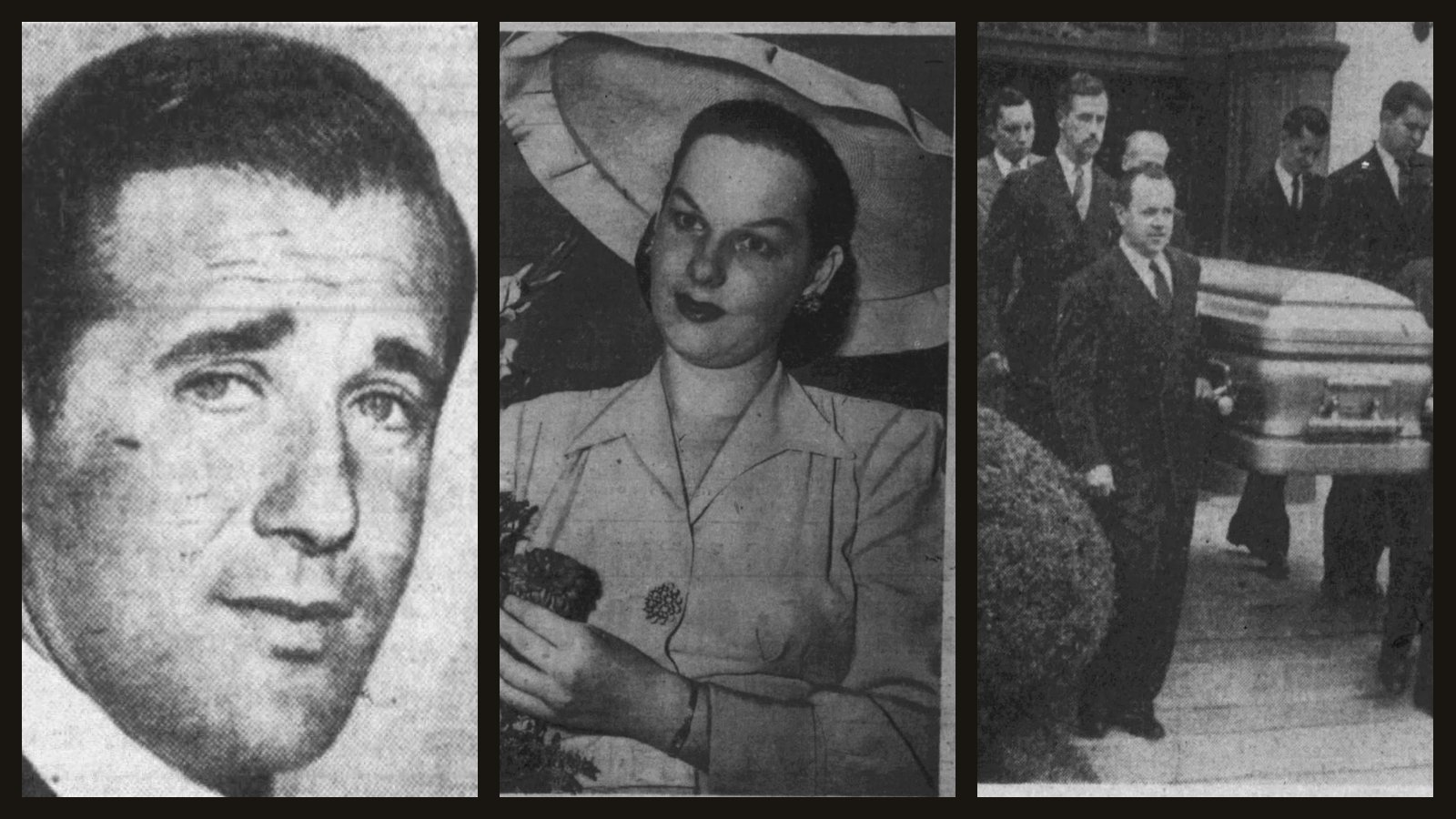
The papers called him America's No. 1 gangster. He hated the nickname, earned, Anderson wrote, by going berserk when he lost his temper. He wanted to be Ben. In the Los Angeles Times portrait that ran the next day, the word stitched on his shirt pocket is "Ben."
He had been charged with murder before. In 1939 Harry "Big Greenie" Greenberg was shot dead in front of his flat in Hollywood. Siegel was arrested in 1940 and indicted with Louis "Lepke" Buchalter; the Daily News listed Frank Carbo among the co-defendants. The case collapsed, and the papers of June 21 could not agree whether he had been acquitted or the charges dropped. While he waited in the county jail, the Daily News recalled, he "ate steak and pheasant for breakfast," and two jail officials were suspended. The Examiner reprinted what Judge A. A. Scott said in freeing him:
The money
The Flamingo was built on 24-hour shifts with imported soil, trees and materials and "the grudging consent of the Civilian Production Administration." Nobody agreed on what it cost: $5,000,000 in the Daily News, $6,000,000 in the United Press, $7,000,000 on the AP wire. By Anderson's account it was $3,000,000 in the red, and Siegel had told friends he needed $1,500,000 in thirty days.
Six months before the murder, Anderson wrote, he had Siegel in his office and told him he "did not want anything unpleasant happening in Beverly Hills." Siegel said not to worry; he was spending his time in Las Vegas.
And on the Monday after he was shot, Siegel was due to sit down with five creditors holding liens of about $1,100,000 on the Flamingo, in Joe Ross's office. The largest was reported to be held by Del Webb, the contractor who had built it.
"Who did it? Why? Who's next?"
The morning after, a Daily News story ran those three questions under the headline "Revenge, gangster quarrel held motives." The police, it said, were keeping to the line that it was a professional job, and working three theories: revenge for Big Greenie; money trouble at the Flamingo, whose investors were "extremely annoyed"; and eastern gangsters moving in on the West Coast. One investigator had a fourth, about a young recent associate with a record that included murder:
He was not named, and nobody was ever charged. The paper closed by saying "observers predicted more and bloodier of the same."
On the AP wire the next day, a Siegel associate who would not give his name said it plainly: "I think Ben was getting a little too big for his britches, and wasn't taking orders like he was supposed to."
In the decades since, others have offered names: Jack Dragna, the Los Angeles boss; Frankie Carbo; Eddie Cannizzaro, who claimed it himself in 1987; Robert MacDonald, whose family came forward in 2012; and more. None was ever charged, and every one of those answers was reached without the police file.
What was actually done
Anderson wrote that they spent "many man-hours" on the case and were convinced Siegel was killed by his own associates, "but there was never sufficient evidence to pinpoint the identity of the assassins."
The only man in the room went first. Smiley was held in the Beverly Hills jail as a material witness. "He was present at a murder and we don't want anything to happen to him," Sergeant Alcorn said. Smiley told a deputy district attorney the shooting came "10 minutes after we arrived home," and left jail shortly before noon for an undisclosed destination.
Then Sedway. Anderson picked him up, questioned him, and told him he wanted to see him again the next day. Sedway was moved to a Hollywood hospital for a heart condition. Anderson found him there behind a door marked "No Admittance — Oxygen!" and said he would be back in the morning. By morning Sedway had been put on a train to Las Vegas.
When the papers reported Anderson was looking at Las Vegas, the chief of police there "announced in a newscast that if he caught me in his city with a gun he would lock me up in jail." And the district attorney in Las Vegas, Anderson found, was also the attorney for one of the men he wanted to ask about: "a rather unusual situation."
The Los Angeles district attorney's chief investigator, H. Leo Stanley, spent four days in Las Vegas and came back with this: "Everybody I talked to said they loved the guy." And then: "But it looks like Bugsy's pride in his personal appearance is what actually caused his death." He had come to Beverly Hills, after all, for his barber.
Nobody was arrested. Nobody was charged.
Four minutes
On the morning of June 26, a limousine pulled up at Groman's Mortuary at 8.50 and six people got out: Siegel's former wife, Elizabeth; Millicent and Barbara; his brother, Dr. Maurice Siegel; his sister, Bessie Soloay; and Allen Smiley. There was no eulogy. Rabbi Max Kert read the Twenty-Third Psalm and a prayer. "It was all over in four minutes." The $5,000 casket was sealed. The family left by a back entrance and across a rear yard, and Joe Ross arrived five minutes too late.
That same day in Paris, a reporter offered Virginia Hill a picture.
Vallejo
Fifteen weeks later, the Vallejo papers, four hundred miles north, printed that Siegel had been collecting money from brothels on Georgia Street, and that a woman called Caroline "Boots" Veisch had collected it for him. Los Angeles sources said she disappeared on a Sunday morning because she "knew too much." The Times Herald reported she was said to know details that "might have implicated others" and to be ready to talk. She was last seen in an all-night restaurant in pajamas and a light coat, with a heavy-set San Francisco man with "cauliflower ears."
None of it was confirmed. It was sourced to unnamed "Los Angeles sources" and "confidential sources," and the same week one Vallejo paper said Siegel had been "tommy-gunned to death," which he had not. What became of Boots Veisch is not in anything found so far.
The file
The FBI had no jurisdiction over the murder, but it kept a file. Its last memo, dated August 11, 1949, carries the subject line BENJAMIN "BUGGSY" SIEGEL; POLICE COOPERATION, name misspelled, and ends with one sentence: "It is suggested this case be closed." Someone wrote "Close 8/16/49" in the margin.
In August 2026 I asked the Beverly Hills Police Department for crime case No. 46176. On August 29 the Records Bureau answered. It had found responsive records, it said, but "the Department has determined that these records are exempt from disclosure." The record is "on permanent retention," "kept indefinitely and not subject to a routine or planned destruction schedule," and it is assigned to the department's "CAPS (Crimes Against Person(s)) unit within the Detective's Bureau." Then it gave the details the law requires:
What I think
This part is theory, not record. Anderson's own conclusion was that "Siegel was killed because he would not comply with the wishes of his associates who had invested millions in the Flamingo." I think the record points the same way: a building millions in the red, a creditors' meeting set for Monday, the Flamingo taken over within the hour, and a shooting timed to the gap between patrol cars. That reads as a decision, made over money.
But I won't name a shooter, and neither did the chief who had the file. A judge once said of Siegel that a man "cannot be convicted on suspicion alone." Five years later that was true of whoever killed him. The answer was not lost. The people who could have been made to give it, Smiley out of the jail by noon, Sedway on the train, never were.
How many bullets hit him. The autopsy surgeon said two, the head of detectives said six, the AP wire said four. The 2026 police response says only "gunshot wounds."
Who the investigator meant by his "strongest hunch," and who the third man at the Flamingo was: Morris Rosen or David Berman.
What became of Caroline "Boots" Veisch. The Vallejo papers have not yet been run forward past October 1947.
What is in case No. 46176. As of the department's response of August 29, 2026, the file is refused, and its last active date and any reclassification were still pending from the Detective's Bureau.